
Daily Current Affairs UPSC 30 October 2024
Welcome to our daily current affairs blog post for UPSC aspirants! In today's edition, we will be discussing the most significant events and news updates that took place on 30th October 2024. Staying updated with current affairs is crucial for UPSC preparation, as it not only helps you stay informed but also enhances your understanding of various subjects. So, let's dive into the important happenings of the day and explore their potential impact on the upcoming UPSC examinations.

World Food Programme (WFP)
WFP warns of potential famine in Gaza.
About United Nations WFP:
- Established in 1961.
- Largest humanitarian agency.
- Saves lives in emergencies and promotes peace, stability, and prosperity.
- Funding sources for WFP
- Voluntary donations from governments, corporates, and private donors.
- WFP operations in India since 1963.
- Presence in over 120 countries and territories.
- WFP awarded Nobel Peace Prize in 2020.
Transfer Pricing
CBDT has issued a notification regarding tolerance limits for transfer pricing.
About Transfer Pricing:
- Transfer pricing is a method used by multinational companies to shift profits to tax havens.
- It involves selling goods and services to themselves at inflated prices.
- CBDT sets tolerance limits to ensure transactions are in line with arm's length principles.
About Arm's Length Transaction Principle:
- Arm's length transaction principle is commonly applied to transactions between related companies.
- It states that transactions should be valued as if they were between unrelated parties acting in their own best interest.
- This principle helps prevent transfer pricing abuse and ensures fair valuation of transactions.
U-WIN portal
Launch of U-WIN portal by Prime Minister of India.
About U-WIN:
- Captures vaccination events of pregnant women and children under UIP.
- Part of RCH Program under NHM.
- Ensures timely administration of vaccines against 12 diseases to pregnant women and children up to 16 years old.
Hydrogels
- New method of creating hydrogels using small protein fragments from SARS-CoV-1 virus.
- Potential to enhance targeted drug delivery and minimize side effects.
About Hydrogels:
- Hydrogels are polymer chains with 3D network structures that can absorb large amounts of fluid.
- Suitable for drug delivery due to swelling behavior, mechanical strength, and biocompatibility.
- Hydrogels could revolutionize tissue engineering and assist in organ regeneration.
Civil Registration System (CRS)
- Union Home Minister launched CRS mobile application.
- Developed by Registrar General and Census Commissioner of India.
- Expected to reduce time for registrations seamlessly.
About CRS:
- Unified system for continuous, mandatory, and permanent documentation of vital events.
- Includes births, deaths, and stillbirths with associated details.
- Mandated by Registration of Births and Deaths Act, 1969.
- Operates under authority of Registrar General and Census Commissioner of India.
- Included in concurrent list under Schedule Seven.
Artemis Mission
NASA has identified 9 potential landing sites for the Artemis III mission.
About Artemis III:
- This mission will take humans to the Moon's South Pole for the first time.
Artemis III Mission Details
- Planned for 2026, Artemis III will be humanity's first return to the lunar surface in over 50 years.
- The Artemis Program aims to send the first woman and first person of color to the Moon.
- India has already landed a spacecraft in the moon's south polar region with the Chandrayaan-3 mission.
Goals of Artemis III Mission:
- Search for water on the Moon and utilize it.
- Study the Moon to uncover its mysteries.
- Learn how to live and work on another celestial body's surface.
- Test technologies necessary for future missions to Mars.
Raigad Fort
Theme of this year's Rashtriya Ekta Diwas celebrates the heritage of Raigad Fort.
About Raigad Fort:
- Raigad Fort is a hill fort located in Raigad district, Maharashtra.
- Established as the capital by Chhatrapati Shivaji Maharaj in 1674.
- Chhatrapati Shivaji Maharaj was also coronated in this fort.
- Surrounded by valleys shaped by the Kal and Gandhari rivers.
- Known as the Gibraltar of the east by British historians.
- Nominated for UNESCO World Heritage under the “Maratha Military Landscapes of India”.
- Main gates include Nanne Darwaza and Maha Darwaza.
Standard Veterinary Treatment Guidelines
Recently, the Ministry of Animal Husbandry, Dairying and Fisheries released Standard Veterinary Treatment Guidelines (SVTG).
Definition of SVTG:
- SVTG are a set of guidelines that provide a comprehensive framework for veterinary care.
- The guidelines aim to improve animal health and productivity while also supporting efforts to combat antimicrobial resistance.
- SVTG promote the use of ayurveda and regulate the use of antibiotics in veterinary treatments.
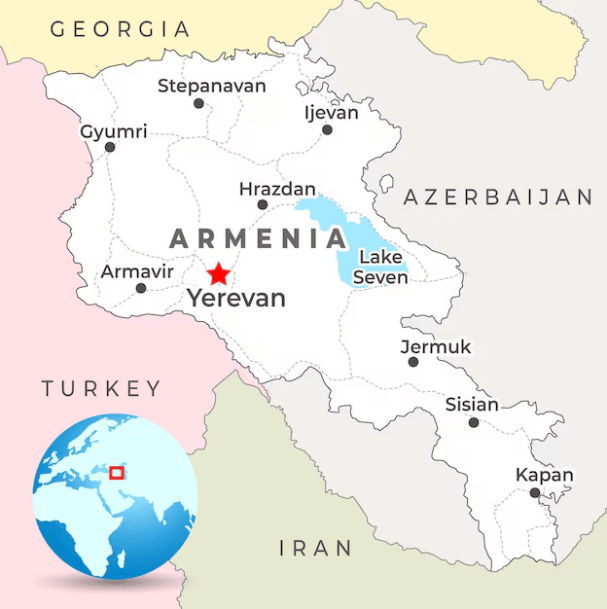
Armenia (Capital: Yerevan)
Armenia has become a significant destination for India's defence exports.
Political Boundaries:
- Location: Landlocked country in Transcaucasia.
- Borders: Azerbaijan, Turkey, Nakhchivan Autonomous Republic, Georgia, and Iran.
- Disputed territory: Nagorno-Karabakh between Armenia and Azerbaijan.
Geographical features:
- Highest Peak: Mount Aragats (Alaghez).
- Rivers: Aras River.
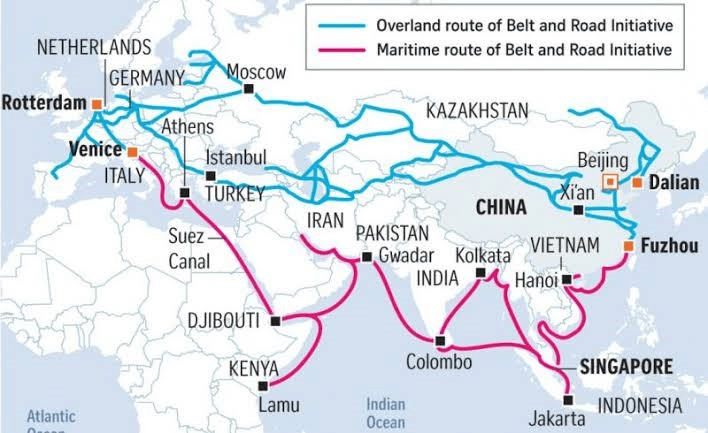
Brazil decided against joining China’s Belt and Road Initiative (BRI)
- Brazil has chosen not to join China's BRI, becoming the second BRICS member after India to do so.
- Other countries like Italy and Philippines have also decided to withdraw from the BRI.
About Belt and Road Initiative (BRI):
- Initiated in 2013 as 'One Belt One Road' to connect Asia, Africa, and Europe through land and maritime networks.
- Aims to improve regional integration, increase trade, and stimulate economic growth.
- Comprises the Silk Road Economic Belt and Maritime Silk Road with major investments in infrastructure projects.
India's Concerns about BRI:
- China's BRI project, specifically the China-Pakistan Economic Corridor (CPEC), undermines India's sovereignty and territorial integrity.
- BRI's financial incentives and loans may reduce Indian influence in South Asia.
- Unsustainable debts to partner countries create a debt trap and increase vulnerability to China's influence.
- India sees China's growing influence in the Indian Ocean region as a security threat.
Countermeasures against BRI
- G7's Partnership for Global Infrastructure and Investment (PGII) and Build Back Better World (B3W) Partnership.
- India-Middle East-Europe Economic Corridor (IMEC) launched during India's G-20 Presidency.
- International North South Transport Corridor (INSTC) connecting the Indian Ocean and Persian Gulf to the Caspian Sea.
Review of Maritime Transport 2024 - Navigating Maritime Chokepoints Report Released
Report has been released by the United Nations Conference on Trade and Development (UN Trade and Development).
Key Findings:
- Global maritime trade grew by 2.4% in 2023, recovering from a 2022 contraction, but the recovery remains fragile.
- Key maritime chokepoints, like the Suez and Panama Canals, faced unsettling disruptions.
About Chokepoints:
- Narrow and strategic geographical features or passageways.
- Examples include valleys, straits, etc.
Geo-strategic Significance
- Facilitates Connectivity
- E.g. Suez Canal connects Mediterranean Sea with Red Sea for trade between Europe and Asia.
- Energy Security
- E.g. Strait of Hormuz witnesses significant petroleum transportation.
Key Reasons behind disruptions
- Climate-induced low water levels.
- E.g. Panama Canal connecting Pacific and Atlantic Oceans.
- Geopolitical tensions and conflicts.
- E.g. Yemen's Houthi rebels attacking ships in Bab al-Mandeb Strait.
Impacts of disruptions
- Straining supply chains and raising costs.
- Rising shipping costs due to rerouting around Cape of Good Hope.
Other Key Chokepoints of the World:
- Strait of Gibraltar: Links the Mediterranean Sea with the Atlantic Ocean.
- Strait of Malacca: Connects the Indian Ocean with the South China Sea.
- Turkish Straits (Bosporus and Dardanelles): Connects the Black Sea with the Mediterranean Sea.
Key decisions taken to strengthen Gram Panchayats across the country
Decisions taken by Central Empowered Committee (CEC) of the Revamped Rashtriya Gram Swaraj Abhiyan (RGSA).
Challenges faced by Panchayati Raj Institutions (PRIs):
- Skilling and Training gaps: lack of skills hinder competency in rural governance.
- Lack of support staff: shortage of secretaries, junior engineers, etc.
- Lack of digital infrastructure in rural areas: leads to Urban Rural digital divide.
- Other challenges: service delivery issues, lack of literacy, etc.
Initiatives taken by CEC to address challenges:
- Adoption of Standardized Honorarium System under RGSA: Ensures fair compensation and consistency in training.
- Funding for long-term domestic training programs: Trains panchayat officials in various areas like spatial planning and disaster management.
- Training Elected Representatives of Panchayats in Smart Classrooms.
- Augmenting Panchayat Infrastructure: Constructing Gram Panchayat Bhawans with Common Service Centers to improve infrastructure and promote digital governance.
- Investment in Panchayat Infrastructure in Vibrant Villages of Border Areas in North East and Jammu and Kashmir.
Revamped Rashtriya Gram Swaraj Abhiyan (RGSA):
- Aims to develop Panchayati Raj Institutions as vibrant centers of local self-governance with focus on localization of Sustainable Development Goals.
- Type: Centrally Sponsored Scheme.
- Tenure: 2022-23 to 2025-26.
- Coverage: All States and UTs, including institutions of rural local government in non-Part IX areas where Panchayats do not exist.
Biological Diversity Rules, 2024 Notified
- Ministry of Environment, Forest and Climate Change notified new rules in accordance with the Biological Diversity Act of 2002.
- These rules will replace the Biological Diversity Rules, 2004 and implement the Biological Diversity (Amendment) Act, 2023.
- Amendment of 2023 aims to streamline research processes and promote Indian system of medicine.
- Rules outline provisions related to National Biodiversity Authority (NBA) and penalties.
Key Highlights of the Rules:
- National Biodiversity Authority (NBA) functions include administering the National Biodiversity Fund (NBF), granting approvals for agreements, providing technical guidance, and maintaining databases.
- Chairperson of NBA appointed by Central Government for a term of three years, eligible for re-appointment.
- Approval of Authority required for Intellectual Property Rights (IPR) grants.
- Penalties for violations range from ₹1 lakh to ₹50 lakh, with additional fines for repeated violations.
- Penalties collected go to NBF or state funds for biodiversity initiatives.
About Biological Diversity Act 2002
- Enacted to align with the objectives of the United Nations Convention on Biological Diversity (CBD) 1992.
Three-tiered mechanism for regulation
- National Biodiversity Authority (NBA) at the national level.
- State Biodiversity Boards (SBB) at the state level.
- Biodiversity Management Committees (BMC) at the local body level.
Decentralized approach
- Allows for more effective regulation and management of biological diversity at different levels of governance.
New Study explores Diamond Dust as a potential Geoengineering Strategy for Cooling of Planet
- Diamond dust as a potential geoengineering strategy.
- Spraying diamonds into Earth's upper atmosphere to cool the planet.
Benefits of using diamond dust:
- Enhanced properties: Reflects light and heat effectively, remains airborne longer, less likely to clump together.
- Safer alternative: Chemically inert compared to sulfur dioxide, which poses risks like acid rain and ozone depletion.
Definition of Geoengineering/Climate Engineering
- Large-scale intervention in Earth's climatic system to reduce global warming.
- Two main categories: Carbon Dioxide Removal and Solar Radiation Management.
Carbon Dioxide Removal:
- Reducing CO2 in the atmosphere by enhancing carbon sinks or directly capturing CO2.
- Direct Air Carbon Capture and Storage (DACCS) uses chemical processes to capture and store CO2.
- Ocean fertilization involves adding nutrients to enhance phytoplankton growth and CO2 removal.
Solar Radiation Management:
- Offsetting greenhouse gas effects by reducing solar radiation absorption.
- Stratospheric aerosol injection involves injecting reflective particles into the stratosphere.
- Marine cloud brightening involves injecting salt spray into marine clouds to increase sunlight reflection.
Concerns associated with Geo-engineering technology
- Undermining existing climate policies and diverting funding from emission reduction.
- High cost of developing and deploying tools.
- Potential chain reactions with risks to humans, oceans, and global temperatures.
The 2024 Report of the Lancet Countdown on Health and Climate Change Released
- 2024 Lancet Countdown Report on Health and Climate Change.
- Progress towards Paris Agreement goals assessed.
Key Finding:
- Increased Temperature: Annual mean surface temperature close to breaching 1.5°C limit.
- Health Impacts:
- Heat-related mortality up by 167% among people over 65 since 1990s.
- Indians face moderate to serious heat stress for 100 days/year.
- Economic Losses:
- Average annual economic losses from extreme weather events increased by 23%.
- 181 billion potential labour hours lost in India due to heat exposure in 2023.
- Inadequate Adaptation:
- Many countries lack health emergency management capacities.
- Only 35% have early warning systems for heat-related illnesses.
Key Recommendations for Addressing Health Impacts of Climate Change.
- Conduct Comprehensive Vulnerability and Adaptation Assessments:
- Countries should fulfill their commitments to assess and address the health impacts of climate change.
- This will help identify vulnerable populations and develop targeted adaptation strategies.
- Implement Health-Focused Climate Policies:
- Develop and enforce policies that prioritize health in climate action.
- This can include regulations on air quality, water sanitation, and access to healthcare in climate planning.
- Encourage Sustainable and Rapid Energy Transition:
- Transition to clean energy sources to reduce reliance on fossil fuels.
- Promote renewable energy technologies to mitigate climate change and improve public health.