
Daily Current Affairs UPSC 26 July 2024
Welcome to our daily current affairs blog post for UPSC aspirants! In today's edition, we will be discussing the most significant events and news updates that took place on 26th July 2024. Staying updated with current affairs is crucial for UPSC preparation, as it not only helps you stay informed but also enhances your understanding of various subjects. So, let's dive into the important happenings of the day and explore their potential impact on the upcoming UPSC examinations.

Climate Finance Action Fund (CFAF)
- Azerbaijan has launched the Climate Finance Action Fund (CFAF) as part of its initiatives for the UN Climate Change Conference COP29.
- The CFAF is headquartered in Baku, Azerbaijan and will support climate projects in developing countries.
- The fund aims to help countries meet their next generation of Nationally Determined Contributions (NDCs) to keep global warming within 1.5 degrees Celsius and address the consequences of natural disasters.
- Contributions to the CFAF will come from fossil fuel producing countries and companies in the oil, gas, and coal industries.
The fund will become operational after raising $1 billion and when 10 contributing countries commit as shareholders.
White Category Sectors
- White category sectors no longer need approval from state pollution control boards to start and operate under the Air Act, 1981 and Water Act, 1974.
- The permissions known as 'consent to establish' and 'consent to operate' are given to regulate industries that release effluents or pollutants into the environment.
- White category industries must inform state pollution control boards through self-declarations.
- White category sectors are industries that are considered to be non-polluting by the Central Pollution Control Board.
- Examples of white category sectors include wind and solar power projects, assembly of air coolers, and bicycle assembly.
Indian Cyber Crime Coordination Centre (I4C)
- The Indian Cyber Crime Coordination Centre (I4C) has been made an attached office of the Ministry of Home Affairs (MHA).
- Previously, I4C was established as a scheme under MHA's Cyber and Information Security (C&IS) division in 2018.
- The objective of I4C is to serve as a central point to combat cybercrime, provide early warnings for cybercrime prevention and detection, and make it easier to file complaints.
- I4C consists of various verticals such as the National Cybercrime Reporting Portal, National Cybercrime Threat Analytics Unit, and National Cybercrime Research & Innovation Centre.
Government Litigation
- The Ministry of Law and Justice (MoL&J) provided information on pending government litigation through the Legal Information and Management Briefing System (LIMBS).
- LIMBS is a project by MoL&J that tracks the progress of litigation from the perspective of the Central Government.
- There are more than 698,000 pending court cases where the Union government is involved as a litigant.
- The majority of these cases are related to the Ministries of Finance, Railways, and Defence, accounting for over 57% of the total pending court cases.
- The highest number of pending cases are in tribunals (275,000), followed by high courts and the Supreme Court.
Methane
- Research has shown that tree bark in forests can absorb methane, a greenhouse gas that contributes significantly to climate warming.
- Methane is a colorless and odorless gas that is easily combustible and has a shorter atmospheric lifetime compared to CO2.
- Methane has a global warming potential that is approximately 27 times greater than CO2.
- The primary sources of methane emissions are agriculture, wetlands, and the energy sector.
- Methane is used in various applications such as making chemicals and as a constituent of fuel and natural gas.
Triput Class Frigates
- The first of two Advanced Frigates, Triput, is being built by Goa Shipyard Limited for the Indian Navy.
- These frigates are the first to be constructed entirely in India by an Indian shipyard.
The Triput Class Frigates are designed for combat operations against enemy surface ships, submarines, and aircraft. - These ships are equipped with stealth features, advanced weapons and sensors, and platform management systems.
- The Triput class frigates are the next generation of ships following the Teg and Talwar class ships that were acquired from Russia.
‘Steel Import Monitoring System’ 2.0 Portal
- SIMS, originally introduced in 2019, has been upgraded to SIMS 2.0 by the Ministry of Steel.
- The main goal of SIMS 2.0 is to monitor steel imports and support the growth of the domestic steel industry.
- New features of SIMS 2.0 include API integration with various government portals, which will improve quality control and streamline processes for better efficiency.
- The detailed data provided by SIMS 2.0 will allow Customs to conduct more thorough analysis and risk management of steel imports.
- The portal also features a strong data entry system that promotes transparency and accountability in the steel industry.
EXERCISE KHAAN QUEST
- The Indian army is set to take part in the 21st edition of a Multinational military exercise.
- The exercise will be held in Ulaanbaatar, Mongolia.
Chandrashekhar Azad (1906-1931)
- Chandra Sekhara Azad remembered on birth anniversary.
- Early Life: Born in princely state of Alirajpur.
Key Contributions:
- Participation in Non-Cooperation Movement at age 15.
- Declared himself as "Azad" (The Free) and his father's name as "Swatantrata" (Independence) when arrested.
- Joined Hindustan Republican Association (HRA).
- Participated in Kakori Train Robbery, shooting of John P. Saunders, and attempted attack on Viceroy of India's train.
- Reorganised HRA into Hindustan Socialist Republican Association in 1928
- Values: Courage, Nationalism, Leadership.
Investing in Adolescent Well-being in India
- A recent report from the Ministry of Health & Family Welfare highlights the potential for significant returns on investments in interventions for adolescents.
Key Highlights
- The report from the Ministry of Health & Family Welfare highlights the importance of investing in adolescents for high returns.
- India has the largest population of adolescents in the world, with 253 million aged 10-19.
- There have been significant improvements in adolescent mortality and fertility rates, as well as an increase in the number of young people completing secondary school.
- However, there has been a concerning rise in fatal road accidents among adolescents under 18.
- The suggested interventions are expected to boost the Indian economy by 10.1% of the annual GDP.
Issues Faced by Adolescents
- Adolescents face issues related to health, education, employment, child marriage, and violence.
- Health challenges include unplanned pregnancies, malnutrition, and mental disorders like depression and anxiety.
- Education and employment issues include stagnant learning and unemployment due to emerging technologies.
- Child marriage remains a problem in India, despite a decline in the number of girls getting married before 18.
- Violence and injury, such as road accidents, self-harm, and suicide, are also prevalent among adolescents.
Recommended Interventions
- Interventions like improving schools in underserved areas, enhancing pedagogy, and providing merit-based scholarships can lead to better learning outcomes.
- Preventive measures against cyberbullying, interpersonal violence, and common mental disorders are crucial for improving adolescent health.
- Life skills training, transfer payments to girls, and changes in cultural norms are needed to curb child marriage.
- Graduated licensing schemes can help reduce injuries to adolescents, especially in road accidents.
India's Initiatives
- India has implemented initiatives like the Rastriya Kishor Swasthya Karyakram, National Education Policy 2.0, and the School Health and Wellness Program under Ayushman Bharat to address adolescent health and education.
- The Motor Vehicle Amendment Act 2019 and National Road Safety Policy aim to improve road safety and reduce accidents involving adolescents.
States empowered to tax mineral rights: Supreme Court
- The Supreme Court ruled 8:1 that state legislatures have the power to tax mining lands, which is not limited by Parliament's Mines and Minerals (Development and Regulation) Act of 1957.
- One dissenting judgment warned about the negative consequences of granting mineral taxation rights to states.
Key Observations by the Court
- The power to tax mineral rights is specified in Entry 50 of List II (State List), and Parliament cannot use its residuary power in this matter.
- While Parliament can impose limitations on states' mineral taxation through laws, the MMDRA does not have any specific provision imposing such limitations.
- Entry 54 of List I (Union List) regarding the Union's power over minerals is regulatory and does not include taxing authority.
- The term "land" in Entry 49 of List II includes mineral-bearing lands, giving states the authority to tax such lands.
- The Court overturned its 1989 judgment and clarified that royalty is not considered a tax and is not covered under the MMDRA.
About MMDRA 1957
- The MMDRA regulates the mining sector in India and provides for various types of licenses.
- It includes different types of licenses for mining activities:
- Reconnaissance permit for initial exploration.
- Prospecting license for further exploration and proving deposits.
- Mining lease for actual mineral extraction.
- Composite license for both exploration and extraction operations.
2023 Amendments in MMDRA
- The amendments added an Exploration License for deep-seated and critical minerals, allowing for reconnaissance and prospecting operations.
- The Central Government now has the power to exclusively auction mining leases and composite licenses for certain critical minerals.
- While the auction will be conducted by the Central Government, the mining lease or composite license will be granted by State governments only.
- Certain minerals like lithium, beryllium, and titanium have been removed from the list of atomic minerals.
"Union Budget 2024-25: ₹1000 Crore Fund for Space Economy"
- Proposed Venture Capital Fund aims to grow the space economy by 5 times in the next decade.
- The fund focuses on investing in early-stage startups with long-term growth potential.
Indian Space Economy
- Currently valued at ₹6,700 crore with a 2% share in the global space economy in 2021.
- Expected to increase to 8% by 2030 and 15% by 2047.
- Number of space startups increased to nearly 200 in 2024 from just 1 in 2022.
- Investment in Indian space startups reached $124.7 million in 2023.
- Implementation of Indian Space Policy 2023 could lead to a $44 billion Indian space economy.
Key Initiatives for Growth
- IN-SPACe established as a single window nodal agency for promoting and authorizing space activities.
- Space sector reform in 2020 opened up the sector for private sector participation.
- Indian Space Policy allows for 100% FDI in certain sub-sectors of space.
- Private sector participation increasing with startups like Skyroot Aerospace and Agnikul Cosmos.
- Technology transfer from ISRO and NSIL/IN-SPACe to private players.
- International collaborations such as the NISAR program and Artemis Accords.
Challenges to Indian Space Economy
- Space debris increasing and posing challenges to space operations.
- Growing militarization of space.
- Disruption risks in global technology supply chains due to geopolitical tensions.
- Lack of substantial domestic investor interest in space ventures.
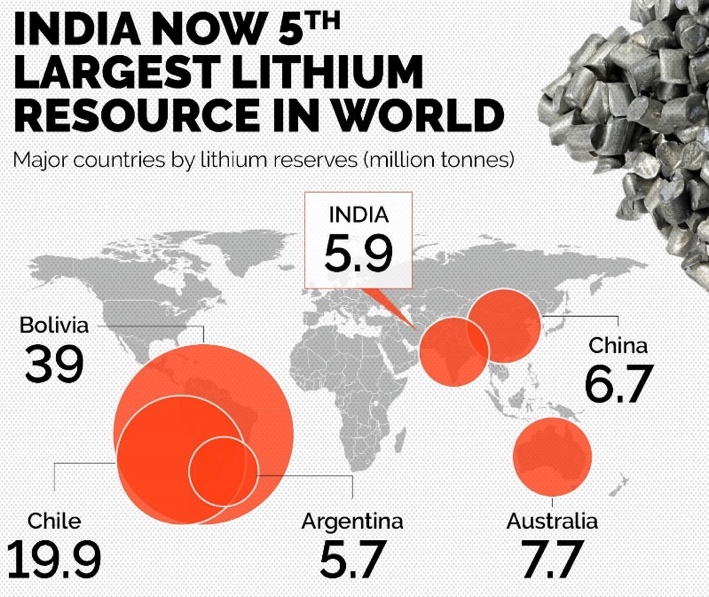
New Lithium Discoveries in Mandya and Yadgiri
- The Atomic Minerals Directorate for Exploration and Research has found 1,600 tonnes of Lithium resources in Mandya district.
- This discovery will lead to reduced import dependence, self-sufficiency in energy storage needs, and industrial development in sectors like vehicle and automobile manufacturing.
About Lithium
- Lithium is a soft, silvery-white alkali metal with various industrial applications.
- It has been classified as a critical and strategic mineral under the Mines and Mineral (Development and Regulation) (Amendment) Act 2023.
Applications of Lithium
- Lithium is used in batteries for mobile phones, electric vehicles, and other devices, as well as in alloys to improve strength and reduce weight in various industries.
- It is also utilized in industrial processes such as air conditioning and glass ceramics production.
Steps Taken to Ensure Mineral Security
- Initiatives like KABIL and the Australia India Critical Minerals Investment Partnership are exploring strategic minerals in overseas territories.
- The Geological Survey of India is actively exploring Lithium reserves within India.
- The Ministry of Mines has joined the Mineral Security Partnership led by the USA to enhance mineral security and cooperation.
"UNESCO's Gender Equality Game Plan"
- Published shortly before the start of the Olympic Games, this report sheds light on the ongoing disparity between genders in sports and offers recommendations for implementing policies and programs that promote gender equality in the sports industry.
Key Observations
- Sexual Abuse: A significant number of women athletes (21%) and men athletes (11%) reported experiencing sexual abuse as children in sports.
- High Dropout in Sports: Girls are six times more likely to drop out of sports during adolescence compared to boys, with factors such as lack of role models, safety concerns, lack of confidence, and negative body image contributing to this high attrition rate.
- Inequality: The pay gap in professional sports is evident from the absence of women in the list of the 50 highest paid athletes in the world.
- Lack of women’s leadership: Only 30% of the world’s largest sports federations were chaired by women in 2023.
Four Actions Suggested by Game Plan
- Harness the power of sports to change attitudes through media coverage and address root causes of gender inequalities.
- Champion gender equality in sport leadership, governance, and decision-making.
- Develop capacity and infrastructure through gender-responsive budgeting and closing funding gaps.
- Commit to ending all forms of gender-based violence in sports.
India’s Initiatives to Promote Women in Sports
- Khelo India Scheme: Includes a "Sports for Women" component dedicated to promoting sports among women.
- ASMITA Portal: Provides identity to women athletes and aims to inspire them through action.
- Khelo India Dus ka Dum: A sports competition conducted on International Women’s Day 2023 to celebrate and promote women in sports.
"Urgent Call: Recognize Aquatic Deoxygenation as a Planetary Boundary"
- AD is a decrease in the amount of oxygen in ocean and coastal waters, which occurs when oxygen is used up faster than it can be replaced.
Status of AD
- Approximately 2% of oxygen content in the ocean has been lost since the 1960s.
- More than 500 low-oxygen sites have been identified in coastal waters.
- Lakes and reservoirs have experienced oxygen losses of 5.5% and 18.6% respectively since 1980.
Reasons underscoring AD
- Global Warming caused by greenhouse gases decreases the solubility of oxygen in water.
- Warm surface layers in the ocean prevent oxygen from mixing deeper into the ocean, leading to low oxygen levels in deep sea waters.
- Eutrophication from nutrient over-enrichment from sources like agriculture leads to algal blooms and increased oxygen consumption.
Impact on Ecosystems
- Dead zones and ocean hypoxia effects occur.
- Habitat compression for fisheries leads to reduced biomass and species loss.
- Affects the regulation and modulation of Earth's climate due to the production of greenhouse gases by microbiotic processes in affected regions.
- Changes in marine food webs due to increased risk of predation and ocean acidification.
Planetary Boundaries
- Planetary boundaries are a framework that describes limits to the impacts of human activities on the Earth system.
- Beyond these limits, the environment may not be able to self-regulate anymore.
- There are nine recognized planetary boundaries including climate change, ocean acidification, land use change, and biodiversity loss.