
Daily Current Affairs UPSC 22 October 2024
Welcome to our daily current affairs blog post for UPSC aspirants! In today's edition, we will be discussing the most significant events and news updates that took place on 22nd October 2024. Staying updated with current affairs is crucial for UPSC preparation, as it not only helps you stay informed but also enhances your understanding of various subjects. So, let's dive into the important happenings of the day and explore their potential impact on the upcoming UPSC examinations.

Economic Freedom Report, 2024
- The Fraser Institute released the 2024 Economic Freedom of the World Report.
About Economic Freedom Report, 2024 (India’s Rank: 84th)
- It ranks 165 countries based on economic policies and institutions that allow for individual economic choices.
Indicators Used in the Report:
- Size of Government: Focuses on fiscal policy.
- Legal System and Property Rights: Includes court impartiality and property protection.
- Sound Money: Looks at inflation rates.
- Freedom to Trade Internationally: Considers customs and clearance.
- Regulation: Examines market entry restrictions.
Top and Bottom Ranks
- Hong Kong ranked 1st in economic freedom.
- Venezuela ranked 165th, indicating low economic freedom.
Iodine Deficiency
- World Iodine Deficiency Day Celebration.
About Iodine
- Essential for thyroid hormones T4 and T3.
- Regulates metabolism and crucial for fetal and infant development.
Impact of Iodine Deficiency
- Hypothyroidism leading to Goitre.
- Neurodevelopmental deficits and growth retardation in fetus of pregnant women.
- Other effects like stunted growth and delayed sexual maturation.
National Iodine Deficiency Disorders Control Programme in India.
- Covers various iodine deficiency disorders across all States and Union Territories.
Naseem-Al-Bahr
- Recently, bilateral naval exercise, Naseem-Al-Bahr, was conducted.
About Naseem-Al-Bahr:
- Recently conducted bilateral naval exercise between Indian Navy and Royal Navy of Oman.
- Held in Goa, with participation from INS Trikand and Dornier Maritime Patrol Aircraft.
- Aimed to strengthen collaboration and mutual growth in the Indian Ocean Region.
- Demonstrates India's commitment to working with like-minded nations for maritime security and cooperation.
Bureau of Civil Aviation Security (BCAS)
- BCAS officials met with airline representatives due to bomb threats affecting multiple flights.
BCAS Meeting with Airline Representatives
- Established in 1978 within the Directorate General of Civil Aviation based on the Pande Committee's recommendation.
- Became an independent department under the Ministry of Civil Aviation in 1987.
Functions of BCAS:
- Lays down standards and measures for the security of civil flights at international and domestic airports in India.
- Establishes Aviation Security Standards in accordance with the Chicago Convention of the International Civil Aviation Organization.
Namo Bharat Trains
- First anniversary of Namo Bharat Trains celebrated as Namo Bharat Diwas.
About Namo Bharat Trains:
- Namo Bharat Trains are India's first Regional Rapid Transit System (RRTS) operating on a 42 km Delhi-Ghaziabad-Meerut corridor with 9 stations.
- The corridor is expected to be 82 km long, connecting Delhi to Meerut by 2025.
- RRTS provides high-speed, efficient connectivity between suburban areas, reducing commuting time and promoting sustainable urban transport solutions.
Halmahera Sea
- A 5.7 magnitude earthquake hit Halmahera Sea in Indonesia, according to the German Research Centre for Geosciences.
About Halmahera Sea:
- Halmahera Sea is located near Halmahera Island in Indonesia and is part of the eastern entry route of the Indonesian throughflow passages.
- The Indonesian throughflow passages link the Pacific Ocean and Indian Ocean through two entry passages, Western and Eastern.
- Halmahera Island is the largest island in the Moluccas, situated between the Molucca Sea and the Pacific Ocean in Indonesia.
Z-Morh Project
- Recent militant attack on Z-Morh Project site in Jammu and Kashmir.
About Z-Morh Project:
- Z-Morh Project is a 6.4-km tunnel on the Srinagar-Sonamarg highway at an altitude of 8,500 feet.
- Aimed at providing all-weather connectivity to Sonamarg, a popular tourist destination.
- Strategic importance in providing connectivity from Srinagar to Ladakh throughout the year.
- Reduces army's reliance on air transport for connectivity in the region.
Space Docking Experiment (SPADEX)
- Two satellites built by an Indian private company for the Space Docking Experiment.
About SPADEX:
- Objective is to demonstrate docking of two spacecraft (Chaser and Target) in orbit.
- After docking, Chaser and Target will separate to carry out designated experiments with payloads.
- Significance for future human spaceflight, lunar sample return missions, and construction of large space structures.
- Important for missions like Chandrayaan-4 and India's proposed Bhartiya Antriksh Station.
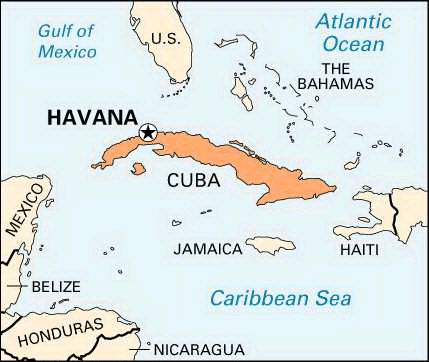
Cuba (Capital: Havana)
- Cuba's electricity grid has experienced multiple collapses due to Hurricane Oscar, making restoration efforts challenging.
Political Features:
- Location: situated in the northern Caribbean Sea at the confluence of the Gulf of Mexico and Atlantic Ocean.
Geographical Features:
- Rich in minerals such as cobalt, nickel, iron ore, copper, manganese, salt, timber, silica, and petroleum. Cuba is the 9th largest producer of Nickel.
- Major rivers: Cauto, Toa.
- Climate: tropical, seasonally humid, with maritime influence and semi-continental features.
India’s Solar Imports could touch $30 billion annually by 2030: Global Trade Research Initiative (GTRI) Report
- China's dominance in global solar industry affecting local manufacturing
- Over 80% of global solar production and exports controlled by China
Challenges in India's Solar Manufacturing Sector:
- High dependency on imports, particularly from China, limits domestic manufacturing capacity
- Limited raw material supply, such as high-purity polysilicon and wafer, crucial inputs in the solar manufacturing value chain
- Gaps in R&D and technology adoption, hindering the use of latest solar cell technologies
- High capital costs and financial barriers
Recommendations to address these challenges:
- Expand PLI Scheme to cover early-stage solar manufacturing and focus on upstream solar production.
- Invest in R&D and advanced manufacturing technology for a fully integrated solar supply chain.
- Reassess current import duties on solar modules and cells to promote local manufacturing.
- Collaborate with countries like US, EU, and Japan to reduce global reliance on China.
India's Initiatives to boost Solar Manufacturing:
- Approved List of Models and Manufacturers (ALMM) for government-backed projects using solar PV modules meeting BIS standards.
- Production Linked Incentive (PLI) Scheme for fully integrated solar PV manufacturing units.
- PM-KUSUM mandating the use of domestically sourced solar cells and modules.
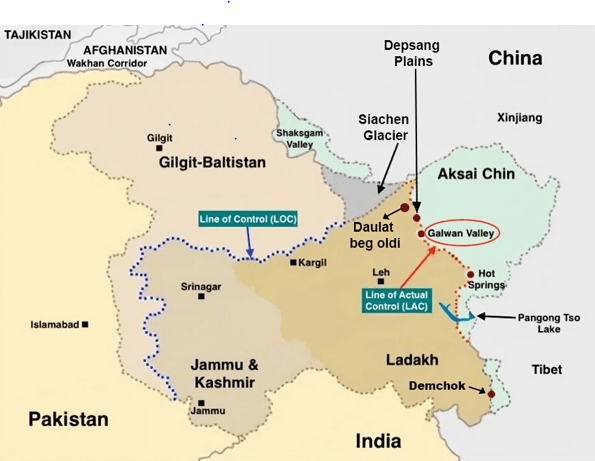
India and China reach agreement on patrolling arrangements along disputed Line of Actual Control (LAC)
- Agreement aims to resolve military standoff that began in April 2020 in areas like Demchok and Depsang in eastern Ladakh.
- Tensions in 2020 stemmed from China's objections to India's infrastructure projects, particularly a road in the Galwan Valley.
India-China Border Dispute:
- India and China have a 3,488-km border that is not clearly demarcated.
- There is no mutually agreed Line of Actual Control (LAC) along certain stretches.
- India - China border is divided into three sectors:
- Western Border (Ladakh)
- Dispute focuses on the Johnson Line from the 1860s.
- India includes Aksai Chin in its territory, while China considers the MaCartney MacDonald Line as the border.
- Middle Sector: Boundary dispute in Himachal Pradesh and Uttarakhand is minor.
- Eastern Sector: Dispute in Arunachal Pradesh and Sikkim centers on the McMahon Line established in the 1914 Simla Convention.
- China rejects the McMahon Line as the border.
- Western Border (Ladakh)
Border Dispute Settlement Mechanism: India and China have signed five agreements to manage disputes along the Line of Actual Control (LAC).
| Year | Agreement Focus |
|---|---|
| 1993 | Focused on maintaining peace and tranquility along the LAC. |
| 1996 | Established confidence-building measures in military operations. |
| 2005 | Detailed implementation of military confidence-building measures. |
| 2012 | Created a Working Mechanism for Consultation & Coordination on India-China Border Affairs (WMCC). |
| 2013 | Enhanced border defense cooperation. |
GUESS India 2023 survey report of IIT Mandi highlights strong entrepreneurial spirit in Indian students
- Survey is part of global research project involving a comprehensive survey on student entrepreneurs in 57 countries worldwide.
Major Trends Highlighted by Report:
- Nascent Entrepreneurship: 33% of college students in India are nascent entrepreneurs, higher than the global average.
- Emerging Career Choice: 14% of students in India plan to become entrepreneurs after graduation.
- Entrepreneurial Intent: Indian students show the highest entrepreneurial intent globally.
Factors Propelling Entrepreneurship among Students:
- Favorable Macroeconomic Environment: India ranks 39th in the Global Innovation Index.
- Thriving Startup Ecosystem: India has over 110 unicorns, the third-largest after the USA and China.
- Educational Ecosystem and Supportive Government Initiatives.
Existing Challenges:
- Low Active Entrepreneurs: Transition from nascent ventures to active businesses is low.
- Limited Reach and Accessibility: Challenges in accessing entrepreneurship education and incubation programs.
- Mismatch between Support Programs and Student Venture Requirements.
Way Forward:
- Encouraging Entrepreneurship during Education: Implement compulsory courses in universities.
- Expansion of Incubation Network: Provide mentorship, funding, and support for student ventures.
Supportive Government Initiatives
- NIDHI Umbrella Programs: Established by the Department of Science and Technology to support incubation centers and startup programs.
- Atal Innovation Mission: Creates Atal Tinkering Labs to promote innovation at the school level.
- National Innovation and Startup Policy: Aims to strengthen the innovation and entrepreneurial ecosystem on campuses.
Government notifies Offshore Areas Operating Right Rules, 2024
- Rules under Offshore Areas Mineral (Development and Regulation) Act, 2002 aim to regulate mineral exploration and production in specified offshore regions.
- Significant for upcoming offshore mineral auction of 10 blocks including sand, lime mud, and polymetallic nodules.
Key Highlights of the Rules:
- Applicability to all minerals in offshore areas except mineral oils, hydrocarbons, and specified atomic minerals.
- Provision for lease surrender after 10 years in case of uneconomic production operations.
- Priority access to government and government-owned companies for operating rights in reserved offshore zones.
Significance of Offshore Mining:
- Deep sea mining involves retrieving mineral deposits from the ocean below 200m.
- Addresses the increasing demand for metals, reduces dependence on mineral imports, and utilizes deep seabed resources.
Issues/Challenges in Offshore Mining:
- Potential environmental damage through habitat destruction, underwater noise, and pollution.
- Impact on fishing communities due to harm to fish populations and livelihoods.
- Lack of adequate R&D and technological development for deep-sea mining.
Initiatives for Offshore Mining
- Offshore Areas Mineral (Development and Regulation) Act, 2002 for mineral resource development and regulation.
- Deep Ocean Mission under Ministry of Earth Sciences for deep sea mineral exploration, including projects like Samudrayaan Mission and MATSYA 6000.
- International Seabed Authority (ISA) allotted 10,000 sq. km. to India in 2016 for exclusive exploration of Poly-Metallic Nodules in the Indian Ocean.
Connections established between Volcanic Eruption & Ionospheric Disturbances
- Recent research by Indian Institute of Geomagnetism highlights the connection between volcanism and space weather.
Key findings of the study:
- Volcanic eruptions trigger the formation of Equatorial Plasma Bubbles (EPBs) in the ionosphere.
- EPBs can impact satellite communication and navigation systems.
- Indian Institute of Geomagnetism study highlights the role of volcanism in shaping space weather.
Impacts of Volcanism:
- A volcano is a rupture in the Earth's crust that allows lava, ash, and gases to escape. Recent incidents include Mount Ruang in Indonesia and Whakaari/White Island in New Zealand.
- Positive Impacts:
- Volcanic activities can temporarily cool the Earth's atmosphere by shading incoming solar radiation.
- They serve as a source of geothermal energy, providing free electricity for locals.
- Ejected volcanic ash can improve soil fertility and bring valuable minerals to the surface, creating mining opportunities.
- Other benefits include tourism potential.
- Negative Consequences:
- Volcanic activity can impact climate by releasing dust, ash, and gases into the atmosphere.
- It can lead to disasters such as tsunamis, as seen in the Tonga eruptions of 2022.
- Other negative effects include damage to lives, property, habitats, and landscapes.
New assessment highlights role of Wetlands in National Biodiversity Strategies and Action Plans (NBSAP)
- Assessment of Wetlands in National Biodiversity Strategies and Action Plans (NBSAP).
- Conducted by 35 per cent ltd after COP15 to the UN Convention on Biological Diversity.
- Encourages countries to align NBSAPs with Kunming-Montreal Global Biodiversity Framework (KMGBF).
- Calls for clear, measurable goals for wetland restoration and protection.
Key Findings of the Assessment:
- 83% of NBSAPs mention wetlands, inland waters, or freshwater in their targets.
- 71% of NBSAPs in Asia explicitly mention wetlands.
- Various types of wetlands like mangroves, rivers, lakes, and peatlands are mentioned in national strategies.
- Some significant areas like the Amazon River Basin and Hudson Bay Lowland are underrepresented in national targets.
Role of Wetlands in Biodiversity Conservation:
- Biodiversity Hotspots: Wetlands support a large percentage of global biodiversity despite covering only 6% of Earth's surface.
- Nutrient Cycling: Plant diversity in wetlands aids in nutrient cycling and water purification, supporting diverse life.
- Carbon Sequestration: Wetlands store carbon in plant biomass and sediments, helping mitigate climate change and control floods.