
Daily Current Affairs UPSC 08 November 2024
Welcome to our daily current affairs blog post for UPSC aspirants! In today's edition, we will be discussing the most significant events and news updates that took place on 8th November 2024. Staying updated with current affairs is crucial for UPSC preparation, as it not only helps you stay informed but also enhances your understanding of various subjects. So, let's dive into the important happenings of the day and explore their potential impact on the upcoming UPSC examinations.

One rank one pension Scheme (OROP)
OROP Scheme celebrates its 10th anniversary
About OROP:
- OROP is a scheme that ensures equal pension for military personnel with the same rank and length of service.
- Features of OROP include pension re-fixing every 5 years and aligning past pensioners' pensions with those who retired in 2013.
- Significance of OROP: benefits over 25 lakh Armed Forces pensioners, addresses pension disparities caused by inflation and pay scale changes, ensures greater dignity for their service to the nation.
WHO Priority endemic pathogens list
- A new study by the World Health Organisation (WHO) has identified 17 pathogens as top priorities for new vaccine development.
- This is the first global effort to prioritize endemic pathogens based on factors such as regional disease burden and antimicrobial resistance risk.
Key Observations:
- The study reaffirms the importance of vaccine research for diseases like HIV, malaria, and tuberculosis.
- It also highlights the need for research on emerging resistant pathogens such as Group A streptococcus and Klebsiella pneumoniae.
- The study emphasizes the importance of research and development (R&D) for HIV, malaria, and tuberculosis, which collectively kill nearly 2.5 million people each year.
Cyanobacteria
Scientists have identified a new strain of cyanobacteria called Chonkus that could be used for carbon sequestration projects and bioproduction.
About Cyanobacteria:
- Cyanobacteria, also known as blue-green bacteria or algae, are photosynthetic microorganisms found in various habitats.
- These organisms get their blue color from the pigment phycocyanin, which helps them capture light for photosynthesis.
- Cyanobacteria play a crucial role in oxygenating the atmosphere and oceans, supporting the aquatic food chain, and enriching soil and water through nitrogen fixation.
Nutraceutical Industry
- India's nutraceutical industry is expected to grow according to the Office of Principal Scientific Advisor.
- Nutraceuticals are products with biological functions derived from foods like omega-3 fatty acids and probiotics.
Nutraceutical Industry:
- Currently, the USA, Japan, and Europe dominate 90% of the global market.
- India's share is around 2% with initiatives like HS codes and PLI Scheme for nutraceuticals.
Amazon Rainforest
- Deforestation in Brazil's Amazon rainforests decreased by nearly 31% compared to the previous year.
- Deforestation in Brazil's Cerrado savannah also decreased by 25.7%, the first decline in five years.
About the Amazon Rainforest:
- Location: Located in South America, occupying parts of Brazil, Peru, Guyana, Colombia, Ecuador, Bolivia, Suriname, French Guiana, and Venezuela.
- Home to 10% of the world's known species, making it the world's largest tropical rainforest.
- Occupies the drainage basin of the Amazon River and holds 20% of the world's liquid freshwater.
PyPIM Platform
PyPIM developed in Israel allows computers to process data directly in memory.
About PyPIM:
- Combines Python programming language with digital processing-in-memory technology.
- Significance: Reduces CPU reliance, addresses "memory wall" issue, improves speed and efficiency.
Photosynthesis
- Scientists have successfully engineered animal cells to perform photosynthesis.
- This can help create cells that produce oxygen and consume less oxygen and emit less carbon dioxide.
About Photosynthesis Process:
- Photosynthesis uses sunlight, water, and carbon dioxide to produce oxygen and sugars.
- Plants, algae, and certain bacteria carry out photosynthesis.
- During photosynthesis, plants take in CO2 and water and produce oxygen and glucose.
- Chlorophyll is the pigment that enables photosynthesis and gives plants their green color.
Sea buckthorn
- Women in Ladakh play a crucial role in the cultivation of sea buckthorn.
- They are involved in the harvesting of the berries in September-October every year.
About Sea Buckthorn:
- Sea buckthorn was given a GI Tag in 2023.
- It is grown organically in Ladakh without the use of pesticides.
- Every part of the plant, including the fruit, leaf, twig, root, and thorn, has traditional uses as medicine and nutritional supplements.
- It is known as the 'Wonder Plant', 'Ladakh Gold', 'Golden Bush', or 'Gold Mine of cold deserts'.
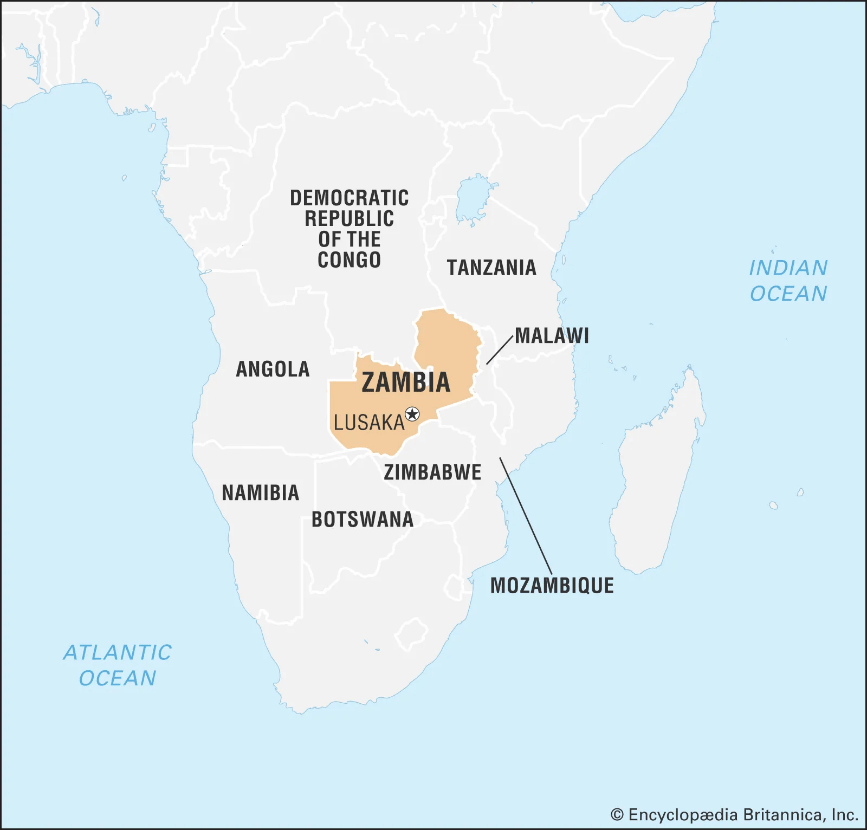
Zambia (Capital: Lusaka)
- Recent India-Zambia Joint Permanent Commission meeting
- Commemorating 60 years of diplomatic relations.
Political Features of Zambia:
- Landlocked country in Southern Africa.
- Borders with Angola, Namibia, Botswana, Zimbabwe, Mozambique, Malawi, Tanzania, and Democratic Republic of Congo.
Geographical Features of Zambia:
- Major rivers: Zambezi River and Kafue River.
- Lake Tanganyika shared with Burundi, DR Congo, and Tanzania.
- Major waterfall: Victoria Falls on Zambezi River.
President released report on ‘Prisons in India: Mapping Prison Manuals and Measures for Reformation and Decongestion’
- Report by Centre for Research & Planning on India's prison system.
- Focus on complexities and potential for technology solutions.
Insights from the Report on Prisons in India:
- Stereotyping in Prison Manuals: The report highlights how prison manuals often use degrading language for essential tasks, reinforcing a hierarchical view of labor.
- High Bail Rejection Rates: The report shows that bail applications have a high rejection rate in both Sessions Courts and Magisterial Courts.
- Slow Trial Process: Over half of cases where the accused were in custody for more than a year were still pending at the evidence stage in 2023.
- Other Issues: The report also addresses the persistence of manual scavenging in prisons, the division of prison work based on the caste system, and the underutilization of open prisons.
Use of Technology for Prison Reforms:
- E-prisons: The National Informatics Centre has developed e-prisons to streamline prison and prisoner management activities.
- Model Prison and Correctional Services Act, 2023: This act introduces electronic monitoring technology as a condition for granting prison leaves for prisoners.
- FASTER System: The Supreme Court's FASTER system has resolved delays in communicating bail orders from courts to prisons.
- Interoperable Criminal Justice System (ICJS): This system can create an automatic channel between courts, police, and prisons to reduce unjustified delays in custody cases.
The Supreme Court (SC) ruled prior sanction mandatory to prosecute public servants
- SC ruling on prior sanction for prosecuting public servants in money laundering cases
- Establishes a procedural safeguard under the PMLA
- Adds accountability to PMLA prosecutions
Key highlights of the Directorate of Enforcement Vs Bibhu Prasad Acharya case:
- Supremacy of CrPC over PMLA in requiring prior sanction for prosecution.
- Section 197 of CrPC protects public servants from prosecution for actions in discharge of duties.
- Exception allows prosecution with prior sanction from appropriate government.
Protections for Civil Servants:
- Articles 311 (1) and 311 (2) in the Constitution provide protection to Civil Servants.
- Public Servants (Inquiries) Act, 1850 ensures fair and transparent inquiries in public administration.
About PMLA, 2002:
- Comprehensive law to prevent money laundering and confiscate property derived from it.
- Implemented by Enforcement Directorate (ED) and Financial Intelligence Unit – India (FIU-IND).
- Money laundering defined as making illegally-earned money appear legitimate through activities like concealing, possessing, or acquiring proceeds of crime.
Ministry of Culture and International Buddhist Confederation Organised First Asian Buddhist Summit 2024, concludes
The summit, themed ‘Role of Buddha Dhamma in Strengthening Asia’ saw participation from 32 countries with over 160 international participants.
Significance of First Asian Buddhist Summit:
- Emphasized the interconnectedness of Buddha Dhamma, India, and Asia.
- Adopted 'The Delhi Declaration' to promote ethical governance, compassionate action, and sustainable development.
- Aligned with India's Act East Policy and Neighborhood First Policy for collective and inclusive development in Asia.
Role of Buddhism in India's Diplomacy:
- India's birthplace status of Buddhism provides diplomatic leverage in Asia.
- Promotes religious heritage sites to attract Buddhist tourists and strengthen cross-border connections.
- Utilizes relic diplomacy to enhance cultural ties with ASEAN countries.
- Hosting the Dalai Lama and Tibetan parliament-in-exile in Dharamshala boosts India's image as a protector of Buddhist traditions.
Delhi Declaration:
- Aims to strengthen connections between Asian nations based on Buddha Dhamma principles.
- Focuses on preserving Pali texts and Buddhist philosophy.
- Encourages youth involvement in cultivating a value-based society.
- Explores the relevance of Buddha Dhamma in modern scientific and medical fields.
- Emphasizes Buddha's teachings as a unifying force for global peace and understanding.
United Nations Environment Programme (UNEP) released Adaptation Gap Report 2024
- Report assesses progress in adaptation planning, implementation, and finance.
- Adaptation Gap is the difference between implemented adaptation measures and societal goals.
- Reflects resource limitations and competing priorities in addressing climate change adaptation.
Key Findings of Report:
- Adaptation Gap: The estimated adaptation gap is between US$187-359 billion per year.
- Adaptation Progress: International public adaptation finance flows to developing countries have increased to US$27.5 billion in 2022.
- Significance of Adaptation: Ambitious adaptation efforts could halve global climate risk. For example, investing US$16 billion in agriculture annually could prevent 78 million people from climate change-related starvation or chronic hunger.
Recommendations for bridging adaptation gap:
- Adopt an ambitious New Collective Quantified Goal for climate finance at COP29.
- Strengthen enabling factors, introduce new financial instruments, focus on capacity building and technology transfer.
- Shift adaptation financing from reactive, incremental, project-based approaches to more anticipatory, strategic, and transformational adaptation.
Key Initiatives for Adaptation:
Global:
- Paris Agreement: Aims to enhance adaptive capacity globally.
- UAE Framework for Global Climate Resilience: Includes 11 global adaptation targets.
- Adaptation Fund: Supports adaptation projects in developing countries under the Kyoto Protocol.
India:
- National Action Plan on Climate Change (NAPCC): Includes eight national missions on climate change.
- National Adaptation Fund for Climate Change (NAFCC): Supports and scales up adaptation actions in vulnerable states.
- Sectoral schemes like MISHTI & Amrit Dharohar focus on specific areas of adaptation.
UNESCO released ‘Global Education Monitoring Report 2024’
Report unveiled at the Global Education Meeting, coordinated by UNESCO and held in Fortaleza by the Brazilian Government (Current G20 President).
Key Observations of the UNESCO Global Education Monitoring Report 2024:
- Leadership in education is crucial for achieving common goals and maximizing joint efforts.
- Lack of funding is a major issue, with 4 in 10 countries spending less than 4% of GDP on education.
- There are still 251 million out-of-school children and youth globally, with only a 1% reduction since 2015.
- Central and Southern Asia have made progress in access to education, but countries like Afghanistan, Bangladesh, India, and Pakistan still have large out-of-school populations.
Key Recommendations from the Report:
- Principals should have the freedom to effectively manage their schools.
- Education officials should be developed as system leaders.
- Climate change education should be integrated into early grades and across various subjects.
India's Initiatives to Improve School Leadership
- The National Education Policy 2020 requires school principals to participate in workshops to enhance their leadership skills.
- The National Initiative for School Heads' and Teachers' Holistic Advancement (NISHTHA) provides training on learning outcomes, assessment, and learner-centered pedagogy.
Study highlights detrimental effect of rainforest conversion to rubber plantation on Soil-Dissolved Organic Carbon (DOC)
- Rainforest conversion to rubber plantations removes 50% of sequestered carbon from the soil, releasing it into the atmosphere as greenhouse gases.
- Loss of carbon from soil is concerning as soil globally stores 1,500 Pg of organic carbon, more than the stock in atmosphere and vegetation combined.
- Soil DOC levels increase significantly by 150-200%, impacting soil formation processes and global carbon cycling.
Environmental Impacts of Rubber Plantation:
- Biodiversity Loss: Shift to rubber monoculture leads to loss of biodiversity and weaker land resilience, with at least 60% biodiversity reduction in Thailand.
- Deforestation: Over 4 million hectares of tropical forests lost to rubber plantations in south-east Asia in the last three decades.
- Water Scarcity: Rubber plantations require more water, leading to increased evapotranspiration, reduced surface water run-off, and water yield.
- Pollution: Water and soil pollution due to rubber processing wastage.
About Natural Rubber (Hevea brasiliensis):
- Native to the Amazon River basin, introduced to tropical Asia and Africa by colonial British Government.
- Grows in a wide range of agro climates and soil conditions with an annual rainfall of about 200 cm.
- South-east Asia accounts for 90% of global rubber production, with Thailand as the largest producer.
- India is the third largest producer of natural rubber, with Kerala being the largest producer state.