
Daily Current Affairs UPSC 08 August 2024
Welcome to our daily current affairs blog post for UPSC aspirants! In today's edition, we will be discussing the most significant events and news updates that took place on 8th August 2024. Staying updated with current affairs is crucial for UPSC preparation, as it not only helps you stay informed but also enhances your understanding of various subjects. So, let's dive into the important happenings of the day and explore their potential impact on the upcoming UPSC examinations.

Exercise Mitra Shakti
- The Mitra Shakti exercise is held every year between the military forces of India and Sri Lanka.
- The main goal of the exercise is to enhance the operational capabilities of both armies.
- This is achieved through the sharing of skills, experiences, and best practices between the two countries' military personnel.
Debt-for-development swaps (Debt Swaps)
- The International Monetary Fund (IMF) has released a paper on Debt for Development Swaps, which are agreements between a government and its creditors to replace sovereign debt with liabilities that support specific development goals.
- Development goals that can be supported through debt swaps include nature conservation, climate action, education, nutrition, and support for refugees.
- Criteria for determining the appropriateness of debt swaps include the country's initial debt situation and net financial benefits.
- Debt swaps are classified into two categories: bilateral swaps where official bilateral debt is written off, and commercial swaps where target debt held by private creditors is involved.
e-Sankhyiki Portal
- The e-Sankhyiki Portal is a system created to manage and share data, making official statistics easily accessible across the country.
- The aim of the portal is to provide timely and valuable data inputs for policymakers, researchers, and the general public.
- The portal was launched by the Ministry of Statistics and Programme Implementation (MoSPI).
- It consists of two modules: the Data Catalogue Module and the Macro Indicators Module.
- The Data Catalogue Module allows users to search within datasets, download relevant data, and enhance its value and reusability.
- The Macro Indicators Module provides time series data on key macro indicators, with tools for filtering and visualizing the data.
DCPA or Dacthal
- The EPA has prohibited the use of the pesticide DCPA, also known as Dacthal.
- DCPA is commonly used on crops like broccoli, brussels sprouts, cabbage, and onions.
- Exposure to DCPA can lead to negative effects on fetuses, including low birth weight, impaired brain development, decreased IQ, and impaired motor skills later in life.
KAVACH
- Indian Railways is issuing tenders to install Kavach 4.0 on 10,000 locomotives.
- Kavach is an indigenous ATP system with Safety Integrity Level - 4 standards.
- Developed by RDSO in collaboration with Indian industry.
- Features include centralised live monitoring, prevention of SPAD, and automatic braking for overspeeding prevention.
Tribo-Electric Nanogenerator (TENG) technology
- IIT Indore has created military footwear using TENG technology.
- TENG technology converts mechanical energy from walking into electrical energy through the triboelectric effect.
- The triboelectric effect is the generation of electricity through friction.
- TENG technology is seen as a portable and renewable energy source.
- The stored energy can be used to power small electronic devices, wearable devices, IoT devices, medical devices, etc.
Lake Turkana
- First comprehensive survey in 50 years of Lake Turkana led by UNESCO and WFP.
- Revealed high fish potential in the lake.
- Lake Turkana is located in northwestern Kenya and southwestern Ethiopia.
- It is Africa's 4th largest lake and the largest permanent desert and alkaline lake in the world.
- Over 90% of inflow comes from the Omo River in Ethiopia.
- Lake Turkana National Parks site was inscribed on the World Heritage List in 1997.
- Threats to the lake include hydro-electric dams and irrigation.
Hypervirulent Klebsiella pneumoniae (hvKp)
- The World Health Organization (WHO) has issued a warning about the superbug hypervirulent Klebsiella pneumoniae (hvKp).
- HvKp is a drug-resistant bacteria that can cause severe and potentially fatal infections, even in individuals with strong immune systems.
- This bacteria can be found in the environment, such as soil and water, as well as in the upper throat and gastrointestinal tract of animals and humans.
- HvKp can lead to various infections including pneumonia, urinary tract infections, bloodstream infections, and meningitis.
Bitumen and Bio-bitumen
- The government plans to allow up to 35% bio-bitumen mixing to save ₹10,000 crore in foreign exchange outflows.
- Bitumen is a black substance made from distilling crude oil and is known for its adhesive properties.
- It is commonly used for paving roads and waterproofing.
- Bio-bitumen is a type of bitumen made from organic elements like bio-char and bio-oil.
- It can be added to bitumen or used to reduce the amount of bitumen in the binder mixture.
- Benefits of bio-bitumen include reduced imports, addressing the issue of stubble burning, and boosting the bio-economy.
Tantalum
- The Central Government has designated Tantalum as a Critical and Strategic Mineral under the Mines and Minerals (Development and Regulation) Act, 1957.
- Tantalum is a rare metal with the atomic number 73 that is grey, heavy, very hard, and corrosion-resistant.
- When pure, tantalum is ductile and has an extremely high melting point.
- Tantalum is used in making capacitors in electronic devices, surgical equipment and implants, components for chemical plants, nuclear power plants, aeroplanes, and missiles.
"Namami Gange Mission 2.0: Four Operational Projects"
- Initiatives have been started in Bihar and Uttar Pradesh to improve sewage treatment capacity.
- The projects aim to increase capacity by 145 megaliters per day (MLD) and enhance sewer networks.
- Additionally, the projects will intercept multiple drains to improve overall sanitation in the regions.
About NGM 2.0.
Namami Gange Programme overview
- Integrated Conservation Mission approved in 2014.
- Extended to March 2026 as NGM 2.0.
Objective of the programme
- Effective abatement of pollution and rejuvenation of River Ganga.
Main pillars of the programme
- Sewage treatment.
- River-front development.
- River surface cleaning.
- Afforestation.
- Biodiversity.
- Public awareness.
- Effluent management.
- Ganga Gram.
Implementation agency
- National Mission for Clean Ganga (NMCG).
- State and district counterparts under Ministry of Jal Shakti.
- NMCG registered as a society under Societies Registration Act 1860.
- Fully central funded initiative with no State-wise allocation.
Achievements of Mission
- 457 projects have been initiated, with 280 of them already completed and operational as of February 2024.
- 139 District Ganga Committees (DGC) have been formed, with District Magistrates serving as chairpersons.
- The National Mission for Clean Ganga (NMCG) has approved Common Effluent Treatment Plants (CETPs) for industries.
"Recalibrating PM-KUSUM Scheme for Success: CSE Study"
The Pradhan Mantri Kisan Urja Suraksha evam Utthaan Mahabhiyan (PM-KUSUM) has only reached 30% of its goals, leading to doubts about its ability to meet the deadline set for 2026.
Key Findings:
- Only 30% of PM-KUSUM targets achieved.
- Component B has seen most implementation, while A and C lag behind.
- Solar Powered Agriculture Pumps help farmers irrigate fields.
- Lack of incentive to shift from electric to solar pumps due to cheap electricity.
- Varying pump capacities not available in all regions.
Recommendations:
- Decentralized implementation model for better farmer outreach.
- Financial viability through installment payment options for farmers.
- Increase in Central financial assistance based on state needs and solar module prices.
About PM-KUSUM:
- Launched in 2019
- Objectives include de-dieselisation of farm sector, water and energy security for farmers, income increase, and environmental pollution reduction.
- Target of adding 34.8 GW solar capacity by March 2026.
- Nodal Ministry: Ministry of New and Renewable Energy.
- Components include solar power plants, standalone agriculture pumps, and solarisation of grid-connected pumps.
"Chhattisgarh's Approval: Guru Ghasidas Tamor Pingla TR Notification"
- The new tiger reserve in Chhattisgarh is created by merging Guru Ghasidas National Park and Tamor Pingla Sanctuary.
- This will be the fourth tiger reserve in Chhattisgarh, with the other three being Indravati, Udanti-Sitanadi, and Achanakmar.
- It will be the third largest tiger reserve in the country, after Nagarjunsagar Srisailam in Andhra Pradesh and Manas in Assam.
About Tiger Reserves
- Tiger reserves are crucial for the conservation of tigers and are divided into core critical tiger habitats and buffer areas.
- Currently, there are 55 tiger reserves in the country, with the latest being Dholpur – Karauli Tiger Reserve declared in 2023.
Notification and Management of Tiger Reserves
- Tiger reserves are notified by State Governments based on the advice of the National Tiger Conservation Authority (NTCA).
- Any alteration or de-notification of tiger reserves requires approval from NTCA and the National Board for Wild Life (NBWL).
Details about Guru Ghasidas National Park and Tamor Pingla Sanctuary
- Guru Ghasidas National Park is located on the Chhota Nagpur plateau and part of the Baghelkhand plateau.
- The vegetation in the park is moist deciduous with key trees like Teak, Sal, Gurjan, Palas, Tendu, and Mahua.
- Tamor Pingla Sanctuary is known for its diverse wildlife including Asian elephants, Bengal tigers, Indian leopards, bears, Sambar deer, and wild boars.
- The sanctuary is named after Tamor Pahar and Pingla River.
SC Rules Delimitation Commission Orders Not Immune From Judicial Review
- SC's decision in Kishorchandra Chhanganlal Rathod case.
- Constitutional courts can review Delimitation Commission orders if they are arbitrary and against constitutional values.
- Gujarat HC had previously dismissed a petition based on Article 329(a) of the Constitution.
Previous SC Judgments
- DMK v. State of T.N: Allowed judicial intervention in cases of mala fide or arbitrary exercise of power
- Meghraj Kothari's case: Limited judicial interference to avoid delays in the election process
Delimitation Process
- Fixing number of seats and boundaries of constituencies for Lok Sabha and Legislative assemblies.
- Delimitation Commission responsible for this task.
- Delimitation done as per Article 82 and laws determined by Parliament.
- Delimitation Commissions have been constituted in India in 1952, 1963, 1973, and 2002.
"Joint Air and Naval Exercise in South China Sea"
- The exercise aims to address common maritime challenges and emphasize the commitment to upholding international law and the rules-based order.
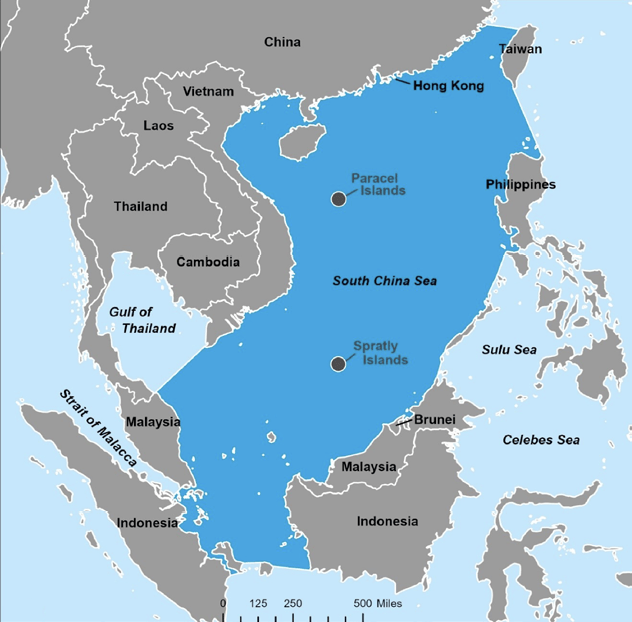
- The South China Sea (SCS) is a region in the western Pacific Ocean, stretching from Singapore to the Strait of Taiwan, known for its importance as a shipping lane, fishing ground, coral reef ecosystem, and oil and gas resources.
- Multiple countries claim parts of the islands in the SCS to assert sovereignty over the surrounding sea and its resources, with China claiming almost the entire region.
- Despite a ruling by the Permanent Court of Arbitration under UNCLOS in 2016 that China's claims have no legal basis, China has not acknowledged the ruling.
- India has increased its military and diplomatic engagement with countries like the Philippines and Vietnam in the SCS, driven by strategic interests, freedom of navigation concerns, and the desire to access oil and gas resources in the region.
"Maharashtra Greenlights River Linking Project"
- Wainganga-Nalganga (Purna Tapi) River linking project.
- Aims to irrigate 3.7 lakh hectare of agricultural land in Vidarbha region.
- Involves diverting excess water from Gosikhurd dam to Nalganga dam through link canals.
- Detailed project report presented by NWDA in 2018 and approved by Central Water Commission.
- Will supplement the National River Linking Project (NRLP).
National River Linking Project (NRLP)
- Based on National Perspective Plan (NPP) from 1980.
- Aims to transfer water from surplus basins to deficit basins.
- 30 identified links for Feasibility Reports.
- Union Cabinet approved implementation of Ken Betwa river link in 2021.
Significance of NRLP
- Provides additional irrigation in drought-prone areas.
- Facilitates navigation and reduces flooding issues.
Challenges
- Resettlement and rehabilitation of project affected people.
- Environmental costs like deforestation and soil erosion.
Wainganga and Nalganga (Purna Tapi) River
- Wainganga River originates from Mahadeo Hills in Madhya Pradesh.
- Major tributary of river Godavari.
- Nalganga is a left bank tributary of river Purna and a sub-tributary of Tapi river.