
Q 21. Raja Ram Mohan Roy's Contribution (Modern History)
Q21. Consider the following statements about Raja Ram Mohan Roy:
1. He possessed great love and respect for the traditional philosophical systems of the East.
2. He desired his countrymen to accept the rational and scientific approach and the principle of human dignity and social equality of all men and women.
Which of the statements given above is/are correct?
Course Name: Prelims PYQs 45 Years Solved | Mains Seat Guidance Programme (MSGP) 2026 UPSC 2012 Q
Explanation:
● Statement 1 is correct: Raja Ram Mohan Roy had a profound appreciation for the traditional philosophical systems of the East. He studied ancient Indian texts and was deeply influenced by the Upanishads and Vedas, which he believed contained valuable philosophical insights.
● Statement 2 is correct: Raja Ram Mohan Roy was a pioneer in advocating for the rational and scientific approach. He emphasized the importance of human dignity and social equality for all men and women. He was a social reformer who worked towards abolishing practices like Sati and promoted women's rights and education.
Q . Social Reform Movements
Consider the following statements about Raja Ram Mohan Roy: 1. He possessed great love and respect for the traditional philosophical systems of the East. 2. He desired his countrymen to accept the rational and scientific approach and the principle of human dignity and social equality of all men and women. Which of the statements given above is/are correct?
Q . Social Reform Movements
Who among the following was the founder of the 'Self-Respect Movement'?
Q . Social Reform Movements
The Vital-Vidhvansak, the first monthly journal to have the untouchable people as its target audience was published by
Q . Social Reform Movements
Consider the following pairs: Movement/ Organization – Leader 1. All India Anti-Untouchability League: Mahatma Gandhi 2. All India Kisan Sabha: Swami Sahajanand Saraswati 3. Self-Respect Movement: E.V. Ramaswami Naicker Which of the pairs given above is/are correctly matched?
Q . Social Reform Movements
He wrote biographies of Mazzini, Garibaldi, Shivaji and Shrikrishna; stayed in America for some time; and was also elected to the Central Assembly. He was
Q . Social Reform Movements
Who among the following were the founders of the “Hind Mazdoor Sabha” established in 1948?
Q . Social Reform Movements
Which among the following events happened earliest?
Q . Social Reform Movements
Consider the following: 1. Calcutta Unitarian Committee 2. Tabernacle of New Dispensation 3. Indian Reform Association. Keshab Chandra Sen is associated with the establishment of which of the above?
Q . Social Reform Movements
Satya Shodhak Samaj organized
Q . Social Reform Movements
Consider the following statements: 1. ‘Bijak’ is a composition of the teachings of Saint Dadu Dayal. 2. The Philosophy of Pushti Marg was propounded by Madhvacharya. Which of the statements given above is/are correct?
Q . Social Reform Movements
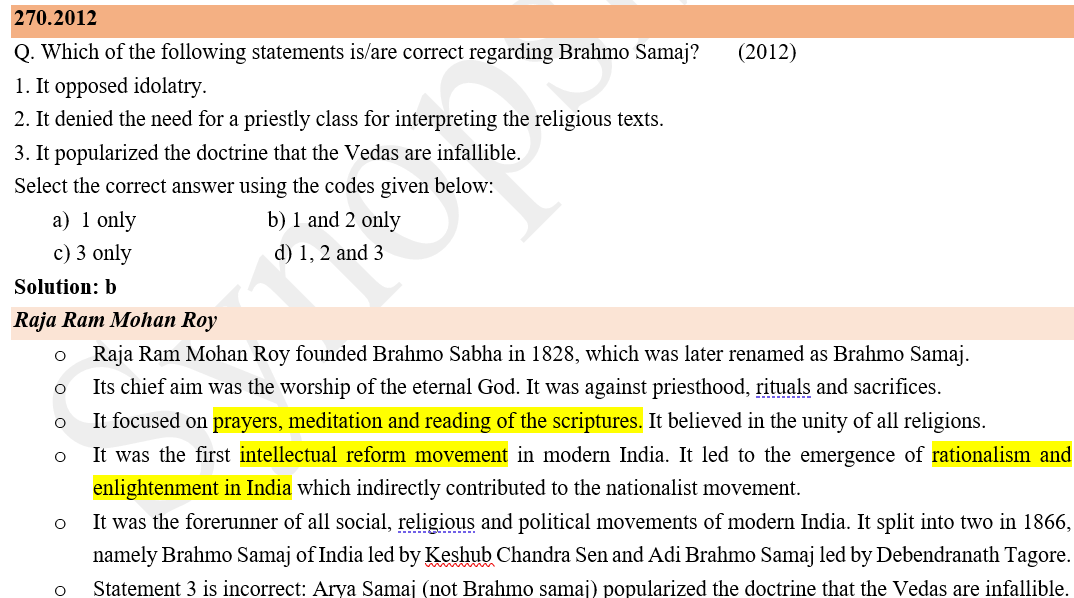
Which of the following statements is/are correct regarding Brahmo Samaj? 1. It opposed idolatry. 2. It denied the need for a priestly class for interpreting the religious texts. 3. It popularized the doctrine that the Vedas are infallible. Select the correct answer using the codes given below:
Q . Social Reform Movements
Which of the following parties were established by Dr. B.R. Ambedkar? 1. The Peasants and Workers Party of India 2. All India Scheduled Castes Federation 3. The Independent Labor Party Select the correct answer using the codes given below:
Q . Social Reform Movements
In collaboration with David Hare and Alexander Duff, who of the following established Hindu College at Calcutta?
Q . Social Reform Movements
Who among the following started the newspaper Shome Prakash?
Q . Social Reform Movements
Who among the following wrote the book Bahubivah?
Q . Social Reform Movements
“Lectures from Colombo to Almora” is based on the experiences of which one of the following?
Q . Social Reform Movements
Consider the following statements: 1. Ishwar Chandra Vidyasagar founded the Bethune School at Calcutta with the main aim of encouraging education for women. 2. Bankim Chandra Chattopadhyay was the first graduate of the Calcutta University. 3. Keshav Chandra Sen’s campaign against Sati led to the enactment of a law to ban Sati by the then Governor General. Which of the statements given above is/are correct?
Q . Social Reform Movements
Consider the following statements: 1. Arya Samaj was founded in 1835. 2. Lala Lajpat Rai opposed the appeal of Arya Samaj to the authority of Vedas in support of its social reform programs. 3. Under Keshab Chandra Sen, the Brahmo Samaj campaigned for women’s education. 4. Vinobha Bhave founded the Sarvodaya Samaj to work among refugees. Which of the statements are correct?
Q . Social Reform Movements
Which of the following is/are correctly matched?Persons — Events 1. Keshab Chandra Sen — Prarthana Samaj 2. Mahadev Govind Ranade — Brahmo Samaj 3. Swami Vivekanand — Ramakrishna Mission
Q . Social Reform Movements
M.C. Setalvad, B.N. Rao and Alladi Krishnaswamy Iyer were distinguished members of the:
Q . Social Reform Movements
Which one of the following pairs is not correctly matched?
Q . Social Reform Movements
Uplift of the backward classes was the main programme of the
Q . Social Reform Movements
Which of the following political parties/organizations were established by Dr. B. R. Ambedkar? 1. Swaraj Party 2. Samaj Samata Sangh 3. All India Scheduled Castes Federation 4. The Independent Labour Party
Q . Social Reform Movements
Match List I with List II and select the correct answer using the codes given below them: List I (Social Reformers of Modern India) A. Kesab Chandra Sen B. Henry Vivian Derozio C. Gopal Hari Deshmukh D. Devendranath Tagore List II (Their contributions) 1. Young Bengal Movement 2. Param Hansa Mandali 3. Sadharan Brahma Samaj 4. Tatvabodhini Sabha A B C D
Q . Social Reform Movements
The “Servants of India Society” was founded by
Q . Social Reform Movements
Who among the following Indians mostly encouraged the remarriage of the widows?
Q . Social Reform Movements
Banaras Hindu University was founded by
Q . Social Reform Movements
Match the columns: List 1 List 2 A. Karsondas Mulji 1. Tatvabodhini Patrika B. Dadabhai Naoroji 2. Satya Prakash C. Debendranath Tagore 3. Fight for legal status to Parsi women D. Henry Vivian Derozio 4. Peasant Movement 5. Did not believe in existence of god A B C D
Q . Social Reform Movements
Go back to the Vedas was the motto of
Q . Social Reform Movements
Which of the following laws was passed during the second half of the nineteenth century under the Social and Religious Reform Movement?
Q . Social Reform Movements
Who represented India at the Chicago Conference of World Religions in 1893?
Q . Social Reform Movements
Match the following correctly A. Ramakrishna Mission - I. Swami Dayanand Saraswati B. Arya Samaj - II. Raja Rammohan Roy C. Brahmo Samaj - III. Keshab Chandra Sen D. Prarthana Samaj - IV. Swami Vivekananda A B C D
Q . Social Reform Movements
Who was the leader of the Depressed Classes in the pre-Independence period?
Q . Social Reform Movements
Raja Rammohan Roy was supporter of
Q . Social Reform Movements
Who among the following was responsible for the revival of Hinduism in the 19th century?
Q . Social Reform Movements
Who was the founder of the Servants of India Society?
Q . Social Reform Movements
“Chipko movement” in Uttar Pradesh relates to
● Explanation for Statement 1:
○ Raja Ram Mohan Roy was a prominent social and religious reformer in India who had a deep appreciation for the traditional philosophical systems of the East. He studied ancient Indian texts and was well-versed in Sanskrit, Persian, and Arabic. His respect for Eastern philosophy was evident in his efforts to synthesize the best elements of Eastern and Western thought.
● Explanation for Statement 2:
○ Raja Ram Mohan Roy was a strong advocate for rationalism, scientific thinking, and social reform. He believed in the principles of human dignity and social equality, and he worked tirelessly to promote these values. His efforts included campaigning against social evils like sati and child marriage, and advocating for women's rights and education. His vision was to modernize Indian society by embracing rational and scientific approaches while maintaining respect for human dignity and equality.