
Q 91. Gandhiji's Statement on Sedition (Modern History)
Q91. "Sedition has become my religion" was the famous statement given by Gandhiji at the time of

This is a difficult question. It was recently asked in RPSC 2019. We can apply some elimination techniques and use PYQs. We teach PYQs and elimination techniques in the Prelims PYQs 45 Years Solved | Mains Seat Guidance Programme (MSGP) Course.
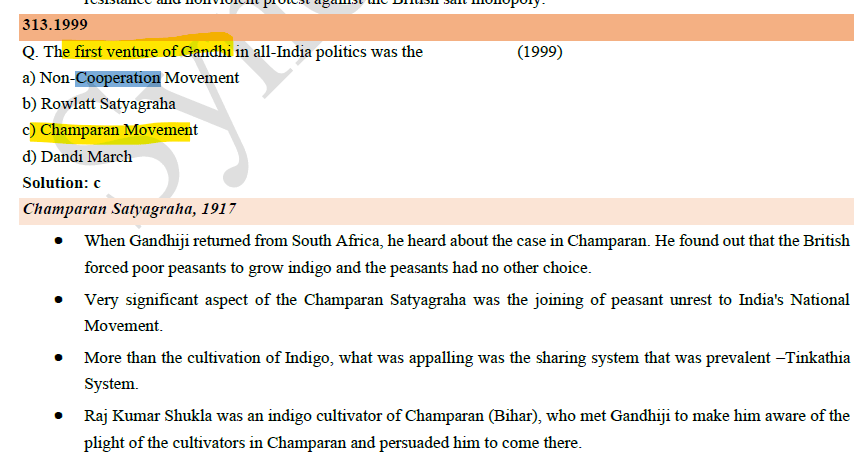
1. Champaran Satyagraha was Gandhi ji first experiment in India. Here, it is difficult to make such strong statement about Sedition. (See UPSC 1999 PYQ Below)
2. In Dandi, Gandhi ji broke the Salt law, which is directly related to extreme annoying the British Rule. This could be a correct answer.
3. The purpose of the Second Round Table Conference in London: Aimed to discuss constitutional reforms in India following the First Round Table Conference. This is not directly related with Sedition.
4. For the launch of the Quit India Movement, the resolution was drafted by the Congress Working Committee. Gandhi gave the slogan of "Do or Die" to the Indian people. This is not directly related with Sedition.
- The statement "Sedition has become my religion" was famously given by Mahatma Gandhi during the Salt March or Dandi March in 1930. This was a pivotal act of civil disobedience against the British monopoly on salt production and sales.
- Salt March: Gandhi led a 240-mile march to the Arabian Sea to produce salt, defying British laws.
- Civil Disobedience: This act was part of a larger campaign of nonviolent resistance against British rule.
- Significance: The statement underscored Gandhi's commitment to challenging unjust laws through peaceful means, making sedition a form of moral and spiritual duty against colonial oppression.
Q 94. Gandhiji's Commitment to Harijan Upliftment (Modern History)
Q94. Subsequent to which one of the following events, Gandhiji, who consistently opposed untouchability and appealed for its eradication, decided to include the upliftment of Harijans' in his programme?
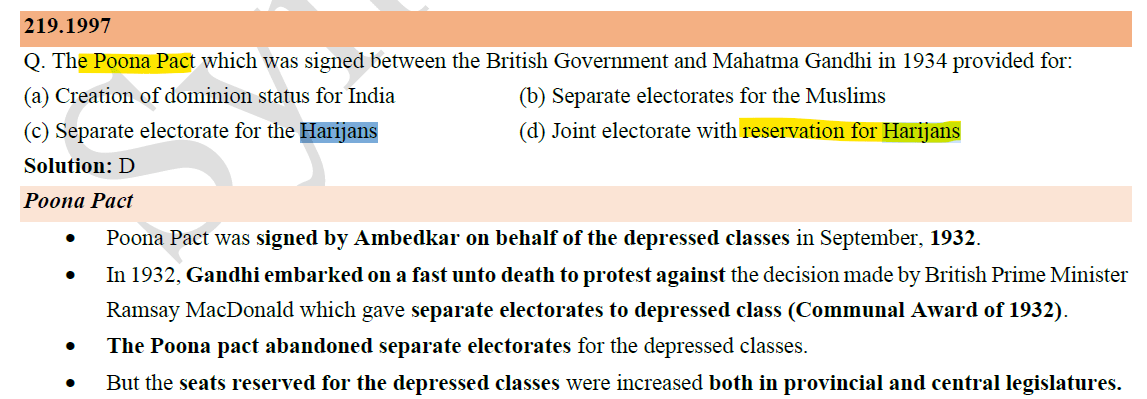
UPSC 1997 Q, UPSC 1980 Q
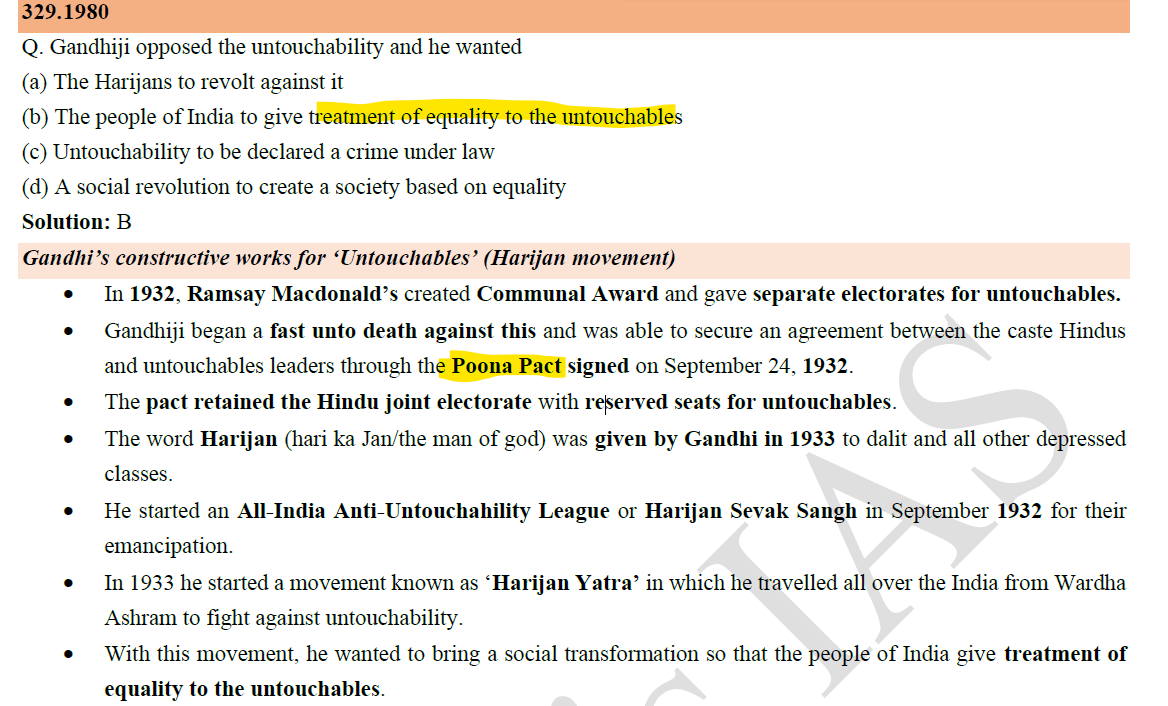
- The Poona Pact was a significant agreement reached in 1932 between Mahatma Gandhi and Dr. B.R. Ambedkar concerning the representation of the Depressed Classes (later known as Scheduled Castes) in the Indian legislative system.
- This pact was a result of Gandhi's opposition to the British proposal of separate electorates for the Depressed Classes, which he believed would further divide Indian society.
- Following the Poona Pact, Gandhi intensified his efforts towards the upliftment of Harijans (a term he used for the Depressed Classes), integrating their welfare into his broader social reform agenda.
Q . Gandhi
"Sedition has become my religion" was the famous statement given by Gandhiji at the time of
● Context
of the Statement: Mahatma Gandhi made the statement "Sedition
has become my religion" during the period of the Salt March,
which was part of the Civil Disobedience Movement. This movement was a direct
action campaign of tax resistance and nonviolent protest against the British
salt monopoly.
● Significance of the Salt March: The
Salt March, also known as the Dandi March, was a pivotal event in the Indian
independence movement. It began on March 12, 1930, and lasted until April 6,
1930, when Gandhi and his followers reached Dandi and made salt from seawater,
defying the British law.
● Gandhi's Philosophy: The statement
reflects Gandhi's commitment to nonviolent resistance and civil disobedience as
a means to challenge unjust laws and colonial rule. By equating sedition with
his religion, Gandhi emphasized his dedication to the cause of Indian
independence and his willingness to face legal consequences for his actions.
Q . Gandhi
Subsequent to which one of the following events, Gandhiji, who consistently opposed untouchability and appealed for its eradication, decided to include the upliftment of Harijans in his programme?
○ The Poona Pact was an agreement reached on September 24, 1932, between Mahatma Gandhi and Dr. B.R. Ambedkar on behalf of the depressed classes and upper-caste Hindu leaders on the reservation of electoral seats for the depressed classes in the legislature of British India.
○ Prior to the Poona Pact, the British government had announced the Communal Award, which provided separate electorates for the depressed classes. Gandhi opposed this as he believed it would further divide the Hindu community.
○ After the Poona Pact, Gandhi intensified his efforts towards the upliftment of the Harijans (a term he used for the untouchables) and included their welfare as a significant part of his social reform agenda.
○ This event marked a pivotal moment in Gandhi's campaign against untouchability, leading to increased focus on the social and economic upliftment of the Harijans.
Q . Gandhi
The Gandhi-Irwin Pact included which of the following? 1. Invitation to Congress to participate in the Round Table Conference 2. Withdrawal of Ordinances promulgated in connection with the Civil Disobedience Movement 3. Acceptance of Gandhi’s suggestion for enquiry into police excesses 4. Release of only those prisoners who were not charged with violence Select the correct answer using the code given below
Q . Gandhi
With reference to the British colonial rule in India, consider the following statements: 1. Mahatma Gandhi was instrumental in the abolition of the system of ‘indentured labor’. 2. In Lord Chelmsford’s ‘War Conference’, Mahatma Gandhi did not support the resolution on recruiting Indians for World War. 3. Consequent upon the breaking of Salt Law by Indian people, the Indian National Congress was declared illegal by the colonial rulers. Which of the statements given above are correct?
Q . Gandhi
Which one of the following is a very significant aspect of the Champaran Satyagraha?
Q . Gandhi
Mahatma Gandhi undertook fast unto death in 1932, mainly because
Q . Gandhi
Mahatma Gandhi said that some of his deepest convictions were reflected in a book titled, “Unto this Last” and the book transformed his life. What was the message from the book that transformed Mahatma Gandhi?
Q . Gandhi
What was the reason for Mahatma Gandhi to organize a satyagraha on behalf of the peasants of Kheda? 1. The Administration did not suspend the land revenue collection in spite of a drought. 2. The Administration proposed to introduce Permanent Settlement in Gujarat. Which of the statements given above is/are correct?
Q . Gandhi
Consider the following statements: 1. Dr. Rajendra Prasad persuaded Mahatma Gandhi to come to Champaran to investigate the problem of peasants. 2. Acharya J.B. Kriplani was one of Mahatma Gandhi’s colleagues in his Champaran investigation. Which of the statements given above is/are correct?
● Statement 1 is incorrect: It was not Rajendra Prasad but Raj Kumar Shukla who requested Gandhi to come to Champaran to investigate the problems of peasants.
Q . Gandhi
Who of the following founded the Ahmedabad Textile Labor Association?
Q . Gandhi
With which one of the following movements is the slogan “Do or die” associated?
'Do or Die 'slogan is associated with Mahatma Gandhi. It is marked as the beginning of the Quit India Movement. Also known as the August Movement or August Kranti Movement, the Quit India Movement began on 8th August 1942.
Q . Gandhi
Who among the following Gandhian followers was a teacher by profession?
Q . Gandhi
At which one of the following places did Mahatma Gandhi first start his Satyagraha in India?
Q . Gandhi
Which of the following pairs are correctly matched? Movement/Satyagraha — Person Actively Associated with 1. Champaran — Rajendra Prasad 2. Ahmedabad Mill Workers — Morarji Desai 3. Kheda — Vallabhbhai Patel Select the correct answer using the code given below: Codes:
● Champaran (First Civil Disobedience)–1917;
● Ahmedabad Mill Strike (First Hunger Strike)–March 1918;
● Kheda Satyagraha (First Non-Cooperation)– June 1918.
Q . Gandhi
After returning from South Africa, Gandhiji launched his first successful Satyagraha in
Q . Gandhi
The first venture of Gandhi in all-India politics was the
Q . Gandhi
A: Gandhi stopped the Non-Cooperation Movement in 1922. R: Violence at Chauri Chaura led him to stop the movement.
Q . Gandhi
At the time of India’s Independence Mahatma Gandhi was
Q . Gandhi
Assertion (A): Gandhi stopped the Non-Cooperation Movement in 1922. Reason (R): Violence at Chauri-Chaura led him to stop the movement.
- The Non-Cooperation movement in 1922 was stopped because of the Chauri Chaura incidence of violence.
Q . Gandhi
At the time of India's Independence, Mahatma Gandhi was:
- At the time of Independence:
o President of Congress was J.B.Kriplani.
o Viceroy of India was Lord Louis Mountbatten.
o Government of India was in the hands of Viceroy’s Executive Council.
o Executive Council of Viceroy was transformed into a council of ministers.
o The Vice President of Executive Council was the Prime Minister of India i.e. Jawaharlal Nehru.
o Commander-in-Chief of India Sir Claude Auchinleck
- Mahatma Gandhi was not the member of Congress at the time of Independence.
Q . Gandhi
In 1930, Mahatma Gandhi started Civil Disobedience Movement from:
On 12 March, 1930, Gandhi started his civil disobedience movement by starting Dandi March from Sabarmati Ashram in Gujarat and reached Dandi on 6 April 1930 and broke the salt law.
Sevagram was the place of Mahatma Gandhi's ashram and his residence from 1936 to his death in 1948.
Wardha is famous for the many social reformers who have called it home. Mahatma Gandhi built his last ashram in Wardha. Its also famous because of Wardha session of INC in 1942 that passed resolution for immediate independence.
Q . Gandhi
The title given by British Government to Mahatma Gandhi which he surrendered during the Non-cooperation Movement, was:
Q . Gandhi
What is the correct chronological sequence of the following stages in the political life of Mahatma Gandhi? I. Champaran II. Ahmedabad Mill Strike III. Kheda IV. Non-cooperation Movement Choose the answer from the codes given below:
Chronological order
- Champaran – 1917
- Ahmedabad Mill Strike – February 1918
- Kheda – March 1918
- Non-cooperation Movement – 1920
Q . Gandhi
Mahatma Gandhi was referred to as the ‘Father of the nation’ first by
- It was Subhas Chandra Bose who used the term for Mahatma Gandhi, in a radio address from Singapore in 1944.
Q . Gandhi
“Indian cotton merchant, banker, associate of Mahatma Gandhi” This description fits
Q . Gandhi
Who declared, “Swaraj had ‘stunk in the nostrils’ and that without adequate discipline and restraint on the part of the people, the movement had proved to be a Himalayan blunder”.
Q . Gandhi
The first great experiment of Gandhiji in ‘Satyagraha’ took place in
Champaran satyagraha – 1917
Bardoli satyagraha – 1928
Dandi March – 1930
Q . Gandhi
Which of the following statements about Mahatma Gandhi is correct in connection with India’s independence?
- Mahatma Gandhi was highly disillusioned and clear in his thought.
- His freedom movement was based on Satyagraha, Truth and Nonviolence.
- Infact all the actions in his life were backed by ethical and moral values.
- These values were ingrained in his thought and were reflected in his actions.
- During his formative years in Africa, he extensively experimented with the impact and effectiveness of these values.
- Once he was clear that Satyagraha was the most powerful method of mass action, he adopted it and applied it in India.
Q . Gandhi
After Chauri Chaura incident in which 22 policemen were killed, the result was that:
- As a result of Chauri-Chaura incident Gandhi ji withdrew non co-operation movement.
Q . Gandhi
Dandi March was organised by Gandhiji to
Q . Gandhi
Gandhiji opposed the untouchability and he wanted
Q . Gandhi
Which of the following is not a tenet of Gandhian Socialism?
Q . Gandhi
The basic education advocated by Gandhiji in Wardha Congress is related with
Q . Gandhi
Gandhiji was of the view that
Q . Gandhi
According to Gandhiji nonviolence is
Q . Gandhi
Whom did Gandhiji consider his political Guru?
Q . Gandhi
Community Development Programme was launched on the birthday of Gandhiji in the year
Q . Gandhi
Gandhiji started Dandi March in 1930
Q . Gandhi
Which of the following was not the outcome of Jallianwalla Bagh massacre?
Q . Gandhi
Gandhiji’s “Champaran Movement” was for