
Q 95. Introduction of Fruits in India by Portuguese (Modern History)
Q95. Consider the following fruits:
1. Papaya
2. Pineapple
3. Guava
How many of the above were introduced in India by the Portuguese in the 16th-17th centuries?
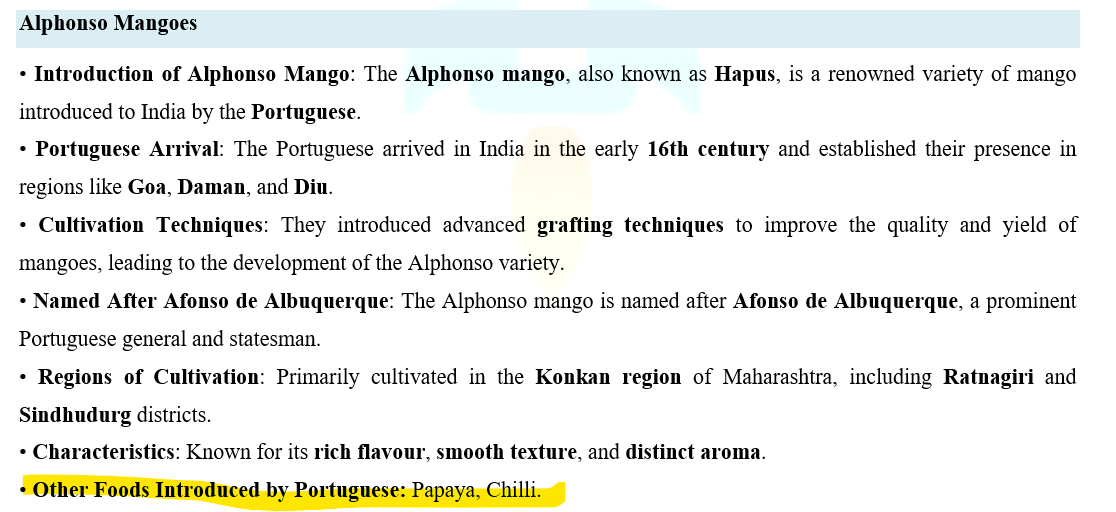
- पपीता: भारत में पुर्तगालियों द्वारा पेश किया गया। पुर्तगाली अपने औपनिवेशिक काल के दौरान भारत में कई उष्णकटिबंधीय फलों को लाने में महत्वपूर्ण थे।
- अनानास: भारत में पुर्तगालियों द्वारा पेश किया गया। अनानास दक्षिण अमेरिका का मूल निवासी है और इसे यूरोपीय खोजकर्ताओं, जिनमें पुर्तगाली भी शामिल थे, द्वारा दुनिया के अन्य हिस्सों में फैलाया गया।
- अमरूद: अमेरिका के उष्णकटिबंधीय क्षेत्रों का मूल निवासी, अमरूद को भी भारत में पुर्तगालियों द्वारा पेश किया गया।
Q . Arrival of Europeans
1. The Dutch established their factories/warehouses on the east coast on lands granted to them by Gajapati rulers.
2. Alfonso de Albuquerque captured Goa from the Bijapur Sultanate.
3. The English East India Company established a factory at Madras on a plot of land leased from a representative of the Vijayanagara empire.
Which of the statements given above are correct?
2. Explain the logic:
● Statement 1: The Dutch did establish factories on the east coast of India, but they were primarily granted lands by local rulers and not specifically by the Gajapati rulers. Therefore, this statement is incorrect.
● Statement 2: Alfonso de Albuquerque did indeed capture Goa from the Bijapur Sultanate in 1510, marking a significant event in Portuguese colonial history in India. This statement is correct.
● Statement 3: The English East India Company established a factory at Madras (now Chennai) on a plot of land leased from a representative of the Vijayanagara Empire in 1639. This statement is correct.
Q . Arrival of Europeans
1. Broach
2. Chicacole
3. Trichinopoly
Select the correct answer using the code given below:
2. Explain the logic:
● Broach (1): The English East India Company established its early factories in several locations in India during the early 17th century. Broach (now Bharuch) was one of the initial sites where the company set up a factory due to its strategic location and trading potential.
● Chicacole (2): There is no historical evidence to suggest that the English East India Company had a factory in Chicacole during the first quarter of the 17th century. Chicacole was not a significant trading post for the company at that time.
● Trichinopoly (3): Similarly, Trichinopoly was not a location where the English East India Company established a factory in the early 17th century. The company's focus was primarily on coastal trading centers.
Q . Arrival of Europeans
1. The first European power to occupy Pondicherry were the Portuguese.
2. The second European power to occupy Pondicherry were the French.
3. The English never occupied Pondicherry.
Which of the statements given above is/are correct?
2. Explain the logic:
● Statement 1: The first European power to occupy Pondicherry were the Portuguese. This statement is correct. The Portuguese were indeed the first Europeans to establish a presence in Pondicherry in the early 16th century.
● Statement 2: The second European power to occupy Pondicherry were the French. This statement is incorrect. The Dutch occupied Pondicherry after the Portuguese, before the French established control in 1674.
● Statement 3: The English never occupied Pondicherry. This statement is incorrect. The English did occupy Pondicherry multiple times during conflicts with the French, notably during the Anglo-French wars in India.
Q . Arrival of Europeans
2. Explain the logic:
● Option A: Akbar: Akbar was the Mughal emperor before Jahangir. During his reign, the English had not yet established a factory in Surat. The first English voyage to India occurred during Akbar's reign, but it was under Jahangir that the English were granted permission to set up a factory.
● Option B: Jahangir: Jahangir was the Mughal emperor who granted the English East India Company permission to establish their first factory in Surat in 1613. This was a significant event as it marked the beginning of English trade in India.
● Option C: Shahjahan: Shahjahan was Jahangir's successor. By the time Shahjahan came to power, the English had already established their presence in Surat.
● Option D: Aurangzeb: Aurangzeb was a later Mughal emperor. The English had already been operating in Surat for several decades by the time Aurangzeb ascended the throne.
Q . Arrival of Europeans
2. Explain the logic:
● Dutch: The Dutch East India Company was established in 1602, and they were among the early European traders in India. They focused on the spice trade and established trading posts in various parts of India.
● English: The English East India Company was formed in 1600, and they became one of the dominant trading powers in India, eventually leading to British colonial rule.
● French: The French were among the last major European powers to establish a significant trading presence in India. The French East India Company was founded in 1664, and they established key trading posts in Pondicherry and Chandernagore.
● Portuguese: The Portuguese were the first Europeans to arrive in India for trade, with Vasco da Gama reaching Calicut in 1498. They established a stronghold in Goa and other coastal areas.
The French were the last among these European powers to establish a significant trading presence in pre-independence India.
Q . Arrival of Europeans
2. Explain the Logic:
● Fort St George: Constructed in 1644 in Chennai (Madras), it was the first fort built by the British in India. It marked the beginning of British influence in the region and served as a trading post and administrative center.
● Fort William: Built later in 1696 in Kolkata, it became a significant British stronghold but was not the first.
● Fort St David: Acquired by the British in 1690 near Cuddalore, it was fortified after Fort St George.
● Fort St Angelo: Located in Kannur, Kerala, it was constructed by the Portuguese in 1505 and later captured by the Dutch and British, but not originally a British fort.
Q . Arrival of Europeans
2. Explain the logic:
○ In 1613, the English East India Company was granted permission by the Mughal Emperor Jahangir to establish a factory (trading post) in Surat. This marked the beginning of the company's trade operations in India.
● Surat was a significant port city on the western coast of India, making it an ideal location for trade and commerce.
● Option A: Bangalore - The English East India Company did not establish a factory in Bangalore in 1613. Bangalore became significant much later.
● Option B: Madras - The English East India Company established a factory in Madras (now Chennai) in 1639, not in 1613.
● Option C: Masulipattanam - The company set up a trading post in Masulipattanam in 1611, but the question specifically asks about 1613, which corresponds to Surat.
Q . Arrival of Europeans
Which one of the following is the correct statement?
1.
2. Explain the logic:
● Option A: Incorrect. The modern Kochi was not a Dutch colony till India's independence. The British took control of Kochi in the 18th century.
● Option B: Correct. The Dutch defeated the Portuguese in the 17th century and established their presence in Kochi, building Fort Williams.
● Option C: Incorrect. The Portuguese were the first Europeans to establish a colony in Kochi, not the Dutch.
● Option D: Incorrect. The modern Kochi did become part of the British colony after the Dutch.
Q . Arrival of Europeans
2. Explain the logic:
● Option A: The statement is incorrect. The Portuguese, led by Afonso de Albuquerque, captured Goa in 1510, not 1499. This marks the beginning of Portuguese colonial rule in India.
● Option B: This statement is correct. The English East India Company established its first factory in South India at Masulipatnam in 1611.
● Option C: This statement is correct. The English Company opened its first factory in Orissa in 1633, marking their presence in Eastern India.
● Option D: This statement is correct. Under Dupleix's leadership, the French captured Madras in 1746 during the First Carnatic War.
Q . Arrival of Europeans
1.
2.
3.
4.
2. Explain the Logic:
○ The Dutch East India Company was established in 1602, and they were keen on establishing trading posts in India to participate in the lucrative spice trade.
● Pulicat was the location where the Dutch established their earliest factory in India in 1609. It became a significant trading post for them, especially for textiles and spices.
● Surat (Option A) was primarily a British and Portuguese trading hub before the Dutch established a presence there later.
● Cochin (Option C) was initially a Portuguese stronghold before the Dutch took control in 1663, but it was not their earliest factory.
● Cassimbazar (Option D) was another trading post established by the Dutch, but it came after Pulicat.
Q . Arrival of Europeans
Who among the following was the first European to initiate the policy of taking part in the quarrels of Indian princes with a view to acquire territories?
2. Explain the logic:
● Dupleix: Joseph François Dupleix was the French Governor-General of India in the mid-18th century. He was the first European to actively engage in the internal conflicts of Indian princes to expand French influence and acquire territories. His strategy involved forming alliances with local rulers and intervening in their disputes, which marked a significant shift in European colonial policy in India.
● Clive: Robert Clive was a British officer who played a key role in establishing British control in India. While he did engage in local conflicts, his actions came after Dupleix's initiatives.
● Albuquerque: Afonso de Albuquerque was a Portuguese general and a key figure in establishing Portuguese colonial rule in India. His focus was more on establishing trade routes and fortifications rather than engaging in local disputes.
● Warren Hastings: Warren Hastings was the first Governor-General of Bengal. His tenure was marked by administrative reforms rather than initiating the policy of engaging in local quarrels for territorial gains.
Q . Arrival of Europeans
The first to start a joint stock company to trade with India were the
2. Explain the logic:
● Portuguese: The Portuguese were among the first Europeans to reach India by sea, establishing a trading post in Goa in 1510. However, they did not form a joint stock company for trade.
● Dutch: The Dutch were the first to establish a joint stock company, the Dutch East India Company (VOC), in 1602. This company was specifically created to trade with India and other parts of Asia, marking the beginning of corporate global trade.
● French: The French East India Company was established later, in 1664, to compete with other European powers in India.
● Danish: The Danish East India Company was founded in 1616, after the Dutch, to engage in trade with India and other Asian countries.
Q . Arrival of Europeans
Establishment of Manufacturing Industries — Place
1. I. Setting up of the first cotton mill — 1854 Bombay
2. II. Manufacture of the first machine-made paper — 1870 Near Calcutta
3. III. Setting up of the first cement factory — 1904 Madras
Choose the correct answer from the codes given below:
Codes:
Explanation:
1. Statement I: Setting up of the first cotton mill in 1854 Bombay is correct. The first cotton mill in India, known as the Bombay Spinning and Weaving Company, was indeed established in Bombay in 1854. However, this statement is not relevant to the options provided, as it is not part of the correct answer.
2. Statement II: Manufacture of the first machine-made paper in 1870 Near Calcutta is correct. The first paper mill was established near Calcutta in 1870, marking the beginning of machine-made paper production in India.
3. Statement III: Setting up of the first cement factory in 1904 Madras is correct. The first cement factory in India was established in Madras in 1904.
Conclusion: Statements II and III are correctly matched, making Option C the correct answer.
Q . Arrival of Europeans
Which one of the following was given to King Charles II as part of his dowry on the occasion of his marriage with Queen Catherina of Braganza?
- On 23 June 1661 a marriage treaty was agreed and signed upon the marriage of Charles II and Catherine of Braganza (Portuguese princess).
- Catherine brought as a dowry
o £500,000, as well as Bombay,
o Tangier (a city in northwestern Morocco) and
o The right of free trade with the Portuguese colonies.
Q . Arrival of Europeans
2. Explain the Logic:
● Portuguese Arrival: The Portuguese, led by Vasco da Gama, arrived in India in 1498. Their primary goal was to establish a direct sea route for the spice trade.
● Trade Rivals: At the time of their arrival, the Arabs were the dominant traders in the Indian Ocean, controlling the spice trade routes between India and Europe. They had established trade networks and were the primary competitors to the Portuguese.
● Other Options:
● Option A: Persians: While the Persians were involved in regional trade, they were not the primary competitors in the Indian Ocean spice trade.
● Option C: Dutch: The Dutch arrived later, in the early 17th century, and became significant rivals to the Portuguese.
● Option D: English: The English also arrived later, with the establishment of the East India Company in 1600, and were not immediate rivals when the Portuguese first arrived.
Q . Arrival of Europeans
Consider the following European missions during the Mughal period: 1. Thomas Roe 2. Tavernier 3. Rudolf Acquaviva. The correct chronological order of their visits is
Q . Arrival of Europeans
Albuquerque captured Goa from the ruler of
2. Explain the Logic:
● Option A: Bijapur: Afonso de Albuquerque, a Portuguese general, captured Goa in 1510 from the Sultan of Bijapur, Yusuf Adil Shah. This marked a significant event in the establishment of Portuguese colonial rule in India.
● Option B: Golkonda: The Golkonda Sultanate was a separate entity located in the Deccan region, known for its diamond mines, and was not involved in the control of Goa during Albuquerque's conquest.
● Option C: Ahmadnagar: The Ahmadnagar Sultanate was another Deccan kingdom, primarily located in present-day Maharashtra, and did not have control over Goa at the time.
● Option D: Vijayanagar: The Vijayanagar Empire was a powerful South Indian empire but did not rule Goa when Albuquerque captured it. The empire was more focused on the southern part of India.
Q . Arrival of Europeans
Who was the person behind conversion of East India Company from a trading company into a regional power?
2. Explain the Logic:
● Lord Clive: Known as Robert Clive, he played a pivotal role in transforming the East India Company from a mere trading entity into a formidable regional power in India. His victory at the Battle of Plassey in 1757 marked the beginning of British political control in India, establishing the foundation for British dominance.
● Lord Warren Hastings: He was the first Governor-General of India, known for administrative reforms but not for the initial transformation of the company into a regional power.
● Lord Dalhousie: Known for the Doctrine of Lapse and infrastructure development, but his contributions came later.
● Lord Wellesley: Expanded British territories through the Subsidiary Alliance System, but his efforts were subsequent to Clive's foundational work.
Q . Arrival of Europeans
Write the correct chronological order of the following annexations by the Britishers. I. Oudh II. Punjab III. Upper Burma
2. Explain the Logic:
● Punjab: Annexed by the British in 1849 after the Second Anglo-Sikh War. This marked the end of the Sikh Empire and the beginning of British rule in the region.
● Oudh (Awadh): Annexed in 1856. The British cited misgovernance as the reason for annexation, leading to significant unrest and contributing to the Indian Rebellion of 1857.
● Upper Burma: Annexed in 1885 following the Third Anglo-Burmese War. This completed the British conquest of Burma, integrating it into British India.
The chronological order of annexations is thus: Punjab (II), Oudh (I), Upper Burma (III).
Q . Arrival of Europeans
The first among the following to establish trade links with India were
Q . Arrival of Europeans
Why could British only succeed in trade and commerce in India?
2. Explain the logic:
● Option A: Government backing: While government support was significant, it was not the sole reason for British success in India. Other European powers also had government backing but did not achieve the same level of dominance.
● Option B: Quality of merchandise: The British did offer quality goods, but this alone did not ensure their success. Other nations also traded high-quality merchandise.
● Option C: Naval superiority: The British had a powerful navy, which allowed them to control sea routes, protect their trade interests, and establish a strong presence in India. This naval dominance was crucial in outmaneuvering competitors and securing trade advantages.
● Option D: All of the above: While each factor contributed to British success, naval superiority was the most decisive element, enabling them to dominate trade and commerce in India.
Q . Arrival of Europeans
The French supremacy in India came to an end with the
2. Explain the Logic:
● Battle of Wandiwash: This battle, fought in 1760, marked the end of French supremacy in India. It was a decisive conflict during the Third Carnatic War where the British forces defeated the French, leading to the eventual decline of French influence in India.
● Battle of Plassey: Fought in 1757, this battle was crucial for the British East India Company as it established British control over Bengal, but it did not directly end French supremacy.
● Battle of Buxar: Occurring in 1764, this battle further solidified British power in India but was not related to the French.
● Battle of Panipat: The third battle in 1761 was between the Marathas and the Durrani Empire, unrelated to French or British conflicts in India.
Q . Arrival of Europeans
First Europeans, who started trade with India, were