
What are the planar and linear structures of a rock? Discuss the genesis of boudins. IAS 2024, 10 Marks
What are the planar and linear structures of a rock? Discuss the genesis of boudins. IAS 2024, 10 Marks

Introduction:
Rocks can exhibit a variety of planar and linear structures that provide valuable information about their formation and geological history.Boudins are a type of sausage that originated in France and are now popular in many countries around the world. The genesis of boudins can be traced back to ancient times and has evolved over the centuries.
Planar and Linear Structures in Rocks
1. Planar Structures
Planar structures in rocks are features that exhibit two-dimensional geometry within the rock's body. These are formed due to tectonic stress and deformation processes.
- Foliation:
- A planar arrangement of minerals or rock fragments caused by deformation and metamorphism.
- Common types include slaty cleavage, schistosity, and gneissic banding.
- Bedding Planes:
- Layers of sedimentary rock that represent different depositional environments.
- Visible as horizontal or nearly horizontal planes.
- Joints: Fractures in rocks with no displacement, often forming due to contraction or tectonic stresses.
- Fault Planes: Surfaces where rocks have slipped past one another due to tectonic forces.
- Axial Planes of Folds: Planes that divide a fold symmetrically and are oriented according to the deformation direction.
2. Linear Structures
Linear structures are features in rocks that exhibit a one-dimensional alignment, often along deformation or flow directions.
- Lineation:
- A collective term for any linear feature in rocks.
- Common examples include mineral lineation, stretching lineation, and intersection lineation.
- Fold Axes: Lines that mark the crest or trough of folds.
- Slickenlines: Striations or grooves on fault surfaces created by friction during movement.
- Stretching Lineations: Alignment of elongated minerals or objects in the direction of maximum stretching.
- Boudinage: Linear features formed when more competent layers are stretched into sausage-like segments.
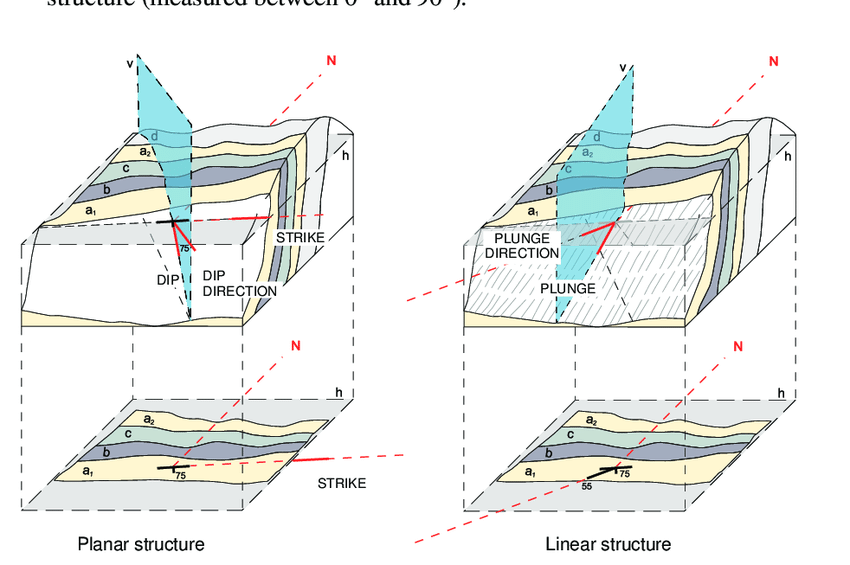
Key Differences in Planar and Linear Structures in Rocks
| Aspect | Planar Structures | Linear Structures |
|---|---|---|
| Definition | Two-dimensional structures, usually forming planes or surfaces. | One-dimensional structures forming lines or elongate features. |
| Examples | Bedding planes, foliations, schistosity, cleavage. | Mineral lineations, stretching lineations, fold axes. |
| Measurement | Measured by strike and dip. | Measured by trend (azimuth) and plunge (angle). |
| Occurrence | Associated with layers or sheets in rocks. | Associated with elongate features or alignments within rocks. |
| Formation Process | Results from compressional or tectonic stresses causing alignment of minerals or rock layers. | Results from stretching, elongation, or shear stresses. |
| Appearance | Planar and typically continuous over large areas. | Linear and can occur as discrete or penetrative alignments. |
| Common Analysis Tool | Strike-dip diagrams and stereonets for planes. | Trend-plunge diagrams and stereonets for lines. |
Genesis of Boudins
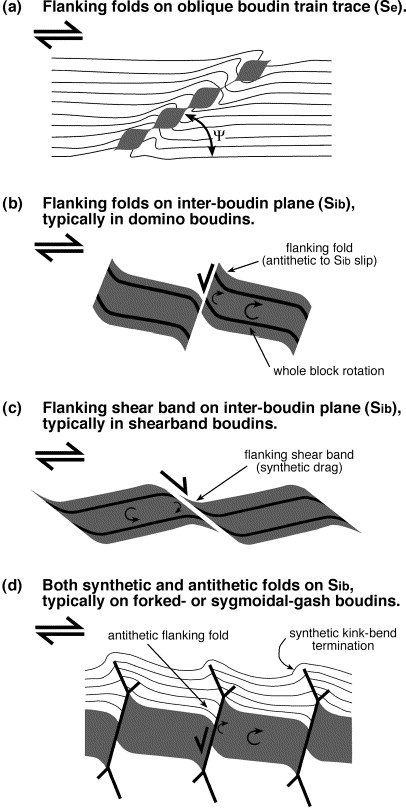
- Boudins are sausage-shaped structures formed when a competent rock layer is extended amidst less competent surroundings.
Formation Process
- Initial Stress Application:
- Boudins form due to extensional stress acting on competent rock layers, causing them to stretch and break apart.
- Material Behavior:
- Competent layers behave in a brittle manner, fracturing or thinning under stress.
- Surrounding less competent material deforms plastically or flows.
- Mechanisms of Formation:
- Planar Fracturing: The competent layer breaks into rectangular fragments.
- Necking: The competent layer thins in certain sections, forming elongate depressions and swells.
Strain Conditions
- Boudinage occurs when the X-axis (maximum stretch) of the strain ellipsoid significantly exceeds the Y-axis (perpendicular to extension).
Spatial Distribution
- Typically found on the limbs of folds, with their long axes oriented parallel to the fold axis.
Associated Structures
- Often co-exist with folds, indicating a combination of compressive (folding) and extensional (boudinage) forces.
- Fold hinges may show thickening, while fold limbs are boudinaged due to extension.
Importance
- Strain Analysis: Boudins are strain markers indicating extension.
- Geological Mapping: Help in understanding the stress history and deformation conditions of the rock.
Conclusion:
The genesis of boudins can be traced back to ancient times and has evolved over the centuries through French influence, colonial expansion, and modern adaptations. Today, boudins continue to be a beloved sausage enjoyed by people around the world. By studying the planar and linear structures of rocks, geologists can gain insights into the geological processes that have shaped the Earth's crust over millions of years. These structures provide valuable clues about the rock's history and the forces that have acted upon it.