
Give an account of the geology and the process of formation of aluminium mineral deposits of India. IAS 2024, 10 Marks
Give an account of the geology and the process of formation of aluminium mineral deposits of India. IAS 2024, 10 Marks

Introduction:
Aluminium mineral deposits in India are primarily found in the states of Odisha, Jharkhand, Chhattisgarh, and Maharashtra. These deposits are formed through a complex geological process involving the interaction of various elements and forces.
Geology and Formation of Aluminium Mineral Deposits in India
Introduction to Aluminium Deposits
- Abundance: Aluminium is the most abundant metal, constituting about 8.07% of the Earth's crust.
- Chief Source: Bauxite, a sedimentary rock with high aluminium content, is the primary source of aluminium.
- Forms of Bauxite: Commercial bauxite occurs as pisolites/oolites, porous sponge ore, or amorphous clay ore.
Mode of Formation
Aluminium deposits, primarily in the form of bauxite, are formed through processes like:
- Laterization:
- Occurs under tropical conditions with alternating wet and dry seasons.
- Leads to the removal of silica and the concentration of alumina.
- This results in the formation of laterite and eventually bauxite.
- Weathering:
- Chemical weathering of alumina-rich rocks like basalt and granite in situ.
- Silica is leached out, enriching aluminium oxides.
- Residual Concentration: Aluminium-rich minerals remain after extensive weathering of parent rocks.
- Transport and Deposition: Bauxite can also be transported from the source and deposited in nearby areas as pseudo-brecciated deposits or conglomerates.
Types of Deposits in India
- Blanket Deposits:
- Occur as caps on high plateaus or hills.
- Examples: Amarkantak (Madhya Pradesh), Kolhapur (Maharashtra), and Belgaum (Karnataka).
- Interstratified Deposits:
- Found in layers between Deccan traps and Tertiary sediments.
- Examples: Kutch and Saurashtra (Gujarat).
- Pocket Deposits:
- Found in funnel-shaped pockets over uneven surfaces of limestone.
- Examples: Saurashtra (Gujarat) and coastal areas of Maharashtra.
- Transported Deposits:
- Found near the source or far away as bauxite conglomerates and grits.
- Examples: Ratnagiri (Maharashtra).
Distribution of Aluminium Mineral Deposits in India
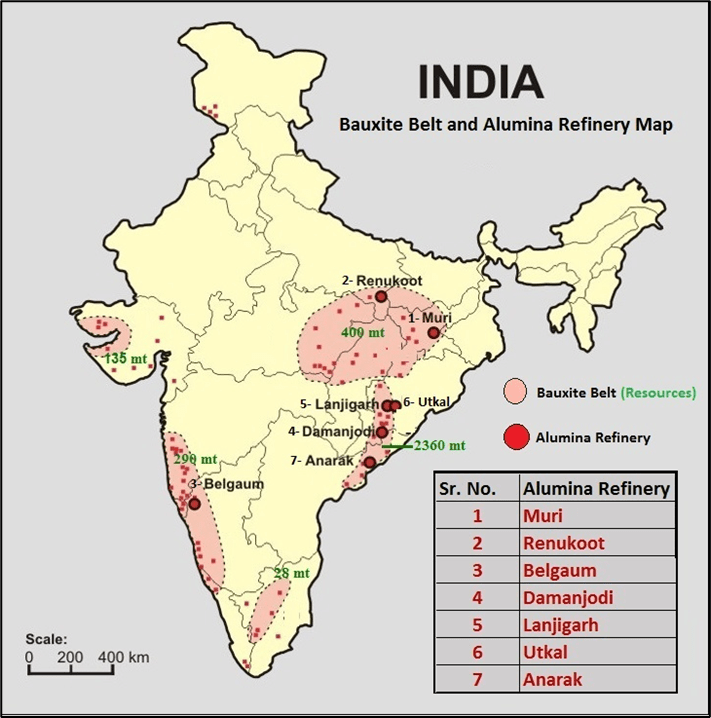
- Major States: Odisha (51% of India's resources), Andhra Pradesh, Gujarat, Jharkhand, Maharashtra, and Chhattisgarh.
- Regions:
- Eastern Ghats (Odisha and Andhra Pradesh) host significant deposits.
- Ranchi-Palamau belt (Jharkhand), overlying granite gneiss.
- Kolhapur and Ratnagiri (Maharashtra) overlying Deccan traps.
Economic Importance
- Industrial Use:
- Aluminium production.
- Refractory materials, abrasives, and chemical products.
- Mining Practices:
- Mechanized mining is common in larger deposits (e.g., Panchpatmali in Odisha).
- Semi-mechanized techniques are used in smaller pockets.
Conclusion:
The formation of aluminium mineral deposits in India is a complex process involving various geological forces and processes. Understanding the geology of these deposits is crucial for the exploration and extraction of aluminium resources in the country.