
Describe lithostratigraphic classification and shift of depositional environments during deposition of the Vindhyan Supergroup. Comment on the age of the Vindhyan succession. IAS 2024, 15 Marks
Describe lithostratigraphic classification and shift of depositional environments during deposition of the Vindhyan Supergroup. Comment on the age of the Vindhyan succession. IAS 2024, 15 Marks

Introduction:
The Vindhyan Supergroup is a sequence of sedimentary rocks that are found in central India and are estimated to be around 1.6 billion years old. The deposition of the Vindhyan Supergroup occurred over a long period of time and involved the shifting of depositional environments.
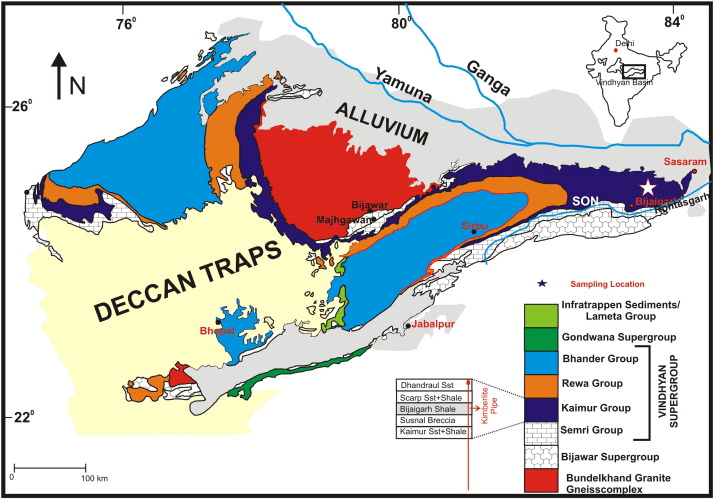
Lithostratigraphic Classification and Depositional Environment of the Vindhyan Supergroup
Lithostratigraphic Classification:
- Supergroup: Vindhyan Supergroup.
- Groups:
- Semri Group: Includes Kajrahat Limestone and Porcellanite Formation.
- Kaimur Group: Includes quartzites, shales, and conglomerates.
- Rewa Group: Consists of shales and sandstones.
- Bhander Group: Contains limestone, shale, and sandstone units.
- Lithological Units:
- Rocks range from sandstones and shales to limestones and dolomites.
- The succession includes numerous cycles of sedimentation.
Shift in Depositional Environments:
- The depositional environment of the Vindhyan Supergroup reflects a gradual shift:
- Semri Group: Initiated in shallow marine conditions, with limestone and shale deposition.
- Kaimur Group: Marked by the dominance of fluvial deposits (quartzites and conglomerates).
- Rewa and Bhander Groups: Transition to lacustrine and deltaic environments with shale and limestone deposition.
- The overall depositional sequence reflects progressive basin filling and episodic transgressions and regressions.
Age of the Vindhyan Succession
Estimated Age:
- The Vindhyan Supergroup is largely Proterozoic in age.
- The age range is broadly estimated to be 1,300 to 600 million years ago.
- This corresponds to the Late Mesoproterozoic to Neoproterozoic era.
Key Age Indicators:
- The Semri Group’s lower formations have been linked with volcanic activity (e.g., Gwalior Volcanics ~1,815 Ma).
- Detrital zircon dating from certain units suggests deposition started around 1,700–1,600 Ma.
- Microbial fossils found within the Vindhyan rocks provide further evidence of its Neoproterozoic timeline.
Significance:
- The Vindhyan succession serves as a reference for understanding Proterozoic basinal evolution in India.
- It contains economically significant minerals like limestone, red sandstone, and diamondiferous units.
Conclusion:
The lithostratigraphic classification of the Vindhyan Supergroup provides valuable insights into the geological history of central India and the shift of depositional environments during its deposition. By studying these rocks, geologists can better understand the processes that shaped the landscape of the region over billions of years.