
Define dip of a rock bed. What is true dip and apparent dip? Find the strike direction of a bed which dips 30°; towards North 30" East. IAS 2024, 10 Marks
Define dip of a rock bed. What is true dip and apparent dip? Find the strike direction of a bed which dips 30°; towards North 30" East. IAS 2024, 10 Marks

Dip of a Rock Bed
- Meaning:
- Dip is the angle between a rock layer's bedding plane and a horizontal plane, measured on a vertical plane perpendicular to the strike.
- It indicates the steepest angle of descent of the inclined plane relative to the horizontal plane.
- Significance: Indicates the orientation and degree of inclination, crucial for structural geology and mapping
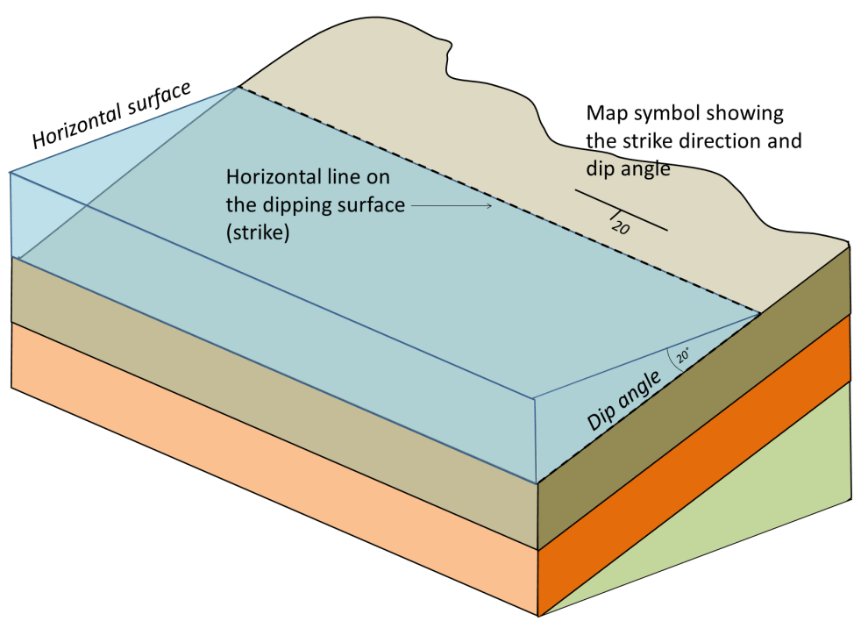
What is True Dip and Apparent Dip?
- True Dip:
- The maximum inclination of a rock bed or layer.
- It is measured perpendicular to the strike direction of the bed.
- Provides the exact steepness of the bed's slope.
- Apparent Dip:
- The inclination of the rock bed measured in any direction other than the true dip.
- Apparent dips are always less than or equal to the true dip.
Finding the Strike Direction
- Given Data:
- Dip: 30°
- Direction of dip: North 30° East
- Strike Direction:
- The strike is perpendicular to the dip direction.
- For a dip of North 30° East, the strike will be along the azimuthal directions North 60° West to South 60° East.
Conclusion:
- The dip of a rock bed is a key parameter for understanding geological processes and interpreting the Earth's structural history.
- Its precise measurement and analysis are indispensable for both academic studies and practical applications in geology, engineering, and resource management.