
How does one define "Double refraction" and "Birefringence" of an anisotropic mineral? Write with the help of suitable sketches. IAS 2024, 10 Marks
How does one define "Double refraction" and "Birefringence" of an anisotropic mineral? Write with the help of suitable sketches. IAS 2024, 10 Marks

Introduction:
Anisotropic minerals are minerals that exhibit different optical properties in different crystallographic directions. Two important optical properties of anisotropic minerals are double refraction and birefringence.
Double Refraction and Birefringence in Anisotropic Minerals
1. Double Refraction
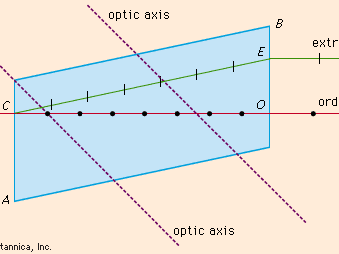
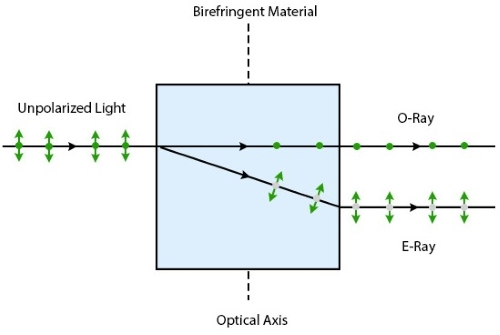
- Double refraction, also known as birefringence, is a phenomenon in anisotropic minerals where a single ray of unpolarized light splits into two separate rays upon entering the mineral.
- Explanation:
- The splitting occurs due to the mineral's internal structure, where the speed of light varies along different crystallographic directions.
- The two rays are:
- Ordinary Ray (O-ray): Travels with a constant velocity irrespective of direction.
- Extraordinary Ray (E-ray): Travels with varying velocity depending on its path through the crystal.
- Examples: Calcite is a classic example of a mineral exhibiting strong double refraction.
2. Birefringence
- Birefringence is the numerical difference between the refractive indices of the ordinary and extraordinary rays in an anisotropic mineral.
- Formula:
- Δn=ne−no
- Where ne is the refractive index of the extraordinary ray and non_ono is that of the ordinary ray.
- Explanation:
- It quantifies the optical anisotropy of the mineral.
- High birefringence leads to strong interference colors observed under a polarizing microscope.
- Practical Use:
- Birefringence is critical in identifying minerals using optical techniques in thin sections.
Key Points in Optical Mineralogy:
- Anisotropy: Minerals with anisotropic properties (non-cubic systems) show birefringence and double refraction.
- Optical Indicatrix: The geometrical representation of light velocities in a mineral aids in understanding birefringence.
- Applications:
- Used in mineral identification.
- Helps determine optical properties like extinction angle and optic sign (positive or negative).
Conclusion:
Double refraction and birefringence are important optical properties of anisotropic minerals that result from the different refractive indices in different crystallographic directions. These properties are key in identifying and studying anisotropic minerals in geology and mineralogy.