
Write in brief about the method(s) of ingestion, digestion of food and excretion of wastes in Paramaecium. (IFS 2019/8 Marks)
Write in brief about the method(s) of ingestion, digestion of food and excretion of wastes in Paramaecium. (IFS 2019/8 Marks)

Introduction
Paramaecium is a unicellular organism belonging to the phylum Ciliophora. It is a ciliated protozoan that exhibits specific methods of ingestion, digestion of food, and excretion of wastes.
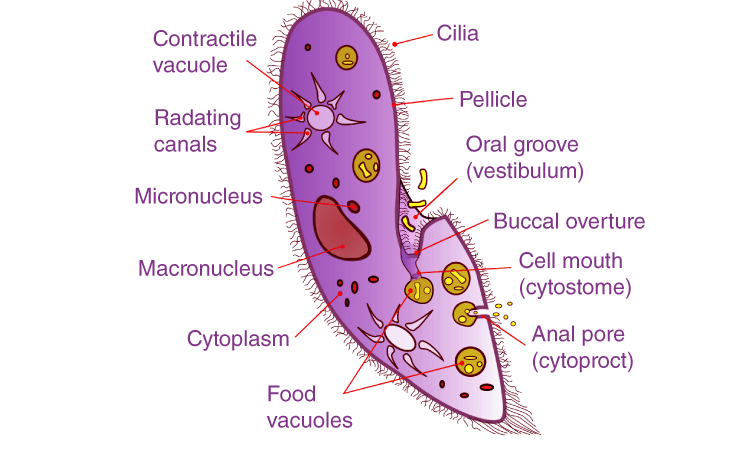
Ingestion of Food:
- Ciliary Action:
- Paramecium utilizes its numerous cilia (tiny hair-like structures) to create water currents, drawing food particles into the oral groove.
- The food particles primarily consist of bacteria, algae, and organic debris.
- Oral Groove:
- The oral groove is a specialized structure that funnels food particles toward the cell mouth (cytostome).
- Food is trapped in the oral groove by the cilia's movement.
Digestion of Food:
- Phagocytosis:
- Once the food particles are directed to the cytostome, they are engulfed through phagocytosis, forming a food vacuole.
- This vacuole then merges with lysosomes containing digestive enzymes.
- Intracellular Digestion:
- Digestive enzymes break down the food particles within the food vacuole.
- Nutrients are absorbed through the vacuole membrane into the cytoplasm, providing energy and growth materials for the organism.
Excretion of Wastes:
- Waste Vacuoles:
- After digestion, indigestible waste remains in the food vacuole, forming a waste vacuole.
- This vacuole moves towards the cell membrane for excretion.
- Exocytosis:
- The waste vacuole fuses with the cell membrane, releasing the indigestible materials outside the cell.
- This process ensures that Paramecium efficiently removes waste without disrupting cellular processes.
Examples:
- Bacterial Feeding: In natural environments, Paramecium consumes bacteria, playing a vital role in nutrient cycling and controlling bacterial populations.
- Algal Feeding: When feeding on algae, Paramecium contributes to the balance of aquatic ecosystems by regulating algal growth.
- Environmental Indicator: Due to its sensitivity to pollution, Paramecium can serve as an indicator species for assessing water quality in freshwater habitats.
Conclusion
Paramaecium exhibits specific methods of ingestion, digestion of food, and excretion of wastes that are essential for its survival and growth. The organism utilizes phagocytosis for ingesting food, digestion primarily occurs within food vacuoles with the help of lysosomes, and wastes are excreted through the contractile vacuole.