
Describe the structure and phylogenetic significance of Trochophore larva. (IFS 2022/10 Marks)
Describe the structure and phylogenetic significance of Trochophore larva. (IFS 2022/10 Marks)

Introduction:
The Trochophore larva is a type of larval stage found in some marine invertebrates, particularly within the phylum Mollusca and Annelida. This larval stage plays a significant role in the development and evolution of these organisms.
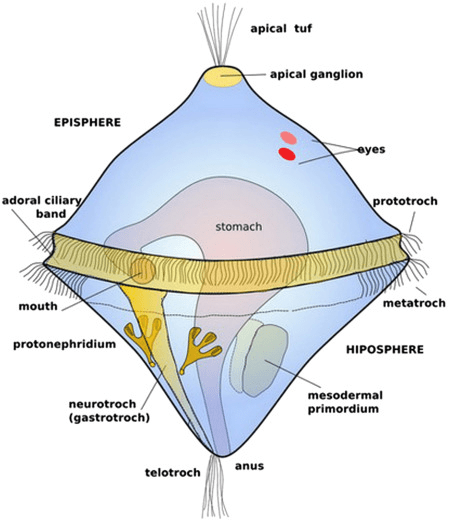
Structure of Trochophore Larva:
- Body Shape and Size
- Small, ciliated, free-swimming larval form with a pear or top-like shape.
- Typically, the size ranges from 50 to 300 micrometers, making it easily mobile in aquatic environments.
- Prototroch and Apical Tuft
- A distinct band of cilia, the prototroch, encircles the body, allowing for locomotion.
- The apical tuft is a group of longer cilia on the anterior end, aiding in sensory functions and feeding.
- Digestive System
- Simple, with a central mouth, stomach, and anus arranged along a straight axis.
- Helps in digesting plankton and small organic particles in the water.
- Mesoderm and Blastocoel
- Trochophore contains a coelomic cavity called the blastocoel and lacks a true body cavity at this stage.
- Mesodermal cells are present, which will later develop into complex tissues in the adult form.
- Sense Organs
- Contains a statocyst or balance organ that aids in orientation in the water.
- Also includes a pair of eyespots that help in light perception, important for surface navigation.
- Metatroch and Additional Ciliary Bands
- Ciliary bands (metatroch and telotroch) may develop, aiding in efficient movement and distribution of water currents around the larva.
- These ciliary bands help the larva remain suspended in the water column, aiding dispersal.
Phylogenetic Significance of Trochophore Larva:
- Ancestral Characteristics
- Trochophore larvae display ancestral traits common in the evolution of marine invertebrates.
- Suggests a common evolutionary origin for groups like Annelida and Mollusca, supporting the concept of a shared lineage.
- Link to Lophotrochozoa
- Key characteristic of Lophotrochozoa, a major clade within protostomes.
- Highlights a significant evolutionary divergence from other larval types, such as the nauplius in arthropods.
- Evolutionary Adaptation
- Its simple structure and swimming adaptations illustrate an early evolutionary solution to larval dispersal.
- Shows evolutionary significance in how early life forms adapted to marine environments for survival.
- Evidence for Homology
- Presence of similar ciliary bands and feeding structures across related species points to homology.
- Reinforces phylogenetic links and structural similarities between mollusks, annelids, and other related groups.
- Developmental Studies
- Provides insights into developmental processes shared by multiple phyla, such as coelom formation and segmentation.
- Contributes to the understanding of developmental genes and pathways conserved across species.
- Evolution of Complexity
- Trochophore larva represents an early stage in the evolution of complex life cycles in marine invertebrates.
- Indicates the evolutionary pathway from simple ciliated larval forms to more complex adult morphologies, aiding in reconstructing the evolutionary history of metazoans.
Conclusion:
The Trochophore larva is a key developmental stage in the life cycle of many marine invertebrates, providing valuable insights into their evolutionary history and phylogenetic relationships. Its unique structure and characteristics have played a significant role in shaping the diversity and adaptation of these organisms in the marine environment.