
Make a diagrammatic presentation of Krebs' cycle. (IAS 2019/15 Marks)
Make a diagrammatic presentation of Krebs' cycle. (IAS 2019/15 Marks)

Introduction
Krebs' cycle, also known as the citric acid cycle, is a series of chemical reactions that occur in the mitochondria of eukaryotic cells. It is a crucial part of cellular respiration, where energy is generated by breaking down carbohydrates, fats, and proteins.
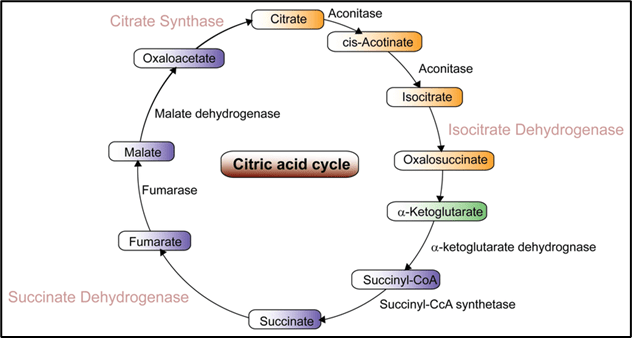
Steps of the Krebs Cycle
- Formation of Citrate
- Acetyl-CoA (2 carbons) combines with oxaloacetate (4 carbons) to form citrate (6 carbons).
- Enzyme: Citrate synthase
- Zoological Significance: Formation of citrate initiates the cycle; citrate can also be used to synthesize fatty acids, important in animal energy storage.
- Conversion of Citrate to Isocitrate
- Citrate undergoes isomerization to form isocitrate.
- Enzyme: Aconitase
- Mechanism: Water is removed and added back, rearranging the molecule.
- Importance: This rearrangement sets up the molecule for subsequent oxidative reactions, crucial in energy transfer.
- Oxidative Decarboxylation of Isocitrate
- Isocitrate is oxidized to α-ketoglutarate, releasing CO₂ and reducing NAD⁺ to NADH.
- Enzyme: Isocitrate dehydrogenase
- Zoological Insight: NADH produced here will enter the electron transport chain, a significant step in ATP production for cellular activities.
- Conversion of α-Ketoglutarate to Succinyl-CoA
- α-Ketoglutarate undergoes decarboxylation, producing succinyl-CoA and releasing CO₂.
- Enzyme: α-Ketoglutarate dehydrogenase complex
- Energy Yield: Another NADH molecule is produced.
- Zoological Relevance: The CO₂ released is a waste product of metabolism in animals and is expelled through respiratory mechanisms.
- Conversion of Succinyl-CoA to Succinate
- Succinyl-CoA is converted to succinate, releasing CoA and generating GTP (or ATP).
- Enzyme: Succinyl-CoA synthetase
- Energy Significance: GTP generated here can be used directly or converted to ATP.
- Zoological Aspect: ATP production in muscle cells enables movement and various cellular processes in animals.
- Oxidation of Succinate to Fumarate
- Succinate is oxidized to fumarate, reducing FAD to FADH₂.
- Enzyme: Succinate dehydrogenase
- Electron Carriers: FADH₂ is formed, which later contributes electrons to the electron transport chain.
- Importance in Zoology: This step is essential for energy production, as FADH₂ will help drive ATP synthesis, especially relevant in high-energy-demand cells like muscle cells.
- Conversion of Fumarate to Malate
- Fumarate is hydrated to form malate.
- Enzyme: Fumarase
- Mechanism: Addition of a water molecule.
- Relevance: Preparation for the final oxidation step, which completes the cycle.
- Oxidation of Malate to Oxaloacetate
- Malate is oxidized to regenerate oxaloacetate, reducing NAD⁺ to NADH.
- Enzyme: Malate dehydrogenase
- Zoological Insight: The regeneration of oxaloacetate allows the cycle to continue, ensuring sustained ATP production in animals.
Conclusion
The Krebs' cycle is a fundamental process in cellular respiration, playing a vital role in generating energy for the cell. By breaking down molecules such as glucose, fats, and proteins, the cycle produces ATP, which is the primary energy currency of the cell.