
Define immunity. Explain cell-mediated immune response in vertebrates with suitable diagram. (IAS 2022/10 Marks)
Define immunity. Explain cell-mediated immune response in vertebrates with suitable diagram. (IAS 2022/10 Marks)

Introduction:
Immunity is the ability of an organism to resist or defend against harmful pathogens or foreign substances. In vertebrates, immunity is achieved through a complex system known as the immune response.
Immunity
- Immunity refers to the ability of an organism to resist or eliminate potentially harmful foreign invaders or abnormal cells, ensuring the protection of the body from diseases.
- Types of Immunity:
- Innate Immunity:
- Present from birth.
- Provides non-specific defense against pathogens.
- Includes physical barriers (e.g., skin) and cellular responses (e.g., phagocytes).
- Acquired Immunity:
- Developed after exposure to antigens.
- Provides specific defense and has memory for quicker response upon re-exposure.
- Divided into humoral immunity (antibody-mediated) and cell-mediated immunity.
- Innate Immunity:
Cell-Mediated Immune Response in Vertebrates
The cell-mediated immune response (CMIR) involves T-lymphocytes (T-cells) targeting and eliminating intracellular pathogens, cancer cells, or transplanted tissues.
Key Components of CMIR
- T-Lymphocytes:
- Mature in the thymus.
- Recognize antigens presented by infected cells or antigen-presenting cells (APCs).
- Include helper T-cells (CD4+) and cytotoxic T-cells (CD8+).
- Antigen-Presenting Cells (APCs):
- Include dendritic cells, macrophages, and B-cells.
- Process and present antigens to T-cells via MHC molecules.
- Major Histocompatibility Complex (MHC):
- Class I MHC presents antigens to CD8+ T-cells (cytotoxic).
- Class II MHC presents antigens to CD4+ T-cells (helper).
Steps in CMIR
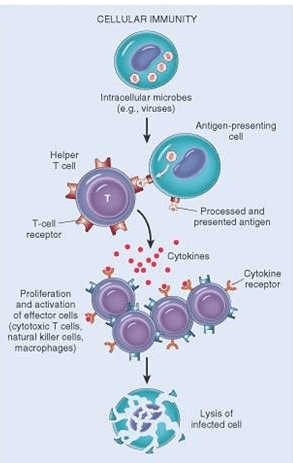
- Antigen Presentation:
- APCs capture and present the antigen using MHC molecules.
- T-Cell Activation:
- Helper T-cells (CD4+) are activated by Class II MHC molecules and release cytokines.
- Cytotoxic T-cells (CD8+) are activated by Class I MHC molecules.
- Effector Phase: Cytotoxic T-cells destroy infected or abnormal cells through perforins and granzymes, leading to apoptosis.
- Regulation and Memory Formation:
- Regulatory T-cells modulate the immune response to prevent overactivation.
- Memory T-cells ensure a faster response upon future exposure to the same antigen.
Diagram: Cell-Mediated Immune Response
Conclusion:
The cell-mediated immune response in vertebrates plays a crucial role in defending against pathogens and maintaining overall health. By understanding the mechanisms involved in this process, researchers can develop new strategies for enhancing immune responses and combating infectious diseases.