
SOIL PROFILE AND HORIZONS | Biogeography Optional for UPSC
SOIL PROFILE AND HORIZONS | Biogeography Optional for UPSC

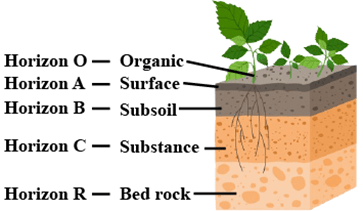
- A soil profile is a vertical cross-section of the soil, made of layers running parallel to the surface, known as soil horizons.
- The soil profile extends from the soil surface to the parent rock material.
- Soil consists of three horizontal layers: top soil (A and E horizons), sub soil (B horizon), and bedrock (C and D horizons).
Thinkers’ Perspective
- Soil develops through a series of changes. The starting point is weathering of freshly accumulated parent material. Its culmination is seen in the development of complete soil profile with well stratified horizons.” – Hans Jenny (1994) in his “Factors of soil formation: a system of quantitative pedology”
“Alterations within the soils due to biogeochemical processes lead to the development of soil horizons. These horizons are distinguished by differences in color, structure, texture, and chemistry.” – Stanley and Southard in “Soil genesis and classification” (2011).
Characteristics
- There is gradual decrease of organic matter with increasing depth.
- The level of aeration of soil decreases downwards.
- There is increase in the concentration of parent minerals downward.
- Soil structure is pronounced upwards.
- There is no definite trend of either increase or decrease in the content of soil water. It is determined by following:
- (i) the location of groundwater,
- (ii) nature of movement of groundwater,
- (iii) frequency and amount of rainfall,
- (iv) absorptive characteristics of different horizons.
Regolith
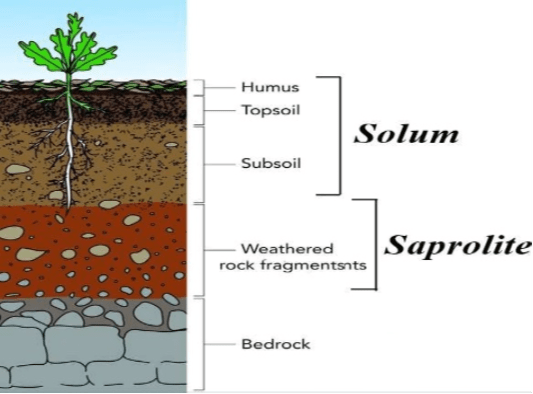
- It includes all the weathered material within the profile.
- It has two components: the solum and the saprolite.
- Solum includes the upper horizons with the most weathered portion of the profile.
- Saprolite is the least weathered portion that lies directly above the bedrock but beneath the regolith.
Soil Horizons
- A soil horizon is a layer generally parallel to the soil surface. The layer differs in texture, colour, depth, and chemical composition.
- A soil horizon is a result of soil-forming processes (pedogenesis). Layers that have not undergone such processes may be simply called "layers".
- In most soil classification systems, horizons are used to define soil types.
- The German system uses entire horizon sequences for definition.
- Other systems pick out certain horizons, known as the "diagnostic horizons" for the definition. Examples are the World Reference Base for Soil Resources (WRB), USDA soil taxonomy and the Australian Soil Classification.
- Horizons develop through interactions among climate, living organisms, and the land surface, over time.
- Horizons are formed by internal processes like leaching or capillary movements, or upward movements of materials and water.
- Horizons usually develop either by selective removal or accumulation of certain ions and chemical compounds.
- Sometimes the boundaries of a horizon are clearly observable and well defined. But sometimes the changes are so slow and gradual that the boundaries are not well marked.
Type of Horizons
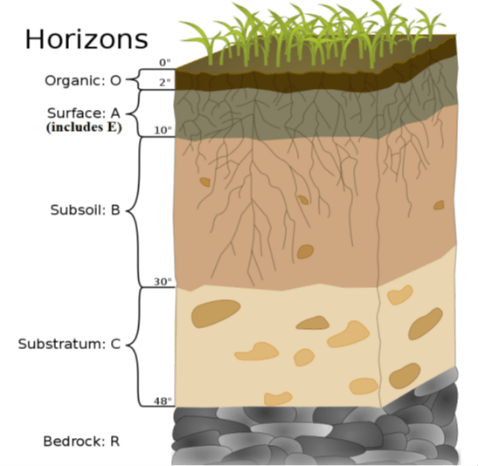
- There are two types of soil horizons: organic and mineral.
- Organic horizons (O Horizons): It lies over mineral horizons. These layers are formed due to accumulation of organic matter.
- Mineral horizons contain inorganic minerals of two types: (i) skeletal minerals (e.g., quartz), and clay minerals. There are four main mineral horizons: A, E, B, C
O Horizon
- It is dominated by organic material.
- Some O layers consist of undecomposed or partially decomposed litter. E.g. leaves, mosses, and lichens.
- The upper O1 horizon or Oi horizon contains decomposing organic matter that is easily recognize by eyes. Eg. leaves or twigs.
- O1 consists of original form of vegetative matter as fresh litter and partly decomposed litter. O1 is also called as litter layer. It is designated by letter L for fresh litter and letter F for partly decomposed litter.
- The lower O2 horizon or Oa horizon contains humus, which is decomposed to the extent that cannot be recognised by eyes. the process of humus formation is culled humification.
A Horizon or Top soil A
- In this layer, organic matter is mixed with mineral matter. Nutrients like iron, aluminium, clay, and organic matter may be dissolved.
- It has a pronounced soil structure. But in some soils, clay minerals, iron, aluminium, organic compounds, and other constituents are soluble and move downwards (eluviation).
- The A horizon may also be the result of soil bioturbation and surface processes that winnow fine particles from topsoil. In this case, the A horizon is regarded as a "biomantle".
- Dark colours show rich in organic matter. Light colour shows the leached materials.
- When eluviation is pronounced in A horizon, a lighter coloured E subsurface soil horizon is apparent at its base.
E horizon
- When eluviation is pronounced in A horizon, a lighter coloured E subsurface soil horizon is apparent at its base.
- “E” stands for eluviated layer. It is also part of the top soil.
- These are present only in older and well-developed soils. These generally occur between the A and B horizons.
B Horizon (Subsoil
- This horizon reflects chemical or physical alteration of the parent material.
- This layer accumulates all the leached minerals from the A and E horizon. this process is known as illuviation (opposite of eluviation).
- The properties of A and B horizons vary from one soil type to the other, and from one climatic to the other.
C Horizon or Parent rock Substratum
- This horizon represents weathered parent materials (regoliths). These are unconsolidated or weakly consolidated.
- This horizon is also called subsurface horizon. It retains the characteristics of the structure of the basal parent rocks. This is also called as glay layer.
- It is a zone of no humus accumulation or less soil structure development. This layer may accumulate soluble compounds (inorganic material).
D or R Horizon or Bedrock
- It denotes the layer at the base of the soil profile.
- Unlike the above layers, R horizons largely comprise continuous masses of hard rock.
- Soils formed in situ will exhibit strong similarities to this bedrock layer.
Variations within the Horizons
There are variations within a single horizon. Lowercase letters are added to the capital letters to reveal special unique properties. Eg.
- b: buried horizon
- f: frozen soil
- g: mottled due to gleying (e.g. Ag. E.g., or Cg)
- h: accumulation of humus (e.g., Ah or Bh)
- ir: accumulation of iron (Bir or iron pan)
- hir: accumulation of humus and iron
- p: horizon disturbed by ploughing (e.g., Ap)
- si: accumulation of silica (e.g., Bsi)
- t: accumulation of translocated clay (e.g. Bt)
- x: brittle layer (fragipan)
Significance
- The study of the soil profile is significant in agriculture sciences.
- Land capability classification is based on the study of soil profile & horizon.