
FACTORS INFLUENCING WORLD DISTRIBUTION OF PLANTS AND ANIMALS | Biogeography Optional for UPSC
FACTORS INFLUENCING WORLD DISTRIBUTION OF PLANTS AND ANIMALS | Biogeography Optional for UPSC

Introduction
- The world is home to a wide variety of plants and animals, each with its own unique distribution patterns.
- Factors such as climate, geography, and human influence play a significant role in shaping the distribution of plants and animals.
Distribution of Plants
A. Terrestrial Plants
1. Tropical Rainforests
- Found near the equator, primarily in South America, Central Africa, and Southeast Asia.
- High rainfall, warm temperatures, and abundant sunlight support diverse plant species.
2. Temperate Deciduous Forests
- Found in temperate regions such as North America, Europe, and East Asia.
- Characterized by trees that shed their leaves in the fall and regrow them in spring.
3. Coniferous Forests
- Found in northern latitudes, including Canada, Russia, and Scandinavia.
- Dominated by evergreen trees such as pine, spruce, and fir.
4. Deserts
- Found in arid regions like the Sahara, Arabian, and Mojave deserts.
- Adapted to survive with limited water availability and extreme temperature fluctuations.
5. Grasslands
- Found in both tropical and temperate regions, including the African savannah and the Great Plains of North America.
- Dominated by grasses and herbaceous plants, with fewer trees.
B. Aquatic Plants
1. Coral Reefs
- Found in warm, shallow waters in tropical regions, such as the Great Barrier Reef in Australia.
- Home to diverse marine plant species and provide habitats for numerous marine animals.
2. Seagrass Meadows
- Found along coastlines and in shallow, brackish waters worldwide.
- Crucial for coastal ecosystems, providing food and shelter for various marine organisms.
3. Kelp Forests
- Found in cold, nutrient-rich waters along temperate coastlines, such as the Pacific coast of North America.
- Large brown algae form towering underwater forests, supporting a range of marine life.
Distribution of Animals
A. Terrestrial Animals
1. Savanna Animals
- Found in tropical grasslands of Africa, South America, and Australia.
- Iconic species include lions, elephants, zebras, and giraffes.
2. Arctic and Antarctic Animals
- Found in the polar regions of the Arctic and Antarctica.
- Adapted to extreme cold conditions, including polar bears, penguins, and seals.
3. Desert Animals
- Found in desert regions globally, such as the Sahara, Gobi, and Mojave deserts.
- Species have adaptations to withstand high temperatures and scarcity of water.
4. Forest Animals
- Found in various forest types worldwide, including tropical rainforests and temperate deciduous forests.
- Examples include tigers, orangutans, deer, and squirrels.
B. Aquatic Animals
1. Marine Animals
- Found in oceans and seas across the globe.
- Include a vast range of species such as fish, whales, dolphins, sharks, and marine invertebrates.
2. Freshwater Animals
- Found in rivers, lakes, and other freshwater ecosystems.
- Examples include trout, salmon, crocodiles, frogs, and various species of aquatic insects.
3. Coral Reef Animals
- Found in coral reef ecosystems, primarily in tropical waters.
- Home to diverse marine life, including colorful fish, coral polyps, and sea turtles.
Thinkers Perspectives
1. Environmental Factors:
A. Climate and Weather:
- Alexander von Humboldt: Emphasized the role of temperature, rainfall, and climate zones in shaping the distribution of plants and animals.
- Alfred Russel Wallace: Studied the influence of temperature and rainfall on the distribution of species, proposing the concept of biogeographic regions.
B. Topography and Landforms:
- Carl Ritter: Landforms have a major role in creating barriers and facilitating or obstructing species distribution.
- Ellen Churchill Semple: Physical geography has a major role on the distribution of organisms.
C. Soil and Geology:
- Vasily Dokuchaev: Soil composition and geology determines the types of plants that can thrive in certain regions.
- Davis and Penck: Developed theories on geomorphology and identified how soil characteristics affect vegetation distribution.
2. Biological Factors:
A. Adaptation and Evolution:
- Charles Darwin: Proposed the theory of natural selection, highlighting how species adapt to their environments over time and how this shapes their distribution.
- Jared Diamond: Evolutionary history influences species' ability to disperse and colonize different regions.
B. Interactions and Ecological Relationships:
- Alexander von Humboldt: Interactions between species influence their distribution patterns.
- Carl Troll: Ecological interactions affect the distribution of plant species.
3. Human Factors:
A. Migration and Human Activities:
- Friedrich Ratzel: Emphasized the role of human migration and cultural activities in dispersing plants and animals across the globe.
- Jared Diamond: Human activities, such as agriculture, hunting, and deforestation, impact the distribution and extinction of species.
B. Political and Economic Factors:
- Halford Mackinder: Political boundaries and economic activities, impacts the distribution of plants and animals.
- Ellen Churchill Semple: Economic pursuits and resource exploitation affect the distribution of flora and fauna.
Theories
The distribution of species has been explained by several theories, including:
1. Continental Drift Theory:
- This theory suggests that the continents were once connected and have since drifted apart over time.
- The movement of land masses allowed species to migrate and colonize different regions.
2. Darwin's Theory of Evolution:
- Darwin's theory proposes that species evolve and adapt to their environments over generations through natural selection.
- This adaptation plays a crucial role in the distribution of species across different habitats.
3. Plate Tectonic Theory:
- This theory explains the movement and interaction of the Earth's lithospheric plates.
- The shifting of these plates over millions of years affects the geographic arrangement of continents and oceans, influencing species distribution.
4. Climate Theory:
- The theory of climate emphasizes the impact of climate conditions on the distribution of species.
- Different climates create varying habitats, which can determine the presence or absence of specific species in particular regions.
These theories have contributed to our understanding of how species came to be distributed across the Earth.
Distribution factors
1. Climatic Factors:
- Temperature variations: Different species have varying temperature tolerances and are adapted to thrive in specific temperature ranges. For instance, tropical rainforests have a high diversity of plant and animal species due to their warm and consistent temperatures.
- Rainfall patterns: Availability of water through rainfall affects the distribution of plants and animals. Some species can withstand arid conditions, while others require high rainfall. For example, cacti are adapted to survive in desert regions with minimal rainfall.
- Humidity levels: Certain species require specific humidity levels to survive and reproduce. Tropical rainforests, with their high humidity, support a wide range of plant and animal life, including epiphytes and amphibians.
- Seasonal changes: Seasonal variations, such as winter or dry seasons, can impact the distribution of species. Some animals hibernate or migrate to escape harsh conditions, while others adapt to survive in cold or dry environments.
2. Geological Factors:
- Soil types and fertility: Different soil compositions and fertility levels affect plant growth and determine the suitability of habitats for specific species. For example, acidic soils favor heathland vegetation, while fertile soils support lush forests.
- Topography: Variation in landforms influences the distribution of plants and animals. Mountains can create diverse ecosystems with distinct microclimates and habitats. Coastal areas provide unique habitats for marine life and coastal plant species.
- Geological formations: Features like mountains, rivers, and lakes affect the distribution of species by creating physical barriers or providing habitats. For instance, rivers may act as barriers for certain aquatic species, leading to the development of distinct populations.
3. Biological Factors:
- Availability of food sources: The presence and abundance of food sources determine the suitability of an area for particular species. Herbivores are limited to areas with sufficient vegetation, while predators require a sufficient prey base.
- Interactions with other species: Species interactions such as predation, competition, and symbiosis play a crucial role in determining distribution. For instance, the presence of prey species influences the distribution of predators, and certain plants rely on specific pollinators for reproduction.
- Reproduction and breeding requirements: The availability of suitable mating partners, nesting sites, and breeding habitats influences the distribution of species. Some animals migrate long distances to find suitable breeding grounds, such as sea turtles returning to specific beaches to lay their eggs.
4. Historical Factors:
- Geological history: Past geological events, such as continental drift, have shaped the distribution of species. For example, the separation of continents led to the development of distinct faunas in different regions.
- Evolutionary history: The evolutionary processes of speciation and extinction have influenced the current distribution of species. Endemic species, found only in specific regions, often reflect historical evolutionary events.
- Migration and dispersal patterns: Historical migration and dispersal of species have resulted in the spread of organisms to new areas. Examples include the colonization of remote islands by birds or the dispersal of seeds by wind or animals.
5. Anthropogenic Factors:
- Human activities: Activities such as deforestation, urbanization, and agriculture have significantly impacted the distribution of plants and animals. For instance, deforestation in the Amazon rainforest has led to habitat loss and the displacement of numerous species.
- Introduction of invasive species: Human-mediated introduction of non-native species can disrupt native ecosystems and impact the distribution of indigenous species. For example, the introduction of the cane toad in Australia has had detrimental effects on native wildlife.
- Pollution and environmental degradation: Pollution and environmental changes caused by human activities can alter habitats and affect the survival of species. Pollution in water bodies, for instance, can lead to declines in aquatic species.
6. Biogeographical Factors:
- Continental drift and plate tectonics: The movement of continents over time has shaped the distribution of species by creating barriers and connections between land masses. This process has contributed to the unique biotas found on different continents.
- Barrier effects: Physical barriers such as oceans, mountain ranges, or deserts can limit the movement of species and result in distinct distribution patterns. For example, the Andes Mountains have contributed to the development of different ecosystems on either side.
- Land bridges and connections: Land bridges or temporary connections between landmasses can facilitate the migration and dispersal of species. For instance, the formation of the Isthmus of Panama allowed the exchange of species between North and South America.
7. Ecological Factors:
- Ecosystem characteristics: Different ecosystems support specific types of plants and animals due to variations in factors like climate, soil, and vegetation. Examples include tropical rainforests, savannas, and coral reefs, each with unique species assemblages.
- Ecological niches and adaptations: Species have evolved to occupy specific ecological niches and have adapted to specific environmental conditions. Darwin's finches in the Galápagos Islands exhibit different beak shapes based on their specialized diets.
- Biotic interactions: Interactions between organisms, such as predation, competition, and mutualism, influence their distribution. For instance, predators may concentrate in areas abundant with prey, shaping their distribution patterns.
8. Physical Factors:
- Altitude and elevation: Changes in elevation lead to variations in temperature, precipitation, and vegetation types, resulting in different species distributions. Mountain ranges often host diverse ecosystems due to altitude gradients.
- Water availability: The presence of water bodies, such as rivers, lakes, and oceans, affects the distribution of aquatic and riparian species. Coastal areas support unique marine ecosystems.
- Sunlight intensity and photoperiod: Sunlight availability and its seasonal variations influence plant growth and the distribution of species. Different plants have adapted to specific light requirements, leading to variations in their distribution patterns.
9. Dispersal Mechanisms:
- Wind dispersal: Some plants and organisms have adaptations for dispersal through wind, such as lightweight seeds or spores. Dandelion seeds, for example, are designed for wind dispersal.
- Water dispersal: Aquatic organisms and certain plant species have adaptations to disperse through water, utilizing currents or floating mechanisms. Coconut palms spread across islands through water dispersal of their large seeds.
- Animal dispersal: Animals, including birds, mammals, and insects, can carry seeds or spores to new areas, aiding in dispersal. Birds feeding on berries, for instance, can spread seeds through their droppings.
10. Connectivity and Isolation:
- Connectivity between habitats: The presence of corridors or connections between habitats allows for the movement and exchange of species. Wildlife corridors in fragmented landscapes enable species to traverse otherwise isolated areas.
- Isolation caused by barriers or distance: Physical barriers, long distances, or habitat fragmentation can isolate populations, leading to distinct distribution patterns. Islands, for instance, often have unique species compositions due to their isolation.
- Corridors and pathways for migration and gene flow: Natural or human-created corridors provide pathways for migration and gene flow, allowing for the exchange of genetic material between populations. Animal migration routes, such as the Serengeti wildebeest migration, illustrate this phenomenon.
Floristic Kingdoms
Introduction
- Floristic kingdoms are large geographical regions with distinct plant species compositions.
- These refer to the major botanical regions of the world that are characterized by distinctive plant species compositions.
- They provide a systematic classification of the world's flora based on evolutionary and biogeographic patterns.
- These kingdoms are defined based on factors such as climate, geology, and evolutionary history.
Major Floristic Kingdoms

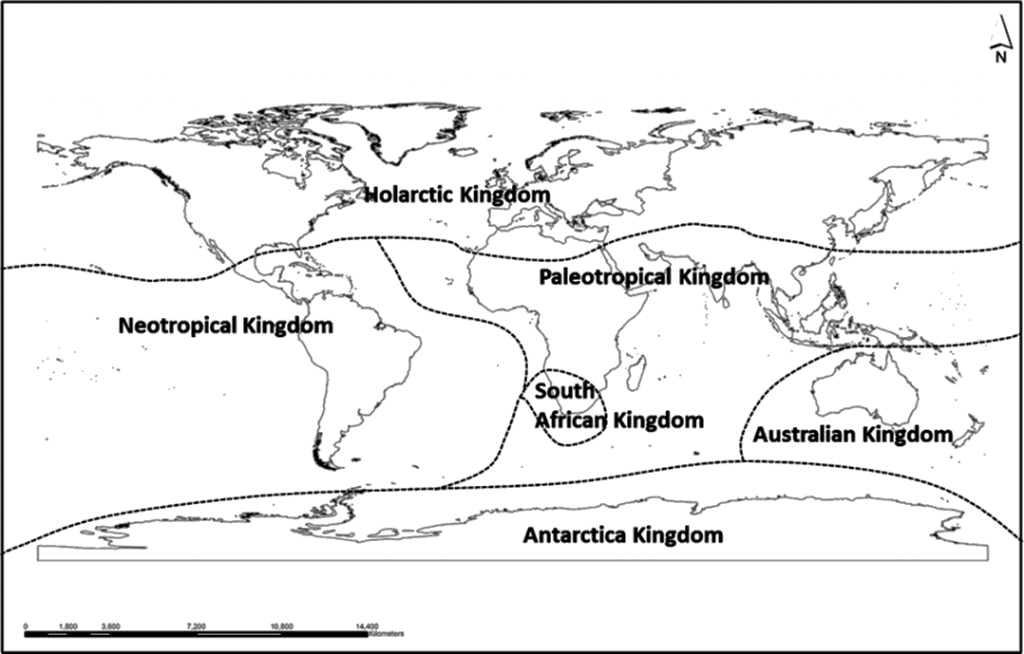
A. Holarctic Kingdom:
- Location: Northern Hemisphere, encompassing North America, Europe, and Asia.
- Characteristic Features: High diversity of temperate and boreal plant species.
- Representative Species: Oak, Maple, Birch, Pine, and Spruce.
Nearctic Kingdom (It is part of Holarctic Kingdom)
- Location: North America, including most of Canada, United States, and parts of Mexico.
- Characteristic Features: Vast temperate and boreal forests, prairies, and deserts.
- Characteristic Flora: Coniferous forests, grasslands, desert plants, and deciduous forests.
- Representative Species: Maple trees, cacti, sagebrush, and prairie grasses.
B. Neotropical Kingdom
- Location: Central and South America, including the Caribbean islands.
- Characteristic Features: Rich biodiversity, high rainfall, extensive rainforests, and diverse ecosystems.
- Characteristic Flora: Dense tropical rainforests, cloud forests, savannas, and mangrove swamps.
- Representative Species: Orchids, bromeliads, cacao trees, and mahogany.
C. Paleotropical Kingdom
- Location: Africa, Madagascar, India, Southeast Asia, and parts of Australia.
- Characteristic Features: Varied climates, from deserts to rainforests, with a mix of ancient and recent evolutionary lineages.
- Characteristic Flora: Tropical rainforests, grasslands, and deserts.
- Representative Species: Baobab trees, acacias, orchids, and carnivorous plants like Nepenthes.
Sub-kingdoms:
- African sub-kingdom,
- Indo-Malaysian sub-kingdom, and
- Polynesian sub-kingdom.
Floral provinces or regions in this kingdom are:
- West African rainforest region,
- Madagascar region,
- Iran-Turanian region
- East Asian region, etc.
D. Australian Kingdom
- Location: Australia, New Guinea, and nearby islands.
- Characteristic Features: Isolated from other continents, unique flora and fauna, arid and semi-arid region.
- Characteristic Flora: Diverse eucalyptus forests, shrublands, and desert-adapted plants.
- Representative Species: Eucalyptus trees, kangaroo paws, Banksia, and wattles.
E. Antarctic Kingdom
- Location: Antarctica and surrounding sub-Antarctic islands.
- Characteristic Features: Extreme cold, ice-covered landscapes, limited plant diversity.
- Characteristic Flora: Mosses, lichens, and small flowering plants adapted to extreme cold and dry conditions.
- Representative Species: Antarctic hairgrass, Antarctic pearlwort, and cushion plants.
- Most important representative plant of this zone is Nothofagus which is also known as Southern Beech.
F. Capensis (Cape) Kingdom
- Location: Southern tip of Africa, including South Africa and Lesotho.
- Characteristic Features: The plants of this kingdom belong to the category of cryptophytes which bear buds in the form of bulbs and tubers which are buried in the soils.
- Characteristic Flora: Fynbos shrubland, succulent karoo, and forests.
- Representative Species: Proteas, heath plants, succulents, and unique bulbous plants like Cape lilies.
Floristic Kingdom Boundaries and Overlaps
- Transition Zones: Some regions display a mix of species from adjacent kingdoms, known as transition zones or ecotones.
- Overlapping Boundaries: Certain areas may share species with more than one kingdom, leading to overlap or hybrid zones.
Significance
- Conservation Hotspots: Floristic kingdoms help identify biodiversity hotspots for targeted conservation efforts.
- Endemism: Many kingdoms harbor a high percentage of endemic plant species, making them vital for preserving unique biodiversity.
- Threats: Habitat loss, climate change, invasive species, and human activities pose significant challenges to the conservation of floristic kingdoms.
- Advances in Molecular Techniques: DNA analysis and phylogenetic studies provide new insights into the relationships between plant species and their evolutionary histories.
- Refinement of Boundaries: Ongoing research may lead to adjustments in floristic kingdom boundaries and the identification of additional kingdoms.
Faunal Regions (World Distribution of animals)
Faunal regions, also known as zoogeographic regions, are large areas of the Earth's surface that share distinct patterns of animal distribution. These regions are based on similarities in the native fauna found within them.
Six Major Faunal Regions by A.R. Wallace (1876)

1. Neartic Region:
- Location: North America (including Greenland and Northern Mexico)
- Characteristic Features: Cold climate with diverse habitats, including tundra, boreal forests, grasslands, and deserts
- Characteristic Fauna: Grizzly bears, wolves, moose, beavers, bison, mountain lions, bald eagles
- Characteristic Flora: Coniferous forests (spruce, fir, pine), deciduous forests (maple, oak, hickory), grasslands
- Palearctic and Nearctic faunal regions share some similarities because both the regions were connected through the Bering Land Bridge during Tertiary Epoch and Pleistocene periods, which enabled free migration of animals.
2. Neotropical Region:
- Location: Central and South America, Caribbean islands
- Characteristic Features: Tropical and subtropical climates with rainforests, savannas, and wetlands
- Characteristic Fauna: Jaguars, sloths, toucans, macaws, anacondas, howler monkeys, capybaras
- Characteristic Flora: Tropical rainforests (mahogany, cacao, rubber trees), orchids, bromeliads, epiphytes
3. Palearctic Region:
- Location: Europe, Asia (excluding the Indian subcontinent), Northern Africa
- Characteristic Features: Vast range of climates from arctic tundra to temperate forests and deserts
- Characteristic Fauna: Brown bears, reindeer, wolves, lynx, snow leopards, camels, ibex. Reptiles are in lesser number.
- Characteristic Flora: Coniferous forests (spruce, pine, fir), deciduous forests (oak, beech), steppes, and grasslands
Sub-regions on the basis of vegetation:
- Tundra region.
- Temperate coniferous forest region.
- Temperate grassland region.
- Deciduous forest region.
- Desert region.
4. Ethiopian Region:
- Location: Sub-Saharan Africa.
- Characteristic Features: Diverse habitats including tropical rainforests, savannas, deserts, and mountains.
- Characteristic Fauna: Elephants, lions, zebras, giraffes, gorillas, rhinoceros, antelopes, ostriches. Unlike other faunal regions, this region is characterized by minimum diversity of animals.
- Characteristic Flora: Acacia trees, baobabs, ebony trees, orchids, aloes, grasslands.
Sub-regions:
- Desert region (springbok, porcupine, jerboa, rock hyrax, etc.)
- Savanna region (zebra, eland, gemsbok, hartebeest, gnu, giraffe, elephant, ostrich, lion, cheetah, etc.)
- Tropical forest (okapi, gorilla, chimpanzee, monkey, forest elephant, etc.)
5. Oriental Region:
- Location: South and Southeast Asia, Indonesian archipelago
- Characteristic Features: Wide range of habitats including tropical rainforests, mangroves, grasslands, and deserts
- Characteristic Fauna: Tigers, elephants, orangutans, pandas, cobras, gibbons, rhinoceros, monkeys
- Characteristic Flora: Bamboo forests, tropical rainforests (teak, bamboo, palm trees), mangroves, orchids
Sub regions:
- The Himalayas, Tibetan plateau, and Chinese mountainous regions form transitional zones between Palaearctic and oriental faunal regions.
- East Indies form transitional zone between Oriental and Australian faunal regions.
6. Australian Region:
- Location: Australia, New Guinea, nearby islands.
- Characteristic Features: Isolated landmass with diverse habitats including deserts, rainforests, and grasslands.
- Characteristic Fauna: Kangaroos, koalas, platypus, emus, wallabies, wombats, dingoes. This region is dominated by placental animals.Marsupials (characterized by pouch attached to the outer part of their abdomen) are the typical animals of the Australian faunal region.
- Characteristic Flora: Eucalyptus forests, acacia trees, banksias, kangaroo paws, desert shrubs.
Sub–regions:
- Desert region (marsupial, mole, jerboa, parakeet, lizard, etc.).
- Savanna region (emu, red kangaroo, bandicoot, wombat, cockatoo, parrot, etc.)
- Tropical forest (tree and musk kangaroos, wallaby, koala, oppossum, cassowary, etc.)
7. Antarctic Region:
- Location: Antarctica and surrounding Southern Ocean
- Characteristic Features: Extreme cold climate with ice and snow-covered landscapes
- Characteristic Fauna: Penguins, seals, whales, krill, albatrosses, petrels
- Characteristic Flora: Mosses, lichens, algae, few flowering plants (e.g., Antarctic hair grass)
Neotropical Region
- It includes the whole of South America which is characterized by tropical environments.
- This region represents the largest number of exclusive mammals (which are not found elsewhere).
- Sub-regions:
- Temperate grassland region ( guanaco, rhea, viscacha, cavy, fox, shunt, etc.)
- Desert region (guanaco, rehea, armadilo, vulture, etc.)
- Tropical forest region (monkeys, kinkajou, pygmy ant eater, sloth, tree snakes, parrot, hummingbirds, etc.)
Minor Faunal region
- The status of minor faunal region have been given to those islands which have been connected with the mainland (though this concept of isolation of some islands from the mainland throughout the geological history of the earth is still debatable).
- Such islands include Hawaii Island, Greater Antilles, Madagascar, and New Zealand.
Overlapping and Transitional Boundaries
Overlapping Boundaries
- Overlapping boundaries refer to areas where two or more faunal/ floral regions meet.
- These areas often display a mix of species from adjacent regions, leading to unique biodiversity.
- Overlapping boundaries can occur due to ecological factors, historical events, or human-induced changes.
Debates on Overlapping Boundaries
A. Ecological Factors
- Ecotones: These boundaries represent ecotones, transition zones where different ecosystems meet and interact.
- Species Interactions: Overlapping boundaries may result from species interactions like competition or hybridization, creating unique assemblages.
B. Historical Events
- Dispersal Events: Some overlapping boundaries may result from historical dispersal events where species migrated and established new populations.
- Climate Change: Shifts in climate throughout history can lead to overlapping boundaries.
C. Human-Induced Changes
- Habitat Fragmentation: Human activities such as deforestation or urbanization can fragment habitats, leading to species range shifts and overlapping boundaries.
- Introduction of Exotic Species: The introduction of non-native species can disrupt native ecosystems, creating new faunal regions or altering existing ones.
Transitional Boundaries
- Transitional boundaries occur where one faunal or floral region gradually transitions into another.
- These boundaries can be characterized by a gradient of species composition and biodiversity.
- These can be influenced by factors like climate, habitat suitability, and dispersal capabilities of species.
Debates on Transitional Boundaries:
A. Gradient vs. Discrete Boundaries:
- Gradient: These can be gradual with a smooth change in species composition.
- Discrete: These can be abrupt and distinct, resulting from specific environmental thresholds or dispersal barriers.
B. Dynamic Nature of Boundaries:
- Temporal Variation: These may shift over time due to changes in climate, habitat conditions, or species interactions.
- Human Influence: It can accelerate the pace of transitional boundary shifts, making them less stable.