
SOIL CONSERVATION | Biogeography Optional for UPSC
SOIL CONSERVATION | Biogeography Optional for UPSC

Introduction
- Soil conservation is the prevention of loss of the topmost layer of the soil from erosion or prevention of reduced fertility caused by over usage, acidification, salinization or other chemical soil contamination.
- It focuses on keeping soils healthy through a combination of practices and techniques.
Principle of soil conservation
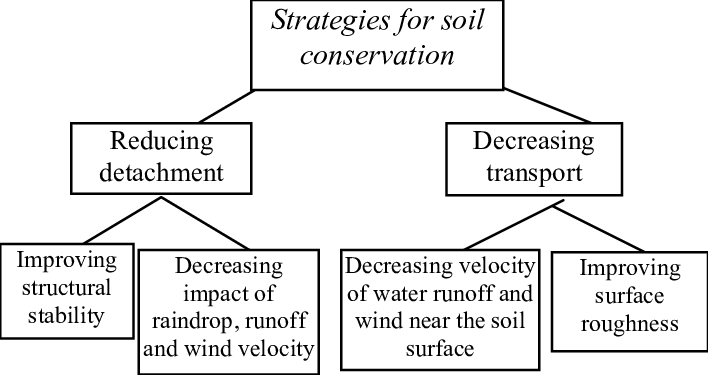
- Protection of Soil from Impact of Raindrops: Raindrops can dislodge soil particles, leading to erosion. Techniques such as mulching and using cover crops help absorb the impact of raindrops, reducing soil erosion.
- Slowing Down Water Concentration: To prevent soil erosion caused by concentrated water flow, methods like contour plowing, terracing, and building check dams are employed. These techniques slow down water movement, preventing gullies and soil loss.
- Slowing Down Water Movement Along Slopes: On sloping lands, measures like contour farming and constructing bunds and trenches help slow down water flow, reducing soil erosion and nutrient runoff.
- Encouraging Water Infiltration: Improving soil structure through practices like adding organic matter and reducing compaction enhances water infiltration, reducing surface runoff and erosion.
- Increasing Soil Particle Size: Methods like adding soil amendments, using cover crops, and reducing tillage help increase soil particle size, making it less prone to erosion.
- Reducing Wind Velocity: Planting windbreaks, using vegetative covers, and adopting conservation tillage methods help reduce wind erosion by decreasing wind velocity near the ground.
- Using Vegetation Strips: Growing strips of vegetation, such as grass strips, along contours or between crops, helps trap soil particles and reduce erosion caused by water or wind.
Geographical Thinkers on Soil Conservation:
- H.H. Bennett: Recognized the severe consequences of soil erosion and advocated for soil conservation practices.
- Aldo Leopold: Promoted the concept of a "land ethic" that called for responsible stewardship of natural resources, including soil.
- Rachel Carson: Although primarily known for her work on environmental pollution, her book "Silent Spring" highlighted the detrimental effects of chemical pesticides on soil health.
- Wangari Maathai: Founded the Green Belt Movement, which focused on reforestation and soil conservation. Recognized the connection between deforestation, soil erosion, and social issues, such as poverty and gender inequality.
- Masanobu Fukuoka: Developed the philosophy of "natural farming" or "do-nothing farming," emphasizing minimal intervention in agricultural practices.
- Allan Savory: Introduced the concept of holistic management and advocated for the use of rotational grazing to restore degraded soils.
Case Studies of Soil Conservation
1. Terracing in the Philippines
- Problem: Severe soil erosion due to heavy rainfall and steep slopes.
- Solution: Implementation of terracing techniques.
- Results: Reduced soil erosion, improved water retention, and increased agricultural productivity.
2. Agroforestry in Kenya
- Problem: Degraded soil and declining agricultural yields.
- Solution: Adoption of agroforestry practices, combining trees and crops.
- Results: Improved soil structure, increased organic matter content, enhanced biodiversity, and higher crop yields.
3. Conservation Tillage in the United States
- Problem: Soil erosion and loss of topsoil due to conventional tillage methods.
- Solution: Introduction of conservation tillage techniques (no-till, reduced tillage).
- Results: Reduced soil erosion, improved soil moisture retention, enhanced carbon sequestration, and reduced fuel and labor costs for farmers.
4. Contour Plowing in Brazil
- Problem: Significant soil erosion caused by heavy rainfall on sloping lands.
- Solution: Implementation of contour plowing, following the natural contour lines of the land.
- Results: Minimized water runoff, reduced soil erosion, and increased water infiltration, leading to improved soil fertility.
5. Strip Cropping in the United States
- Problem: Soil erosion caused by wind and water on flat farmland.
- Solution: Adoption of strip cropping, alternating different crops in strips.
- Results: Reduced wind and water erosion, improved soil structure, increased biodiversity, and enhanced crop yields.
6. Alley Cropping in Ghana
- Problem: Soil degradation, deforestation, and low crop productivity.
- Solution: Introduction of alley cropping, planting rows of trees in between crops.
- Results: Reduced soil erosion, increased organic matter content, improved microclimate, enhanced nutrient cycling, and higher crop yields.
7. Rehabilitation of Degraded Land in China's Loess Plateau
- Problem: Severe soil erosion and desertification in the Loess Plateau region.
- Solution: Implementation of a large-scale ecological restoration project.
- Results: Decreased soil erosion, improved water retention, increased vegetation cover, restored biodiversity, and enhanced ecosystem services.
8. Community-Based Soil Conservation in Ethiopia
- Problem: Soil degradation, food insecurity, and poverty in rural communities.
- Solution: Engaging local communities in soil conservation practices and sustainable land management.
- Results: Increased soil fertility, improved agricultural productivity, enhanced food security, and empowered local communities.
9. Soil Conservation in the Netherlands
- Problem: Soil subsidence and nutrient runoff in low-lying agricultural areas.
- Solution: Implementation of precision agriculture techniques, including precise nutrient application and drainage management.
- Results: Reduced soil subsidence, improved nutrient use efficiency, decreased environmental pollution, and sustained agricultural productivity.
Indian Case Studies of Soil Conservation
1. Watershed Development Programs
A. Ralegan Siddhi, Maharashtra
- Led by social activist Anna Hazare.
- Implemented watershed management techniques like contour bunding, check dams, and afforestation.
- Resulted in increased groundwater levels and improved soil fertility.
B. Tarunyabhan, Gujarat
- Focus on water conservation and soil management.
- Introduced measures like micro-irrigation, agroforestry, and soil and water. conservation structures.
- Enhanced water availability, reduced soil erosion, and increased crop productivity.
2. Terrace Farming Practices
A. Ziro Valley, Arunachal Pradesh
- Implemented traditional terrace farming techniques called 'paddy cum fish culture'.
- Terraces constructed to conserve water and prevent soil erosion.
- Increased agricultural productivity and sustained livelihoods.
B. Koraput, Odisha
- Tribal communities practice terrace farming known as 'dong cultivation'.
- Terraces constructed with stone walls to prevent soil erosion.
- Improved soil fertility, reduced runoff, and promoted sustainable agriculture.
3. Conservation Agriculture
A. Nalanda, Bihar
- Promoted conservation agriculture techniques like zero tillage, residue management, and crop rotation.
- Reduced soil erosion, conserved moisture, and improved soil health.
- Enhanced crop yields and promoted sustainable farming practices.
B. Ramanagara, Karnataka
- Adopted conservation agriculture practices to combat soil degradation.
- Techniques such as minimum tillage, mulching, and crop diversification. implemented.
- Improved soil moisture retention, reduced erosion, and increased crop productivity.
4. Afforestation and Reforestation
A. Cherrapunji, Meghalaya
- Implemented afforestation initiatives to control soil erosion and landslides.
- Planted tree species to stabilize slopes and improve soil quality.
- Mitigated erosion, retained soil moisture, and preserved biodiversity.
B. Aravalli Hills, Rajasthan
- Undertook reforestation programs to combat soil erosion in the degraded landscape.
- Planted native tree species like Prosopis cineraria and Acacia spp.
- Restored soil fertility, reduced erosion, and promoted ecological balance.
5. Community-led Soil Conservation
A. Mendha-Lekha, Maharashtra
- Tribal community-led soil and water conservation initiatives.
- Implemented contour trenching, plantation, and watershed development activities.
- Improved soil moisture retention, increased crop productivity, and restored natural resources.
B. Siruthuli, Coimbatore, Tamil Nadu
- Citizen-driven organization focused on rejuvenating water bodies and conserving soil.
- Undertook activities like rainwater harvesting, lake restoration, and tree planting.
- Enhanced soil fertility, improved groundwater levels, and revitalized ecosystems.
Soil Conservation Strategies
Protecting Native Vegetation:
- Protecting and preserving existing native plants and ecosystems.
- Example: Implementing laws and regulations to prevent deforestation in sensitive ecological areas like rainforests or mangrove forests.
Replanting Native Vegetation:
- Reintroducing native plants in areas where vegetation has been depleted or destroyed.
- Example: Afforestation projects in degraded lands, such as planting native trees in areas affected by wildfires.
Perennial Crop Cultivation Systems:
- Growing crops that do not require annual replanting, reducing soil disturbance.
- Example: Growing perennial crops like fruit orchards or perennial grasses for forage in sustainable agriculture practices.
Use of Ground Cover while Cultivating Annual Crops:
- Utilizing cover crops or mulching to protect soil from erosion and nutrient loss.
- Example: Planting cover crops like legumes or grasses between rows of cash crops to prevent soil erosion and improve soil fertility.
Minimum Tillage Cultivation System:
- Limiting the amount of soil disturbance during planting and cultivation.
- Example: Adopting no-till or reduced tillage techniques in agriculture to preserve soil structure and reduce erosion.
Crop Rotation:
- Alternating different crops in a specific sequence on the same land to improve soil health and productivity.
- Example: Rotating crops like corn, soybeans, and wheat in a cycle to break pest cycles, improve nutrient uptake, and reduce soil erosion.
Contour Barriers:
- Constructing barriers along contours to slow down water runoff and prevent soil erosion.
- Example: Building contour bunds or terraces on sloping lands to trap rainwater and reduce soil erosion.
Contour Farming:
- Plowing and planting crops along the contour lines of the land to reduce water runoff and erosion.
- Example: Cultivating crops like maize or beans along the contour lines of hills to prevent soil loss and improve water retention.
Terrace Farming:
- Creating flat areas on steep slopes to create level planting surfaces and reduce soil erosion.
- Example: Constructing stepped terraces on hillsides for rice cultivation in regions prone to heavy rainfall and erosion.
Protected Drainageways:
- Designating and protecting natural drainage pathways to prevent soil erosion and sedimentation.
- Example: Establishing vegetated buffer zones along rivers or streams to filter runoff and reduce sedimentation.
Gully Prevention and Control:
- Implementing measures to prevent the formation and expansion of gullies, which are deep erosional channels.
- Example: Installing check dams or gabions in gully-prone areas to slow down water flow, trap sediments, and stabilize the soil.
Steps to follow in designing a conservation plan
- Select lot, subdivide if necessary.
- Study lot, find out problems with respect to erosion, drainage, drought.
- Select suitable drainage site if necessary.
- Decide on position of "linea madre".
- Calculate slope.
- Select conservation strategy.
- Decide on appropriate distance between structures.
- Place marker stakes along the "linea madre" at the appropriate intervals.
- Survey and mark contour lines.
- Realign stakes along contour lines if necessary.
- Carry out conservation practice.
- Plant protective barriers if necessary.
- Plant desired crop(s) along the contour.
- Periodically review structures and carry out any needed maintenance practices.
Methods of soil conservation
1. Biological methods:
- Agronomic practices: Contour farming, Mulching, Crop rotation, Strip cropping.
- Dry farming.
- Agrostological methods: Lay farming: Retiring lands to grass.
2. Mechanical methods:
- Basin listing
- Counter terracing
- Channel terrace
- Broad based ridge terrace.
- Bench terrace
3. Other method:
- Gully control
- Stream bank protection
- Afforestation
- Mineralization
- Salinity management
Benefits of Soil Conservation
- Boosts earth quality and productivity and saving costs at the same time.
- Mitigates erosion.
- Promotes water infiltration and increases its storage.
- Water purification
- Soil carbon sequestration and reduced chemical applications contribute to air purity.
- Gives food and shelter for wildlife with growing vegetation.
Indian government initiative
- Soil Health Card (SHC) Scheme.
- Pradhan Mantri Krishi Sinchayee Yojana.
- National Mission for Sustainable Agriculture.
- Collaboration with FAO for the development of forecasting tools, capacity development etc.