
Desertification | ENVIRONMENTAL GEOGRAPHY Optional for UPSC
Desertification | ENVIRONMENTAL GEOGRAPHY Optional for UPSC

Introduction
- Desertification is a type of land degradation in drylands in which biological productivity is lost due to natural processes or induced by human activities whereby fertile areas become increasingly arid.
- Desertification refers to the process of land degradation in arid, semi-arid, and dry sub-humid regions, resulting in the transformation of once productive land into desert-like conditions.
- It is the spread of arid areas caused by a variety of factors, such as climate change and overexploitation of soil as a result of human activity.
- United Nations Convention to Combat Desertification (UNCCD) defined desertification as "land degradation in arid, semi-arid and dry sub-humid regions resulting from various factors, including climatic variations and human activities."
- Princeton University Dictionary defined it as "the process of fertile land transforming into desert typically as a result of deforestation, drought or improper/inappropriate agriculture".
Thinkers Perspectives
1. Environmental Determinism:
- Environmental determinism suggests that natural factors, such as climate and soil conditions, primarily determine the occurrence of desertification.
- Examples: Ellsworth Huntington argued that desertification in North Africa was a result of climatic changes.
2. Possibilism:
- Possibilist perspective on desertification believe that human actions and socio-economic factors are the primary drivers of desertification.
- They emphasize how human interventions, such as deforestation, overgrazing, and improper land use, contribute to the expansion of desert areas.
- For example, Gilbert F. White highlighted how human decisions to settle in arid regions and engage in unsustainable agricultural practices contribute to desertification.
3. Radical Perspective:
- Takes a critical perspective on the political and economic systems contributing to desertification.
- Critiques mainstream approaches and institutions, advocating for alternative models of governance and resource management.
- Example: The environmentalist and activist Vandana Shiva promotes ecological and social justice movements that challenge the dominant paradigm of industrial agriculture and promote sustainable farming practices to combat desertification.
4. Marxist Perspective:
- Argues that desertification is driven by processes such as land degradation, overexploitation, and unequal access to resources resulting from capitalist modes of production.
- Example: The works of geographer David Harvey highlight the connections between capitalism, urbanization, and environmental degradation, including desertification.
5. Biogeographical Perspective:
- Geographers focus on the processes of land degradation and soil erosion as key drivers of desertification.
- Examples: David R. Montgomery, a geologist and author, explores the historical and contemporary impacts of soil erosion on desertification and its implications for sustainable land management.
6. Spatial Analysis:
- Geographers employ spatial analysis techniques to understand the patterns and dynamics of desertification, including the identification of vulnerable areas.
- Examples: Remote sensing technologies, such as satellite imagery and Geographic Information Systems (GIS), enable geographers to monitor desertification processes over large areas and identify hotspots for intervention.
7. Sustainable Land Management:
- Geographical thinkers emphasize the importance of adopting sustainable land management practices to prevent and reverse desertification.
- Examples: Wangari Maathai, a Kenyan environmental activist, promoted afforestation and reforestation initiatives, such as the Green Belt Movement, to combat desertification and improve local livelihoods.
Distribution
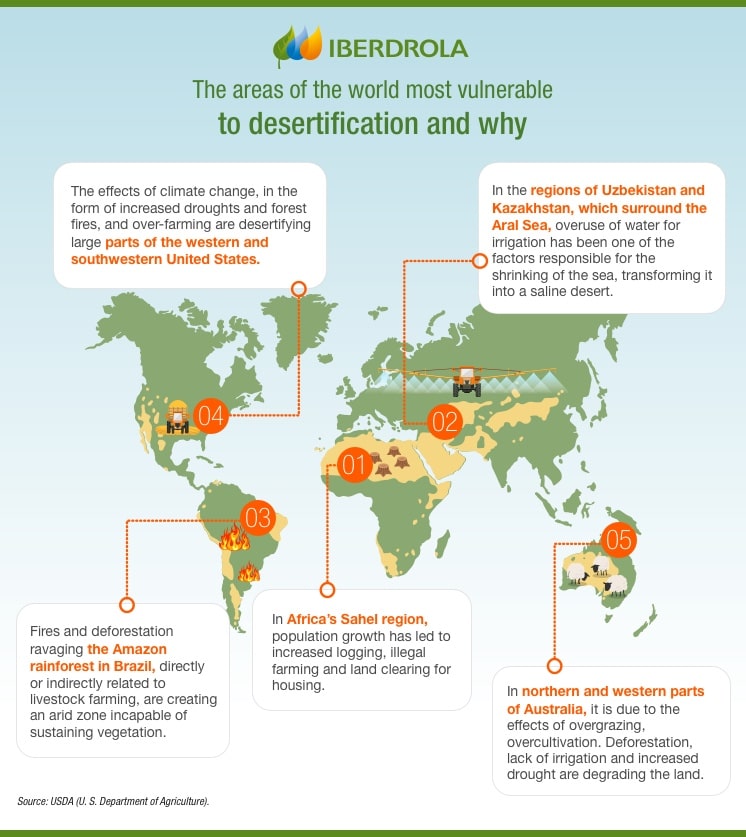
Global condition:
- 36 million square miles of the world are currently affected by this.
- Africa and Asia are the most affected areas in the world by desertification.
- More specifically, desertification plays its largest role in the grasslands of East Africa, the Kalahari Desert and the Sahara Desert.
- These regions span over 65 percent of the land. In Ethiopia, 80 percent of the land is at risk of desertification.
Condition in India:
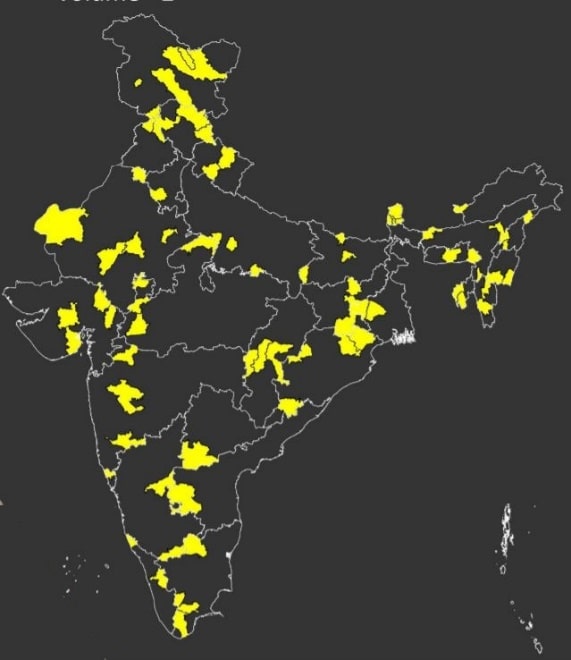
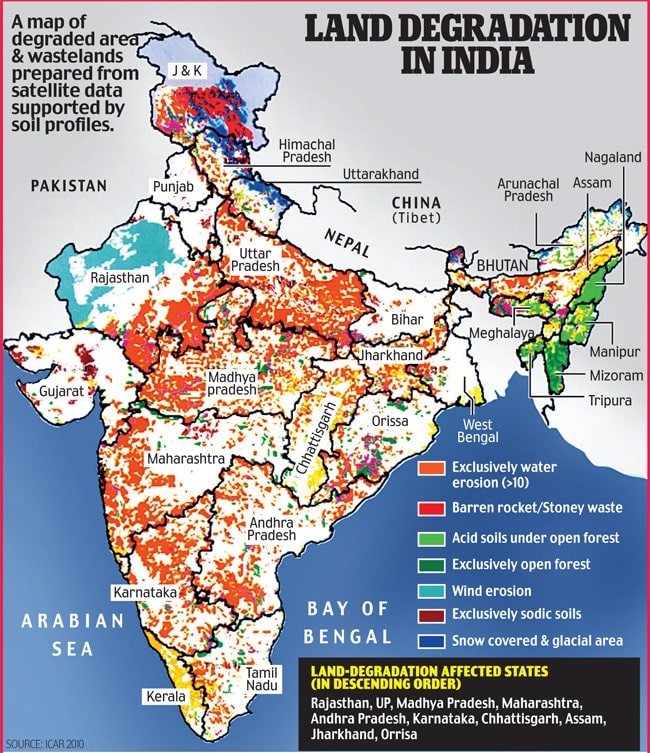
- 81.45 million hectares area of the country is under desertification (land degradation within drylands).
- Arid - 34.89 million hectares
- Semi-Arid - 31.99 million hectares
- Dry sub-humid - 14.57 million hectares
- Around 23.95% of desertification/land degradation is contributed nine states: Rajasthan, Maharashtra, Gujarat, Jammu & Kashmir, Karnataka, Jharkhand, Odisha, Madhya Pradesh and Telangana.
- Jharkhand, Rajasthan, Delhi, Gujarat and Goa have more than 50% area under desertification/land degradation.
- Kerala, Assam, Mizoram, Haryana, Bihar, Uttar Pradesh, Punjab and Arunachal Pradesh had less than 10% area under desertification/land degradation.
Causes
- Unsustainable Agricultural Practices, incl. Shifting Cultivation.
- Unsustainable Water Management Practices.
- Land Use Changes.
- Deforestation & Loss of Vegetative Cover.
- Industrial and Mining Activities.
- Disposal of Solid & Toxic Wastes onto Land.
- Demographic Pressures.
- Drought and Land Degradation.
Effects
Environmental impact:
- A decrease in potable water stocks from reductions in surface water and groundwater flow,
- Increased sand dune intrusion onto croplands and settlements,
- Increased flooding due to rising sedimentation in rivers and lakes,
- Amplified air and water pollution from dust and sedimentation.
- Vegetation destruction causing habitat loss and risk to biodiversity
Economic Impact:
- Crop failures or decreased yields in rain-fed farmland,
- The loss of perennial plant cover and thus loss of forage for livestock,
- reduced woody biomass and thus scarcity of fuelwood and building materials,
Social Impact:
- Risk to food security, famine.
- Poverty.
- Increased social conflicts.
- Forced migration.
Political impact:
- Political instability due to general dissatisfaction.
Remedial Measures / Disaster Management of Desertification
A. Pre-disaster stage
1. Preparedness (P):
- Identification and assessment of desertification-prone areas: conducting surveys to identify such areas.
- Early warning systems: e.g. monitoring soil moisture levels, vegetation health, and climate patterns.
- Community education and awareness: Educating communities living in desertification-prone areas about the causes, impacts, and preventive measures of desertification.
- Capacity building: Enhancing the knowledge and skills of local communities, government agencies, and relevant stakeholders to effectively manage and respond to desertification.
2. Mitigation (M):
- Soil conservation measures: Implementing practices such as contour plowing, terracing, and agroforestry to reduce soil erosion and maintain soil fertility.
- Water management strategies: Implementing efficient irrigation systems, rainwater harvesting techniques, and water conservation practices to optimize water usage in agricultural activities.
- Sustainable land management: Promoting sustainable land use practices, including crop rotation, proper grazing management, and afforestation, to prevent soil degradation and enhance ecosystem resilience.
- Reforestation and restoration: Planting native vegetation and restoring degraded ecosystems to stabilize soil, increase biodiversity, and improve ecosystem functions.
3. Prevention (P):
- Policy and regulatory frameworks: Developing and enforcing laws, regulations, and policies that promote sustainable land use practices and regulate activities that contribute to desertification.
- Land use planning and zoning: Implementing land use planning strategies that consider the vulnerability of areas to desertification and prevent inappropriate land use practices in high-risk zones.
- Sustainable livelihood options: Promoting alternative livelihood options for communities dependent on activities that contribute to desertification. E.g. encouraging eco-tourism, sustainable farming practices, and non-agricultural income.
- International cooperation and collaboration: Encouraging cooperation among nations and organizations to address transboundary desertification issues and share best practices for prevention.
B. Disaster stage
1. Rescue operation (R):
- Evacuation and relocation: Ensuring the safe evacuation and relocation of affected communities from areas severely impacted by desertification to safer locations.
- Emergency relief: Providing immediate assistance, such as food, water, shelter, and medical aid, to the affected populations during the initial stages of the disaster.
- Search and rescue: Conducting operations to locate and rescue individuals who may be stranded or trapped.
C. Post-disaster stage
1. Relief (R):
- Long-term food and water supply: Ensuring a sustained supply of food and clean water to the affected populations until they can regain self-sufficiency.
- Healthcare and sanitation: Providing medical services, vaccinations, and sanitation facilities to prevent the outbreak of diseases in the affected areas.
- Psychological support: Offering counseling and support services to individuals and communities affected by desertification-induced disasters to address trauma and emotional distress.
2. Recovery (R):
- Infrastructure restoration: Rebuilding damaged infrastructure, including roads, bridges, schools, and healthcare facilities, to enable the affected communities to resume normal activities.
- Livelihood restoration: Assisting affected communities in restoring their livelihoods through training, financial support, and the introduction of sustainable income-generating activities.
- Natural resource management: Implementing measures to restore and rehabilitate natural resources, such as reforestation programs, water conservation projects, and soil rehabilitation initiatives.
3. Rehabilitation (R):
- Capacity building and skills development: Providing training programs to enhance the knowledge and skills of affected communities, enabling them to adapt to and mitigate future desertification risks.
- Resilience building: Implementing measures to strengthen the resilience of communities and ecosystems to future desertification events, such as the development of early warning systems and community-based adaptation strategies.
- Knowledge sharing and awareness: Promoting knowledge exchange and awareness campaigns to disseminate information about desertification management, prevention strategies, and sustainable land use practices.
Indian Efforts
- Desertification and Land Degradation Atlas 2016.
- National Mission on Green India as a part of National Action Plan on Climate change 2014.
- Fodder and Feed Development Scheme 2010.
- National Afforestation Programme 2000.
- Soil Conservation in the Catchment of River Valley Projects and Flood Prone Rivers 2000.
- Desert Development Program 1995.
- Integrated Watershed Management Programme 1989-90.
- Command Area Development 1974.
- National Action Programme to Combat Desertification 2001.
Recommendations under National Action Programme to Combat Desertification
- National Land Use Policy.
- Land Degradation Monitoring & Assessment.
- Programmes & Schemes for Addressing Land Degradation.
- Participatory Approach: Decentralised Governance, Institutional Framework at the Local Level, Inclusion of NGOs.
- Social Sector and Community Based Programmes.
- Capacity Building.
- Drought management and mitigation.
- Use of Traditional Knowledge.
- Integration of regional, sub-regional action programmes and other activities of UNCCD with National Action Plan.
- Establishment of Monitoring mechanism on desertification.
Global efforts
- Bonn Challenge.
- Sustainable Development Goal 15.
- United Nations Convention to Combat Desertification (UNCCD).
- The World Day to Combat Desertification and Drought (17 June).
- Great Green Wall Initiative by Global Environment Facility (GEF).