
Pollution | ENVIRONMENTAL GEOGRAPHY Optional for UPSC
Pollution | ENVIRONMENTAL GEOGRAPHY Optional for UPSC

Issues Relating to Environmental Pollution
Environmental Pollution
- Environmental pollution, the addition of any substance (solid, liquid, or gas) or any form of energy (such as heat, sound, or radioactivity) to the environment at a rate faster than it can be dispersed, diluted, decomposed, recycled, or stored in some harmless form.
- Pollution of all kinds can have negative effects on the environment and wildlife and often impacts human health and well-being.
Perspectives on Pollution
- According to the report of the Restoring the Quality of our Environment, President’s Science Advisory Committee, Washington, USA pollution may be defined as “unfavorable alteration of our surrounding wholly or largely as a by-product of man’s actions through direct or indirect effects of changes in energy patterns, radiation levels, chemical and physical constitution and the abundance of organism.”
- According to D.M Dixon (1972) pollution includes “all those activities conscious or unconscious of human beings and their domestic cattle and result thereof or short term from enjoyment of his environment and his ability to derive full benefit therefrom”
- According to, Natural Environmental Research Council (NERC) 1976, Pollution is viewed as "the release of substances and energy as waste products of human activities which result in changes, usually harmful within the natural environment".
- Savindra Singh (1991) has defined pollution in a very simple manner: Disequilibrium condition from equilibrium condition in any system is called pollution.
- There are three criteria, as mentioned by N. Lee and C. Wood (1972) for defining pollution viz.
- the waste materials resulting from human activities and disposal of wastes,
- damages caused by disposed wastes whether directly or indirectly, and
- the circumstances where the effect of damage is met by third parties.
Sources of Pollution
- Natural source of pollution includes pollutants such as volcanic ashes and dust from volcanic eruptions (volcanic dust layers in the atmosphere reduce air temperature).
- Anthropogenic sources: Most of the pollutants come from industrial and urban sectors. Pollutants such as gaseous pollutants (nitrogen oxides, sulphur dioxide, carbon monoxides, hydrocarbon as methane and numerous toxic gases) are emitted.
- Agricultural source of pollution includes the pollutants related to chemical fertilizers, pesticides, and insecticides.
Types of Pollutants
- natural pollutants.
- man-made pollutants.
On the basis of visibility:
- visible pollutants include smoke, gases, dusts coming out of 'human volcanoes' (chimneys), wastewater or sewage water coming out from factories and urban areas, heaps of garbage’s, animal and human wastes etc.
- invisible pollutants. include several types of bacteria, toxic chemicals mixed with water and soils etc.
- solid particulate: aerosols, industrial wastes such as lead, mercury, tailings, asbestos etc.
- gaseous pollutants: chlorofluorocarbons, carbon dioxide, sulphur dioxide, nitrogen oxides, carbon monoxides, methane etc.
- liquid pollutants: Oil slicks, dissolved solids, ammonia, urea, nitrate, chloride, fluoride. carbonates, pesticides and insecticides etc.—all in dissolved form, oil and greases etc.
- cultural pollutants: include over-population or say explosive population, poverty, crime, richness, cultural backwardness etc.
- biological pollutants: include eutrophication, locust swarms etc.
- air pollutants: e.g., particulate matter, gases, smokes, soot’s etc.
- water pollutants: e.g., dissolved, and suspended solids, different types of ions, pesticides and insecticides residues, toxic metals such as lead, mercury and cadmium, radioactive wastes etc.
- land pollutants: e.g., human and animal excreta, garbage, pesticides, insecticides and chemical fertilizers, machines and tools, radioactive substances etc.
Key Pollutants
- carbon dioxide.
- particulate matter.
- sulphur dioxide.
- oxides of nitrogen.
- toxic heavy metals (lead, mercury, arsenic, cadmium, nickel, manganese, copper, Zinc)
- oil.
- chlorinated hydrocarbons (especially DDT and polychlorinated biphenys-PCB).
- other hydrocarbons.
- radionuclides.
- heat.
- nutrients.
- Domestic sewage and other oxygen demanding wastes.
- Infectious agents.
- Plant nutrients.
- Organic chemicals which are highly toxic at very low concentrations (such as insecticides, pesticides, detergents, and Petro-chemicals).
- Minerals and chemicals (including chemical residues, salts, acids, silts and sludges).
- Sediments from land erosion.
- Radioactive substances.
- Heat from power and industrial plants.
Types of Pollution
- Land Pollution,
- Water Pollution, and
- Air Pollution
- Economic Pollution, (poverty).
- Religious Pollution (communal riots and violence).
- Political Pollution (wars).
- Ethnic Pollution (ethnic riots).
- Social Pollution (crimes such as robbery, rape, dacoity, murders etc.)
- Land Pollution
- water Pollution
- air pollution
- urban pollution
- rural pollution
- industrial pollution
- agricultural pollution
- Point pollution is always visible and hence can be easily identified
- Discharge of effluents from a drain or pipe into a river channel is termed point-source pollution or simply a point pollution.
- Nonpoint pollution mostly occurs from agricultural practices.
- Nonpoint pollution is a slow poisoning of our physical environment mainly surface and subsurface waters and soils.
- The polluted water in turn adversely affects biological communities in general and human community in particular and soil pollution results in phenomenal decrease in fertility and productivity.
- A substantial shortage of food supply may cause economic pollution through poverty, starvation and deaths.
Non-point pollution is further divided into two types:
- The major source of nonpoint pollution in rural areas is agricultural activity
- Nature and amount of chemical fertilizers, pesticides and insecticides applied to the farms are important factors
- Amount and intensity of annual rainfall, other climatic conditions, methods of ploughing and farm management techniques are also important.
- These are divided into 3 categories viz. (i) pollutants coming from residential areas, (ii) pollutants coming from small-scale industries, and (iii) pollutants coming from large-scale industries.
Air Pollution
Introduction
- The atmosphere is a gaseous envelope which surrounds the earth from all sides.
- Air is very important for all types of life in the biosphere
- It constitutes about 80 per cent of the total intake of all things by a person every day
- A person breathes 22,000 times a day inhaling 35 gallons or 16 kilograms of air
- Man-made pollutants being concentrated in certain parts of the atmosphere pollute the air
- The air becomes polluted when its natural composition is disturbed either by natural or man-made sources or by both
- The nature, dimension and magnitude of air pollution depend on a variety of factors such as residence time of pollutants in the atmosphere, sources of pollutants, nature of pollutants and amount of pollutants etc.
Perspectives
- H. Perkins (1974) has defined air pollution as “the presence in the outdoor atmosphere of one or more contaminants such as dust, fumes, gas, mist, odor, smoke or vapor in quantities of characteristics and of duration such as to be injurious to human, plant or animal life and to property or which unreasonably interferes with the comfortable enjoyment of life and property.”
- WHO defines “Air pollution as limited to situation in which the outdoor ambient atmosphere contains materials in concentration, which are harmful to man and his surrounding environment.”
Sources of Pollutants
- Natural sources: e.g., volcanic eruptions, deflation of sands and dusts, forest fires etc.
- Anthropogenic sources: e.g., industries, urban centers, automobiles, aircrafts, agriculture, power plants etc.
Types of Air Pollutants
- Gaseous pollutants include carbon dioxide (CO2), carbon monoxide (CO) and hydrogen sulphide (H2SO4) from the burning of fossil fuels, transportation sector, industrial processes and garbage disposal
- Nitrous oxide (NO20), NO (nitric oxide) and NO3 (nitrogen trioxide) from high flying aircrafts, as well as other nitrogenous compounds such as NO2 (Nitrogen dioxide) are released.
- Particulate Air pollutants aerosols are fine particles which are around one micron to 10 microns in size
- They are added to the atmosphere by industries, thermal power generation, automobiles, space heating, agricultural activities and soot and smokestack emission processes.
- visible or living particulate matter: e.g., bacteria, pollen grains, fungal and other spores, all of which belong to the category of natural air pollutants.
- non-living particulate matter: e.g., all of the pollutants whether gaseous or particulate from anthropogenic sources as referred to above.
Types of Air Pollution
- on the basis of types of pollutants, and
- on the basis of sources of air pollutants.
- gaseous air pollution, and
- particulate air pollution.
- automobiles air pollution,
- industrial in pollution,
- thermal air pollution,
- urban air pollution,
- rural air pollution, and
- nuclear air pollution.
Carbon Monoxide and Air Pollution
- Carbon monoxide (CO) is produced by incomplete burning of fossil fuels like coal and petroleum and wood charcoal
- Urban areas and industrial centers are the most significant contributors of carbon monoxide because they account for the largest number of automobiles and industries.
- Carbon monoxide is not toxic to plants, but it causes respiratory problem and suffocation, when inhaled, in the human bodies.
- The USA alone produces about 65 million tons of carbon monoxide per year.
- Carbon dioxide gas is one of the natural gaseous components of the atmosphere and in itself, it is not harmful to human health rather it is a resource.
- The content of CO2 in the atmosphere is increasing at an alarming rate because of two major factors viz. burning of fossil fuels and rapid rate of deforestation.
- Researchers estimate that nearly 30% of greenhouse gas emissions come from transportation, while another 25% comes from the production of electricity, 23% from industrial production, 13% from commercial and residential sources and 10% from agriculture.
- The amount of carbon dioxide (CO2) in the atmosphere has risen by 31 per cent from pre-industrial levels to 368 ppm by 2000 A.D.
- It traps the outgoing heat radiation waves of the earth and warms up the air which results in a gradual increase in the temperature of the surface and lower atmosphere.
- The effect of carbon dioxide on the earth's surface is called the greenhouse effect.
- An increase in atmospheric carbon dioxide from anthropogenic sources is expected to have far reaching effects on global climate through gradual rise in temperature.
- There may be substantial decrease in precipitation and soil moisture content in the most developed agricultural regions of the world.
- There would be melting of continental and mountain glaciers and consequent rise in sea level and resultant flooding of coastal lowlands.
- The Chlorofluorocarbons, popularly known as CFCs, are relatively simple compounds of the element's chlorine, fluorine, and carbon
- They are initially stable compounds which do not have any toxic effect on life processes in the biosphere at the ground level
- These synthetic chemicals are widely used as propellants in spray can dispensers, as fluids in air conditioners and refrigerators and as blowing agents in insulation foams.
- Chlorofluorocarbons (CFCs) in aerosol and non-aerosol forms into the troposphere and then transport to the stratosphere
- The atmospheric concentration of CFCs is increasing rapidly at the rate of 13 to per cent (of freon 11) per annum
- The depletion of ozone layer would result in more ultra-violet radiation reaching the populated areas of the world within coming years.
- According to an estimate 12 percent decrease in ozone would cause skin cancer to 1,20,000 people per year in the USA alone
- Increased ultra-violet radiation and consequent increased photochemical processes would cause poisonous smog.
- Human beings will face food shortage because of very severe adverse effects of increased solar radiation or agricultural crops.
- Methane gas is one of the greenhouse gases that cause rise in the temperature of the earth's surface
- The major sources of methane (CH4) are biological processes such as enteric fermentation in cattle, sheep, and other animals and anaerobic situation in wetlands and rice fields
- Concentration of methane gas in the stratosphere increases water vapor there and thus increased water vapor together with other factors intensifies greenhouse effect of the atmosphere which causes rise in the temperature of the earth's surface.
- After carbon monoxide (CO), sulphur dioxide (S02) is the second most important contributor of air pollutants as it accounts for about 29 per cent of the total weight of all air pollutants
- Sulphur dioxide after combining with smoke over urban and industrial areas forms poisonous smog which causes respiratory diseases in human body and sometimes causes deaths
- Acid rain is very dangerous hazard as it causes irreparable damage to agricultural crops, forests, aquatic life and human bodies.
- The main sources of man-originated nitrogen oxides are thermal power stations, factories, automobiles and aircrafts
- High concentration of nitric oxide causes several diseases in human bodies such as gum inflammation, internal bleeding, oxygen deficiency, pneumonia, lung cancer etc
- Nitrogen oxides released from large fleets of supersonic jet aircrafts are expected to reduce the concentration of ozone by 30 per cent
- According to an estimate each ton of coal after burning produce between 5 to 10 kilograms of nitrogen oxide.
- Heat energy released from industrial processes, space heating and cooling and power generation stations into the atmosphere is expected to upset the balance between solar energy input and absorption of solar energy at the earth’s surface
- According to S.R Hanna and F.A. Gifford heat emission from a 4× 〖10〗^4 MW (M= mega, which means million=1,000,000) nuclear power plant may cause and accelerate the formation of convective clouds and precipitation therefrom over the source region and may introduce slight ground fog within 100 km of cooling towers.
Particulate Metter end Air Pollution
- Several solid particulates are emitted from the industrial, urban, and agricultural sectors, the fallout of which causes various types of health hazards to living beings on this planet earth.
- The particulate matter includes smoke and soot, aerosols and dusts and mists.
- Solid particulates such as dusts are divided into two categories depending on the sources of their production e.g.,
- metallic dust particulates coming out of industrial, mining and metallurgical operations.
- Non-metallic dust particles including particles of dusts of cement, glass ceramics, asbestos etc. are produced from industrial operations.
- Domestic air pollution includes pollution of air due to pollutants emitted from the houses and offices in both rural and urban areas
- The major domestic pollutants are smokes from cigarettes, biri, cigars and other tobacco smokes, burning of coal, firewood, cow dung cakes, kerosene oil and liquid gases
- Incomplete combustion of wood, coal, pally skins etc. releases carbon monoxide which reaches 50 p.p.m, or even more in unventilated kitchen room.
- Formaldehyde off-gassing from building products (especially particleboard and plywood) and from dry-cleaned textiles can accumulate in indoor air.
- In some geographic regions, naturally occurring radon, a radioactive gas, can seep from the ground into buildings and accumulate to harmful levels.
- Such polluted air causes eye diseases and suffocation.
Adverse Effects of Air Pollution
- Climate change is caused by the loss of ozone in the atmosphere and the increase in ultra-violet solar radiation reaching the earth's surface, which would lead to an increase in the temperature of the earth.
- It is also caused by increased concentration of greenhouse gases such as carbon dioxide and other greenhouse gases in the Earth's atmosphere.
- Smog is generally formed when fog is mixed with smoke and air pollutants such as Sulphur dioxide (SO2), oxides of nitrogen (NOx) and ozone (03).
- The incidents of deadly urban smog of December 1930 in Belgium, of October 26, 1948 at Donora in Pennsylvania (USA), and of 1952 in London tell the ordeal or air pollution causing poisonous smog.
- 'Rain made artificially acid by pollutants, particularly oxides of Sulphur and nitrogen ' is called acid rain
- Acid rains are not confined to the source areas of the emissions of these pollutants rather they cover much larger areas far away from the source
- For example, mills in Germany and U.K. have caused widespread acid rains in Scandinavian countries with the result most of the lakes there have lost their biological communities and are now biologically termed as 'dead lakes'.
- The productivity of soils is also significantly lowered because of acid rains.
- Forests of Canada, the USA, Germany and many countries of middle Europe have been largely damaged due to acid rain
- Acid rains also damage several monuments and buildings of historical importance.
- Air pollution has both acute and chronic effects on human health, affecting a number of different systems and organs
- It ranges from minor upper respiratory irritation to chronic respiratory and heart disease, lung cancer, acute respiratory infections in children and chronic bronchitis in adults, aggravating pre-existing heart and lung disease, or asthmatic attacks.
- Carbon monoxide is major pollutant for human community because it combines with hemoglobin molecules of human blood much faster than oxygen (about 200 times faster than oxygen does) and thus causes suffocation Inspite of the presence of sufficient amount of oxygen in the air.
- A 5 per cent reduction in the amount of ozone in the atmosphere could cause between 20,000 and 60,000 additional cases of skin cancer in the United States alone, according to studies.
- Depletion of ozone is expected to cause skin cancer mainly among white people because of exposure to ultra-violet solar radiation.
- SO2 (sulphur dioxide) pollution also causes diseases of eyes, throat and lungs
- SO2 causes instantaneous irritation of nose and throat when its concentration crosses the permissible limit of 10 ppm in the air for 8 hours of exposure.
- The depletion of ozone, if left unchecked, would greatly increase ultraviolet solar radiation reaching the earth's surface
- Photosynthesis waters use efficiency and yields of plants would be substantially reduced
- Soil-moisture would he significantly reduced, and thus agricultural crops would weather away.
- Photosynthesis by phytoplankton in the marine ecosystems would be greatly reduced
- Lichens are more susceptible to Sulphur dioxide and other air pollutants
- The deciduous forests in the state of Tennessee in the USA and the evergreen forests of Black Forest in Germany are being gradually destroyed owing to pollution.
- Air pollution costs the world economy $5 trillion per year as a result of productivity losses and degraded quality of life, according to a joint study by the World Bank and the Institute for Health Metrics and Evaluation (IHME) at the University of Washington.
- These productivity losses are caused by deaths due to diseases caused by air pollution
- The problem is even more acute in the developing world.
- After air pollutants enter the agricultural environment, they not only directly affect agricultural production and quality but also enter agricultural waters and soil.
- It was reported in 2014 India, that air pollution by black carbon and ground level ozone had reduced crop yields in the most affected areas by almost half in 2011 when compared to 1980 levels.
Control of Air Pollution
| Pollutants | Ambient Standards |
|---|---|
| Carbon monoxide (CO) | Primary standard: 10 milligrams per cubic meter of air (9 p.p.m.) on a maximum 8-hour concentration, not to be exceeded more than once a year. Secondary standard: 40 milligrams per cubic meter of air (35 p.p.m.) as a maximum one-hour concentration. |
| Photochemical oxidants | Primary and secondary standard: 160 micrograms per cubic meter of air (0.08 p.p.m) as a maximum one-hour concentration. |
| Hydrocarbons | Primary and secondary standard: 160 micrograms per cubic meter of air (0.24 p.p.m) as a maximum 3-hour concentration (6 to 9 a.m.). |
| Nitrogen oxides | Primary and secondary standard: 100 micrograms per cubic meter of air (0.05 p.p.m) on an annual arithmetic mean. |
| Sulphur oxide | Primary standard: 80 micrograms per cubic meter of air (0.03 p.p.m) on an annual arithmetic mean and 365 micrograms per cubic meter of air (0.14 p.p.m) as a maximum 24-hour concentration. Secondary standard: 60 micrograms per cubic meter of air (0.02 p.p.m) on an annual arithmetic mean. |
| Particulate matter | Primary standard: 75 micrograms per cubic meter of air on an annual geometric mean and 260 micrograms per cubic meter of air as a maximum 24-hour concentration. Secondary standard: 60 micrograms per cubic meter of air on an annual geometric mean. |
Control measures
- The air pollution control measures may involve the following steps:
- To create awareness among all walks of people in society and government bodies and officials towards the causes and effects of air pollution.
- To conduct extensive survey and regular monitoring of the existing level of air pollution and to predict, based on existing information, the possible level of air pollution and adverse effects emanating from it in near future.
- To reduce the total pollution load of the atmosphere.
- To eradicate extremely hazardous forms of air pollution which cause irreparable loss to human society.
- To switch over from diesel driven buses and autorickshaws to CNG driven vehicles in major cities as is followed in Delhi.
- To start metro-rails in major cities in India and other developing countries on the line of metro-rails in Kolkata and Delhi.
Instrumental devices to check air pollution through gaseous and particulate pollutants
The particulate matter coming out of ‘human volcanoes’ (chimneys of factories) can be checked and reduced to a much lower level using following instruments:
(a) Bag filter is a filtering device which is used to filter and thus separate particulates from the industrial fumes(having particulate matters).
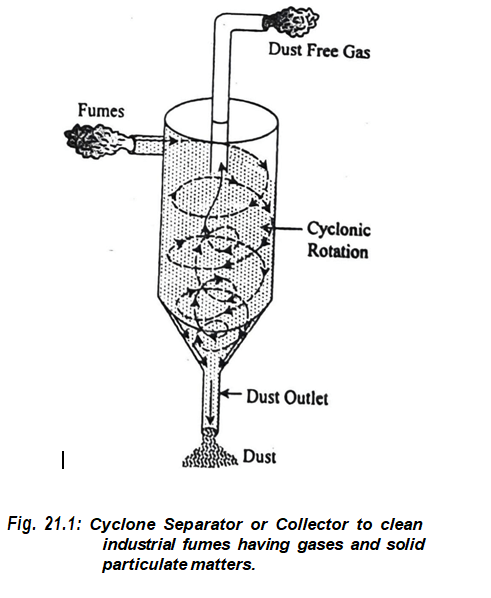
(b) Particulate matters of size larger than 50 micrometers are filtered and separated by cyclone separator or cyclone collector and wet scrubbers. The industrial fumes with particulate matters are allowed to pass through an opening into a conical cylinder where the fumes are whirled and chained at desired speed. The water scrubbers clean the gases by wetting them with water.
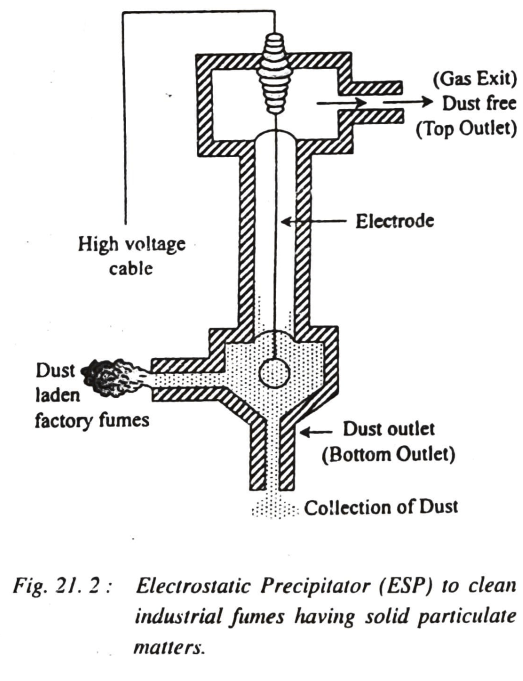
(c) Particulate matters of smaller size (smaller than one micrometer) are effectively handled by electrostatic precipitators, high energy scrubbers and fabric filters. Based on this principle smaller solid particulates emitted from the factory chimneys have electrical charges on their surfaces. High voltage electrodes attract charged dusts attracted and are forced to settle down.
Several other devices are used to control particulate and gaseous pollution of air as follows:
- Sulphur dioxide produced through the combustion of fossil fuels can be removed from stock gases by flue gas desulphurization methods.
- Combustion modifications may be adopted to control the emission of nitrogen oxides.
- Combustion modifications may also be used to reduce the emissions of carbon monoxide.
Air Pollution in India
- Air pollution in India is a serious environmental issue.
- Of the 30 most polluted cities in the world, 21 were in India in 2019.
- 51% of the pollution is caused by industrial pollution, 27 % by vehicles, 17% by crop burning and 5% by other sources.
- Exposure to particulate matter for a long time can lead to respiratory and cardiovascular diseases such as asthma, bronchitis, COPD, lung cancer and heart attack.
- India also has one of the highest number of COPD patients and the highest number of deaths due to COPD.
- Over a million Indians die prematurely every year due to air pollution, according to the non-profit Health Effects Institute.
- Asthma is the most common health problem faced by Indians and it accounts for more than half of the health issues caused by air pollution.
- The Air (Prevention and Control of Pollution) Act was passed in 1981 to regulate air pollution but has failed to reduce pollution because of poor enforcement of the rules.
Causes
- Fuel wood and biomass burning is the primary reason for near-permanent haze and smoke observed above rural and urban India
- Adulteration of gasoline and diesel with lower-priced fuels is common in South Asia, including India.
- Some adulterants increase emissions of harmful pollutants from vehicles, worsening urban air pollution.
- Financial incentives arising from differential taxes are generally the primary cause of fuel adulteration.
- Traffic congestion reduces the average traffic speed. At low speeds, scientific studies reveal that vehicles burn fuel inefficiently and pollute more per trip.
- The country emits 7% of global green house gas emissions, despite having 17% of the world population.
Steps taken
- Local governments of various states have implemented measures such as odd-even rationing, tighter vehicle emissions' norms, higher penalties for burning rubbish and better control of road dust.
- The Central Government has launched National Clean Air Programme (NCAP) under the Central Sector “Control of Pollution” Scheme as a long-term, time-bound, national level strategy to tackle the air pollution problem
- The Central Government has notified a Comprehensive Action Plan (CAP) in 2018 identifying timelines and implementing agencies for actions identified for prevention, control and mitigation of air pollution in Delhi and NCR.
- Graded Response Action Plan (GRAP) was notified on January 12, 2017, for prevention, control and abatement of air pollution in Delhi and NCR
- The Indian government has committed to a 50% reduction in households using solid fuel for cooking
- According to Inter-governmental Panel on Climate Change, India is committed to limit warming well below 2 degree Celsius, CO2 emissions should decline by about 20 per cent by 2030 and reach net zero around 2075; to limit warming below 1.5 degree Celsius, CO2 emissions should decline by 50 per cent by 2030 and reach net zero by around 2050.
- In 2015, Government of India, together with IIT Kanpur launched the National Air Quality Index.
- In 2019, India launched 'The National Clean Air Programme' with tentative national target of 20%-30% reduction in PM2.5 and PM10 concentrations by 2024.
Steps for creating awareness:
- SAMEER app has been launched wherein air quality information is available to public.
- The Ministry of Environment, Forest and Climate Change is implementing Environment Education, Awareness and Training Scheme with the objective to promote environmental awareness among all sections of the society.
Water Pollution
Introduction
- Water is the most important element in the biosphere because on one hand it is vital for the maintenance of all forms of life and on the other hand it helps in the movement, circulation and cycling of nutrients.
- Water is also essential for power generation, navigation, irrigation of crops, disposal of sewage etc.
- Though water like other natural substances has self-purifying capacity during recycling processes but when the amount of foreign undesirable substances added by the man to the water exceeds the tolerance level -it gets polluted.
- The substances which degrade the quality of water from its equilibrium state are called water pollutants.
Perspectives
- Water pollution is defined as 'natural or induced change in the quality of water which renders it unsuitable or dangerous as regards food, human and animal health, industry, agriculture, fishing or leisure pursuits'. - P. Vivier, 1958.
- The term water pollution 'refers to deterioration in chemical, physical and biological properties of water brought about by human activities and/or by natural (e.g., hydrological) processes which induce decomposed and vegetable materials and weathering products of rocks etc. - C.S. Southwick, 1976, Ecology and the Quality of Our Environment, New York.
- 'Foreign materials either from natural or other sources are contaminated with water supplies and may be harmful to life, because of their toxicity, reduction of normal oxygen level of water, aesthetically unsuitable effects and -spread of epidemic diseases. World Health Organization (WHO), 1966.
Sources of Water Pollutants
(1) Natural sources:
- Natural sources of water pollutants include soil erosion, landslides, coastal and cliff erosion, volcanic eruption and decay and decomposition of plants and animals.
(2) Anthropogenic sources:
- It is the anthropogenic sources which are the real sources of water pollution.
- Anthropogenic sources include industrial source, urban source, agricultural source, cultural source etc.
- Urban source contributes water pollutants such as sewage, huge quantity of municipal and domestic garbage, industrial effluents from the industrial units located in the urban centers, fallout of particulate matter of automobile exhausts etc.
Types of Water Pollutants
Water pollutants may be divided into certain categories on different bases such as sources of pollutants, physical and chemical properties of water, and the nature of degradation.
On the basis of sources of pollutants
(a) industrial pollutants
- examples: industrial wastewater, including several chemical pollutants such as chlorides, sulphide, carbonates, ammoniacal nitrogen, nitrites, nitrates, heavy metals such as mercury, lead, zinc, arsenic, baron etc., organic chemical compounds synthesized for industrial purposes, radioactive wastes etc.
(b) agricultural pollutants
- examples: chemical fertilizers, pesticides, insecticides and herbicides, and several other synthetic chemical compounds, weeds and plant remains.
(c) urban pollutants
- examples: various types of ions such as sulphate ion, nitrate ion, chlorine ion, and sodium ion, calcium ions and bicarbonate ions etc.
(d) natural pollutants
- examples: volcanic dusts, eroded and weathered sediments, debris caused by landslides, decayed, and decomposed organic matter (both plants and animals).
On the basis of physical and chemical properties
(a) physical pollutants
- examples: color, taste, turbidity, sediments, volcanic dust, oil and grease, dissolved and suspended solids, total solids.
(b) chemical pollutants
- examples: chlorides, sulphide, carbonates, ammoniacal nitrogen, nitrates, nitrites, pesticides, insecticides, herbicides, several other synthetic chemical compounds.
On the basis of degradability
(a) biodegradable pollutants.
(b) non-biodegradable pollutants.
- Degradable pollutants are those that can be broken down and decomposed by biological means such as decomposers/micro-organisms. Examples of biodegradable or organic pollutants are leaf litters, sewage, garbage, plants and animals, human and animal excreta etc.
- Non-degradable pollutants include all of the chemical pollutants and toxic solid substances. Such pollutants are also called as inorganic pollutants.
Types of Water Pollution
On the basis of sources and storages of water:
- Surface water (river water) pollution,
- Lake water pollution,
- Groundwater pollution, and
- Sea water pollution
On the basis of sources of water pollution:
- Sewage water pollution,
- Domestic waste water pollution,
- Industrial waste water pollution, and
- Solid waste water pollution
Surface (River) Water Pollution
Nature of river water pollution:
- The major source of surface water is precipitation.
- Surface water includes river water, lake water and pond water. Surface river water is polluted through the mixing of different quantities of dissolved inorganic matter in the form of ions.
Pollutants of River Water Pollution:
- US Department of Health, Education and Welfare (HEW) has classified pollutants of surface water pollution into 8 major categories as follows: Sewage wastes, Infectious agents, Plant nutrients and dissolved substances, Particulate matter, Radioactive substances, Mineral and chemical substances, Heat and Organic chemical exotics.
Types of River Pollution:
- Point pollution of river water involves discharge of pollutants mainly from industries and urban centers through sewage drains and industrial effluents at specific points (outfall points) at the riverbanks.
- Non-point pollution occurs mainly from agricultural fields through surface runoff. Rainfall generates surface runoff which removes chemical substances from land applied to agricultural fields.
- Increasing urbanization and industrial expansion are responsible for the release of enormous quantities of pollutants of various kinds through sewage effluents into the rivers and lakes and thus contaminating the water beyond permissible safety level.
- "Thermal enrichment", is the degradation of water quality by any process that changes ambient water temperature.
- This can also be caused by the release of very cold water from the base of reservoirs into warmer rivers.
- The introduction of aquatic invasive organisms is a form of water pollution as well. It causes biological pollution.
Lake and Sea Water Pollution
- Lakes are polluted through natural and anthropogenic sources.
- Siltation of lakes due to rapid rate of deforestation is the major form of anthropogenic source of lake pollution.
- Numerous lakes in the Kumaun Region of Uttarakhand (India) have disappeared or are near extinction due to increased rate of weathering and erosion.
- The discharge of organic waste matter from hill slopes surrounding Nainital lake from all sides and toxic effluents from the urban area has polluted the lake water.
- Washing and dumping of tailings or waste sludges from factories into stagnant water of lakes and tanks pollute them more than they pollute the rivers because the river water is mobile while the lake water, in most cases, is stagnant.
- If the concentration of a single matter becomes very high, it may become a killing factor and the water so contaminated may turn into 'killer water'.
- Inorganic nutrients from the agricultural fields are also brought to the lakes by surface runoff, rivulets, streams and rivers. Besides, nitrates, phosphates and organic matters are contributed by sewage treatment plants.
- Acid lakes are caused by pollution from factories and other man-made sources such as fossil fuels and automobiles.
- Most of the lakes in Norway and Sweden have lost their biological communities and are now biologically termed as 'dead lakes,' according to a study conducted by the University of Oslo.
Seawater/ Marine Pollution
- “Seawater contamination is known as marine pollution”.
- There are numerous sources that contaminate marine ecology such pollution occurs due to soil erosion & mining.
- Sea water is polluted mostly near the coast through the disposal of urban and industrial waste matters.
- Concentration of a single matter in the littoral water causes serious environmental problem.
- For example, concentration of mercury in the Minamata Bay (Japan) (Minamata disease) due to dumping of mercury-rich sludges caused severe mercury poisoning.
Types of Marine Pollution:
- Toxin marine Pollution: Toxins such as DDT, Furan, Radioactive waste, pesticides, PCB, TBT, Phenol etc. neither gets dissolve nor gets fragmented and hence cause dangerous effects to marine life.
- Eutrophication Marine Pollution: Eutrophication actually means nutrient pollution which occurs when excessive chemical nutrients (especially nitrates & phosphates) are present in water.
- Plastic Marine Pollution: The rate of plastic dumped in the oceans is increasing simultaneously with the increase of human population. The plastic dumps are affecting the marine ecosystem.
- Acidification Marine Pollution: water of the oceans is becoming acidic due to the excessive carbon dioxide present in the atmosphere. Acidification of oceans is also affecting marine life.
Source of Marine Pollution:
- Plastics: Dumping of plastic bag, bottles, microbeads etc.
- Sewage disposed of in sea water.
- Toxins from various sources such as pesticides, fertilizers, phenol etc.
- Thermal pollution - increasing the temperature of the water.
- Leakage of immense quantities of crude oils from oil tankers and offshore oil wells is a major source of sea water pollution.
- Deep-sea mining affects the base level of the ocean.
- Maritime traffic.
- Air pollution – increased CO2 in atmosphere, acid rain.
Groundwater Pollution
- Groundwater is polluted through a variety of sources viz. leaching and downward movement of pollutants.
- Sources of these pollutants:
- Agricultural field ( nitrates, potassium, insecticides, fertilizers and pesticides)
- Industrial dumping areas,
- Urban and rural garbage,
- Sewage and sewage sludge
- Earthen septic tanks and
- Polluted ponds and tanks.
- The main controlling factors of groundwater pollution are lithological characteristics of sub-soils and subsurface materials, depth of water table of groundwater and nature of aquifer.
- The loose and friable sandy soils, high water table and moderate to high annual rainfall accelerate the rate of infiltration of rainwater and rapid downward movement of pollutants with percolating water.
- Pollutants which move downward with percolating water are called leachates.
- Leaching of polluting ions from the earthen soak pits and septic tanks and rotten and damaged underground sewer pipelines often pollute groundwater up to a depth of 400 m.
- Several case of pollution of groundwater mainly the water drawn up by hand pumps and from wells have been reported almost from all of the world.
- Pollution of well water was reported back as 1831 in the USA when 3500 people were killed in New York City because of cholera due to the use of polluted water.
- Underground cavities caused by excessive pumping of water from groundwater reserves in the cities located near the seacoast result in contamination of groundwater because of leakage of saline sea water into the cavities.
Effects of Water Pollution
Impact on health
- The use of polluted water for drinking purpose causes epidemics and several dangerous diseases such as cholera, tuberculosis, typhoid, jaundice, dysentery, paratyphoid, diarrhea etc.
- Water polluted with high concentration of certain trace minerals causes stomach disorders and cancer mainly in hill areas, sclerosis etc.
- Higher concentration of arsenic matter causes severe skin disease as happens in Kolkata and its environs.
- Use of polluted water can cause contamination of food chain through polluted irrigation water, consumption of contaminated aquatic organism etc.
Impact on ecosystem
- Heavy concentration of toxic chemicals in water causes death of aquatic organisms, both plants, animals and micro-organisms.
- Some natural and anthropogenic substances may cause turbidity (cloudiness) which blocks light and disrupts plant growth, and clogs the gills of some fish species.
- The use of river water with high concentration of sand load for irrigation purposes reduces soil fertility and raises water requirement of soils.
- Water having higher concentration of salt content increases alkalinity of soils.
- Water scarcity is also related with water pollution. The UN says that billions of people around the world have no access to clean water to drink or sanitation, particularly in rural areas.
- Increased uptake of CO2 caused Oceans to be acidic.
Eutrophication
- Nitrogen pollution can cause eutrophication, especially in lakes.
- Eutrophication is the process by which an entire body of water, or parts of it, becomes progressively enriched with minerals and nutrients, particularly nitrogen and phosphorus.
- It has also been defined as "nutrient-induced increase in phytoplankton productivity".
- Depending on the degree of eutrophication, subsequent negative environmental effects such as anoxia (oxygen depletion) and severe reductions in water quality may occur, affecting fish and other animal populations.
Control of Water Pollution
Control of water pollution requires several remedial measures involving individuals, community, governments at national and international levels as follows:
- The individuals must be educated enough to understand the nature of water pollution and its adverse effects on human health and wealth.
- People must restrain themselves from throwing human and animal excreta and garbage into any water body.
- Government should provide adequate funds to the municipal corporations for making water pollution control more effective.
- Government must bring in force effective laws for water pollution control measures.
Some Methods that can be utilized are:
- Adoption of pollution control policy.
- Sanitation and sewage treatment.
- Industrial wastewater treatment.
- Agricultural wastewater treatment.
- Management of erosion and sediment control.
- Control of urban runoff (storm water).
- Legislation.
Water pollution in India
- Water pollution has already assumed alarming proportion in many large cities and industrial complexes in India such as in Delhi, Kanpur, Varanasi, Kolkata, Mumbai, Chennai etc.
- About 80% of India's drinking water needs are met by polluted ground water.
- Only 21.5 per cent of the solid waste generated in India is processed.
- This debris is one of the main sources of river water pollution.
- The death of over one lakh children and losses of a whopping 3.6 lakh crore are caused every year in India by poor sanitation and hygiene issues.
- The following examples denote the nature of water pollution in India.
- The Yamuna River at Delhi has, in fact, become a sewage as 323 million gallons of sewage enter the Yamuna per day through 17 open drains.
- The capacity of all treatment plants of the Municipal Corporation of Delhi (MCD) is only 184 million gallons per day.
- The contamination of streams in Medak district of Andhra Pradesh from the effluents of chemical plants presents the haunting spectrum of hazardous pollution caused by human activities.
Challenges
- Major gaps in standard setting, including lack of standards for ambient water quality,
- poor monitoring and weak enforcement by the pollution control boards
- Orthodox religious faiths are also adding fuels to the problem of river water pollution.
- Inspite of the provision of electric crematorium in several big cities at the bank of the Ganga people still burn dead human bodies with wood and throw half burnt wood, ash and human bodies in the River Ganga.
Government steps
- Water being a State subject, initiatives on water management including conservation and water harvesting in the Country is primarily States’ responsibility.
- However, the important measures taken by the Central Government for conservation, management of ground water and effective implementation of rain water harvesting in the country.
- The government of India has already taken initiative in controlling water pollution by passing the Water (Prevention and Control of Pollution) Act in 1974.
- This water pollution prevention and control Act aims at the maintenance of good water quality for human use. Important Water Acts are given below:
Central Water Control Acts:
- Before Independence:
- The North India Canal and Drainage Act, 1873.
- The Obstruction of Fairways (navigable channel) Act, 1881.
- The Indian Fisheries Act, 1897.
- After Independence:
- The Damodar Valley Corporation (Prevention of Pollution of Water) Regulation Act, 1948.
- The River Boards Act, 1956.
- The Merchant (Amendment) Shipping Act, 1970.
- The water (Prevention and Control of Pollution) Act, 1974.
- The Water (Prevention and Control of Pollution) Cess Act, 1977.
- The Water Prevention and Control of Pollution) Cess Rules, 1978.
- The Coastal Regulation Zone Notification, 1991.
- The government plans to clean the Ganga and the Yamuna under the Ganga Action Plan (GAP) and the Yamuna Action Plan (YAP).
Global scenario
- One in nine people worldwide uses drinking water from unimproved and unsafe sources.
- 2.4 billion people live without any form of sanitation.
- Lack of sanitation is one of the most significant forms of water pollution.
- 90% of sewage in developing countries is discharged untreated directly into water bodies.
- Every day 2 million tonnes of sewage and other effluents drain into the world’s water.
- Industry discharges an estimated 300-400 megatonnes of waste into water bodies every year.
- Non-point source pollution from agriculture and urban areas often greatly increases the total pollutant load together with industrial point source pollution.
- A reduction of about one-third of the global biodiversity is estimated to be a consequence of the degradation of freshwater ecosystems mainly due to pollution of water resources and aquatic ecosystems.
- Re-use of wastewater in agriculture is important for livelihoods, but is associated with serious health risks.
The 2030 Agenda and Sustainable Development Goals (SDGs) bring water quality issues to the forefront of international action by setting Goal 6 specifically aiming to “ensure availability and sustainable management of water and sanitation for all” to respond to the pressing challenges posed by water quality issues.
Water standard
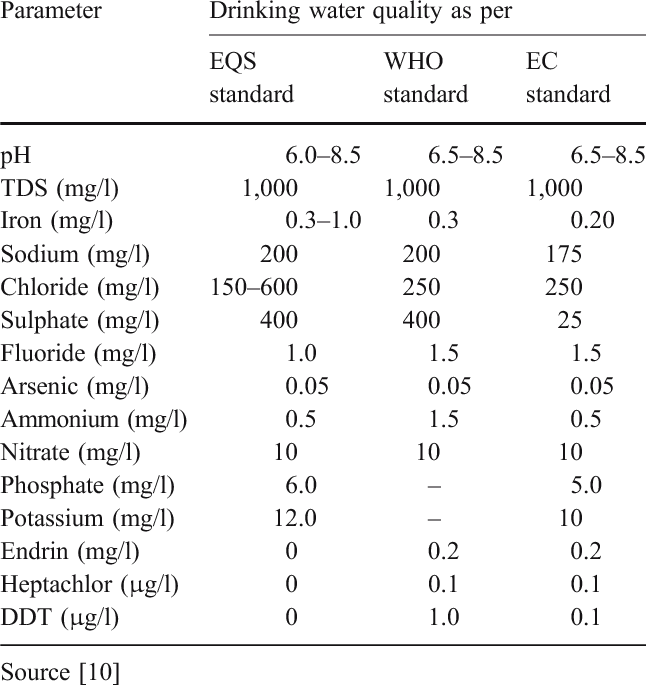
- WHO produces international norms on water quality and human health in the form of guidelines that are used as the basis for regulation and standard setting, in developing and developed countries worldwide.
- The quality of drinking water is a powerful environmental determinant of health.
- Assurance of drinking water safety is a foundation for the prevention and control of waterborne diseases.
- Parameters that are frequently sampled or monitored for water quality include temperature, dissolved oxygen, pH, conductivity, ORP, and turbidity.
Groundwater Pollution
Introduction
- Groundwater pollution occurs when pollutants are released to the ground and make their way into groundwater.
- Virtually any activity whereby chemicals or wastes may be released to the environment, either intentionally or accidentally, has the potential to pollute ground water.
- When ground water becomes contaminated, it is difficult and expensive to clean up.
Pollutant types
- Contaminants found in groundwater cover a broad range of physical, inorganic chemical, organic chemical, bacteriological, and radioactive parameters.
- Principally, many of the same pollutants that play a role in surface water pollution may also be found in polluted groundwater, although their respective importance may differ.
Some of the important pollutants found in groundwater are:
- Arsenic and fluoride: The metalloid arsenic can occur naturally in groundwater and through leaching of mining waste.
- Pathogens: The lack of proper sanitation measures, as well as improperly placed wells, can lead to drinking water contaminated with pathogens carried in feces and urine.
- Nitrate: by on-site sanitation, sewage sludge disposal and agricultural activities.
- Organic compounds(VOC) : through careless industrial practices, insecticides and herbicides . Primary VOC pollutants found in groundwater include aromatic hydrocarbons such as BTEX compounds (benzene, toluene, ethylbenzene and xylenes), and chlorinated solvents including tetrachloroethylene (PCE), trichloroethylene (TCE), and vinyl chloride (VC).
- Metals: industrial activities such as mining, metallurgy, solid waste disposal, paint and enamel works, etc. can lead to elevated concentrations of toxic metals including lead, cadmium and chromium.
- Pharmaceuticals: antibiotics, anti-inflammatories, antidepressants, decongestants, tranquilizers, etc. are normally found in treated wastewater.
- Others: Petroleum hydrocarbons, various chemical compounds found in personal hygiene and cosmetic products, drug pollution.
Sources of Ground Water Contamination
- Natural Sources.
- Sewers and Other Pipelines.
- Septic Systems.
- Surface Impoundments.
- Improper Disposal of Hazardous Waste.
- Releases and Spills from Stored Chemicals and Petroleum Products.
- Landfills.
- Pesticide and Fertilizer Use.
- Drainage Wells.
- Injection Wells/Floor Drains.
- Improperly Abandoned Wells.
- Active Drinking Water Supply Wells.
- Poorly Constructed Irrigation Wells.
- Mining Activities.
Effects of Groundwater Pollution
Health Issues:
- Contaminated groundwater has detrimental effects on human health.
- The waste may contain hepatitis-causing bacteria that may lead to irreversible damage to the liver.
- Also, it may cause dysentery, which leads to severe diarrhea, dehydration, and, in some cases, death.
- Additional health problems include poisoning that may be a result of the use of excessive pesticides and fertilizers or natural chemicals.
- The chemicals leach into water sources and poison them. Drinking water from such a source may lead to serious health effects.
Economic effect:
- Contamination of groundwater sources renders the area incapable of sustaining plant, human, and animal life.
- The population in the area reduces and the land value depreciates.
- It leads to less stability in industries relying on groundwater to produce their goods.
- The industries in the affected areas will have to outsource water from other regions, which may turn out to be expensive.
- In addition, they may be forced to close down due to the poor quality of water.
Effect on ecosystem:
- Groundwater pollution can lead to devastating environmental changes.
- One such alteration is the loss of certain nutrients that are essential for the self-sustenance of the ecosystem.
- Also, when the pollutants mix with water bodies, alteration of the aquatic ecosystem may also occur.
- Aquatic animals such as fish may die off quickly as a result of too many contaminants in the bodies of water.
- Animals and plants using contaminated water may also be affected.
- Toxic substances accumulate with time in the aquifers and once the prime spreads, it may render the groundwater unsuitable for human and animal consumption.
- The effects are serious, especially for people who rely on groundwater during drought periods.
Prevention
Precautionary principle:
- The precautionary principle, evolved from Principle 15 of the Rio Declaration on Environment and Development, is important in protecting groundwater resources from pollution.
- It provides that “where there are threats of irreversible damage, lack of full scientific certainty shall not be used as reason for postponing cost-effective measures to prevent environmental degradation.”
Groundwater quality monitoring:
- They are important components to understand the hydrogeological system, and for the development of conceptual models and aquifer vulnerability maps.
- Contaminant levels can be compared to the World Health Organization (WHO) guidelines for drinking-water quality.
- When a problem is found, action should be taken to correct it.
Land zoning for groundwater protection:
- There are two types of zoning maps: aquifer vulnerability maps and source protection maps.
Locating on-site sanitation systems:
- On-site sanitation systems can be designed in such a way that groundwater pollution from these sanitation systems is prevented from occurring.
- Detailed guidelines have been developed to estimate safe distances to protect groundwater sources from pollution from on-site sanitation.
Legislation:
- Institutional and legal issues are critical in determining the success or failure of groundwater protection policies and strategies.
Management
Options for remediation of contaminated groundwater can be grouped into the following categories:
- containing the pollutants to prevent them from migrating further.
- removing the pollutants from the aquifer.
- remediating the aquifer by either immobilizing or detoxifying the contaminants while they are still in the aquifer (in-situ).
- treating the groundwater at its point of use.
- abandoning the use of this aquifer's groundwater and finding an alternative source of water.
Methods
Point-of-use treatment:
- Portable water purification devices or "point-of-use" (POU) water treatment systems and field water disinfection techniques can be used to remove some forms of groundwater pollution prior to drinking, namely any fecal pollution.
- Techniques include boiling, filtration, activated charcoal absorption, chemical disinfection, ultraviolet purification, ozone water disinfection, solar water disinfection, solar distillation, homemade water filters.
Groundwater remediation:
- Ground water treatment (or remediation) techniques span biological, chemical, and physical treatment technologies.
- Some of the biological treatment techniques include bioaugmentation, bioventing, biosparging, bioslurping, and phytoremediation.
- Some chemical treatment techniques include ozone and oxygen gas injection, chemical precipitation, membrane separation, ion exchange, carbon absorption, aqueous chemical oxidation, and surfactant-enhanced recovery.
- Some chemical techniques may be implemented using nanomaterials.
- Physical treatment techniques include, but are not limited to, pump and treat, air sparging, and dual phase extraction.
Abandonment:
- If treatment or remediation of the polluted groundwater is deemed to be too difficult or expensive, then abandoning the use of this aquifer's groundwater and finding an alternative source of water is the only other option.
Groundwater pollution in India
- According to the Central Groundwater Board, India's groundwater is highly polluted.
- As many as 276 districts have high concentrations of fluoride.
- Nitrates above acceptable levels are found in 387 districts, and arsenic in high quantities is present in eighty-six districts.
- Many districts have more than one, two or three toxic elements in ground water.
- In the Ganges Plain of northern India severe contamination of groundwater by naturally occurring arsenic affects 25% of water wells in the shallower of two regional aquifers.
- Groundwater in these areas is also contaminated by the use of arsenic-based pesticides.
- Affected states include Uttarakhand, Uttar Pradesh, Delhi, Madhya Pradesh, Bihar, Jharkhand, Rajasthan, Chhattisgarh, Punjab, Haryana, and West Bengal.
Challenges
- Most of the desalination plants commissioned by government agencies became non-operational due to lack of technical manpower for maintenance and improper selection of membrane.
- Most of the treatment systems for drinking water have to be tried out at the community level to be cost effective and affordable.
- Civil society/institutions need to be strengthened to respond to water quality problems quickly.
Policies
- Jal Shakti Abhiyan (JSA) in 2019, a time bound campaign with a mission mode approach intended to improve water availability including ground water conditions in the water stressed blocks of 256 districts in India
- As per the guidelines all new/ existing industries and industries seeking expansion, infrastructure projects and mining projects extracting groundwater shall be required to seek NOC from CGWA or, the concerned State/ UT Ground Water Authority.
- the Atal Bhujal Yojana, to help improve groundwater management. Implemented in 9000 gram panchayats across seven Indian states.
- The “Paani Bachao, Paisa Kamao” (Save Water, Earn Money) scheme of Punjab gov to incentiviz farmers to reduce groundwater usage.
Global Scenario
- More than 2.5 billion people on the globe rely on groundwater for drinking and providing high-quality drinking water has become one of the major challenges of human society.
- Nearly 108 countries of the globe affected by arsenic contamination in groundwater.
- More than 230 million people, including 180 million from Asia are at risk.
- More than 90% of arsenic pollution is inferred to be geogenic.
- Prolonged consumption of arsenic-contaminated groundwater results in severe health issues.
Surface Water Pollution
Introduction
Surface water is any body of water found on the Earth’s surface, including oceans, lakes, and rivers. It is at risk from pollution due to its exposure and ability to dissolve substances rapidly. Surface water pollution can have serious health implications when contaminated water is consumed.
Sources of Surface Water Pollution
- Point Sources
- Industrial discharge.
- Sewage treatment plants.
- Oil spills.
- Non-Point Sources
- Agricultural runoff (pesticides, fertilizers).
- Urban runoff (stormwater).
- Atmospheric deposition.
Point Sources
Industrial discharge:
- Factories and manufacturing plants often release harmful chemicals and pollutants into nearby water sources.
- Example: A chemical plant dumping waste into a river, causing contamination and harm to aquatic life.
Sewage treatment plants:
- Wastewater treatment facilities can release untreated or partially treated sewage into rivers and streams.
- Example: A malfunctioning sewage treatment plant releasing raw sewage into a local waterway.
Oil spills:
- Accidental or intentional spills of oil can have devastating effects on surface water quality.
- Example: An oil tanker leaking oil into the ocean, leading to widespread pollution and harm to marine life.
Non-Point Sources
Agricultural Runoff:
- Excessive use of pesticides and fertilizers on farms can lead to runoff into nearby water bodies, contaminating them with harmful chemicals.
- For example, runoff from a cornfield treated with pesticides can flow into a nearby stream, affecting aquatic life.
Urban Runoff:
- Stormwater runoff from urban areas can carry pollutants such as oil, grease, and litter into rivers and lakes.
- For example, runoff from a parking lot can carry oil and grease into a nearby river, impacting water quality.
Atmospheric Deposition:
- Pollutants from the air, such as sulfur dioxide and nitrogen oxides, can be deposited onto the surface of water bodies through rainfall.
- For example, acid rain caused by air pollution can lead to increased acidity in lakes and streams, harming aquatic ecosystems.
Effects of Surface Water Pollution
- Contamination of Drinking Water: Surface water pollution can lead to the contamination of drinking water sources, posing a risk to human health.
- Harm to Aquatic Life: Pollutants in surface water can harm aquatic life by disrupting ecosystems, causing fish kills, and reducing biodiversity.
- Impact on Agriculture: Polluted surface water can affect agricultural activities by contaminating irrigation water and soil, leading to reduced crop yields and food safety concerns.
- Economic Costs: Surface water pollution can result in economic costs due to the need for water treatment, loss of revenue from fisheries, and decreased tourism in affected areas.
- Health Risks: Exposure to polluted surface water can result in various health risks for humans, including skin irritation, gastrointestinal issues, and respiratory problems.
- Eutrophication: Excessive nutrient pollution in surface water can lead to eutrophication, causing algal blooms, oxygen depletion, and the death of aquatic organisms.
Case Studies
- Flint Water Crisis: The contamination of the Flint River in Michigan with lead resulted in a public health crisis, with residents experiencing adverse health effects due to drinking contaminated water.
- Love Canal Disaster: The dumping of toxic chemicals at Love Canal in New York led to the contamination of surface water and soil, causing health issues for residents and resulting in the area being declared a Superfund site.
- Exxon Valdez Oil Spill: The oil spill in Prince William Sound, Alaska, caused by the Exxon Valdez tanker, resulted in extensive pollution of surface water, harming marine life and ecosystems in the area.
- Citarum River Pollution: The Citarum River in Indonesia is one of the most polluted rivers in the world, with industrial and domestic waste contaminating the water and causing health issues for local communities.
- Ganges River Pollution: The Ganges River in India is heavily polluted with sewage, industrial waste, and agricultural runoff, leading to waterborne diseases and environmental degradation along its banks.
- Great Pacific Garbage Patch: The accumulation of plastic debris in the Pacific Ocean has created a massive garbage patch, impacting marine life and ecosystems through ingestion, entanglement, and habitat destruction.
Land/Soils Pollution
Introduction
- Land simply means the surficial parts of lithosphere wherein soil is the most significant aspect of land surface for biological communities.
- Land degradation simply means loss of utility of land for plants and animals.
- Soil pollution is the major form of land degradation and pollution.
- Soil is a very important natural resource because it provides the base for the evolution and development of human society, as well as the medium for production of food and timber.
- The formation of soil is a slow process.
- Thus it cannot be replaced if destroyed or lost through excessive soil erosion caused by anthropogenic activities.
- Soil pollution hampers the achievement of Sustainable Development Goals (SDGs), including achieving zero hunger, ending poverty, ensuring healthy lives and human well-being, halting and reversing land degradation and biodiversity loss, and making cities safe and resilient.
Soil Pollution: Definition
- Soil pollution is defined as a degradation or even destruction of the earth’s surface and soil as a result of human activities.
- According to Environmental Pollution Centers, soil pollution is, “The presence of toxic chemicals (pollutants or contaminants) in soil, in high enough concentrations to pose a risk to human health and/or the ecosystem. In the case of contaminants which occur naturally in soil, even when their levels are not high enough to pose a risk, soil pollution is still said to occur if the levels of the contaminants in soil exceed the levels that should naturally be present.”
Factors of Soil Pollution
Decrease in the quality of soils is caused due to accelerated rate of soil erosion, decrease in plant nutrients, decrease in soil micro-organisms, excess or deficit of moisture content, high fluctuation of temperature, lack of humus content and input and concentration of various types of pollutants.
The main factors of soil pollution are
- Accelerated rate of soil erosion consequent upon major land use changes (e.g., deforestation);
- Excessive use of chemical fertilizers, pesticides, insecticides, and herbicides;
- Polluted wastewater from industrial and urban areas;
- A few micro-organisms;
- Forest fires;
- Dumping of urban and industrial solid wastes;
- Water logging and related capillary process;
- Leaching processes;
- Drought etc.
Sources of Soil Pollution
The sources or agents of soil pollution may be divided into the following categories:
- physical agents/sources,
- biological agents/sources,
- air-born sources,
- biocides and chemical fertilizers, and
- urban and industrial sources.
- Nuclear sources
Physical source:
- Soil pollution is related to soil erosion and consequent soil degradation caused by natural and anthropogenic factors.
- In most of the developing countries of the tropical and subtropical regions accelerated rate of soil erosion due to rapid rate of deforestation and faulty agricultural practices has degraded the soil on a large-scale.
Biological sources:
- These agents of soil pollution include those micro- organisms and unwanted plants which degrade the quality and therefore fertility of the soils.
- Micro-organisms enter the soils from various sources and degrade them.
- These micro-organisms also enter the food chains and thus affect human bodies.
Air-born sources:
- These are, in fact, air pollutants which are released into the atmosphere by 'human volcanoes' , automobiles, thermal power plants, industrial activities and domestic sources.
- The fallouts of these pollutants are deposited in the soils which are polluted due to toxic substances.
- Acid rains increase the acidity of the soils. Highly acidic soils are injurious to plant growth.
- Sulphur dioxide emitted from the factories in U.K. and Germany has been responsible for widespread acid rains in the Scandinavian countries wherein substantial decrease in soil pH and increased soil acidity have largely damaged forest resources.
- Chlorine and nitrogen oxides emitted from the factories combine with the water and pollute the soils by altering the chemical composition.
- Numerous mica chips may be seen strewn all over the agricultural fields in the vicinity of Kodarma mica belt of Jharkhand.
- Fallouts of metallic particulate matter from metal smelters into soils damage their physical and chemical properties.
- The fallouts of mercury released from industrial processes and combustion of fossil fuels when mixed in the soils reach the food chain.
Chemical fertilizers and biocides:
- Excessive use of chemical fertilizers to boost agricultural production causes alteration in the physical and chemical properties of soils, though chemical fertilizers act as inorganic plant nutrients.
- Biocides reach the food chains in toxic forms and ultimately enter the bodies of human beings and even animals through food they eat.
- Biocides first kill germs and unwanted plants and then degrade the quality of soils and reach the plants through their roots. Biocides are, thus, called as creeping deaths.
- The analysis of innumerable samples of food grains all over the world has shown that the human food is widely contaminated by the concentration of pesticides, insecticides and herbicides and thus these synthetic chemicals have become a part of human diet all over the world.
- The main culprits are carbaryl, D.D.T., malathion, parathion, dieldrin, lindane, hepatachlor, aldrine etc.
- Some harmful chemical compounds are:
- Organic phosphate compounds e.g., malathions. These are used to kill insects by damaging their nerve systems. Frequent use of these chemicals results in the accumulation of acetyl chorine in the soils and ultimately these chemicals are transported to plant tissues.
- Chlorinated hydrocarbon compounds e.g., D.D.T. dieldrin, aldrin etc. are generally used to kill insects and micro-organisms. These chemicals stay for relatively longer period in the soils and other components of physical environment and are not required to be used frequently.
- Arsenic containing pesticides reach the soils and are transported to plants and thus to food grains. These chemicals cause gastric and digestive problem in humans.
- Sodium fluoroacetates are generally used to kill rodents and accumulate in the soils to reach the food chains.
Urban and Industrial sources:
- Disposal of Industrial and Urban wastes are the major problem for soil pollution Sources.
- Industrial pollutants are mainly discharged from various origins such as pulp and paper mills, chemical fertilizers, oil refineries, sugar factories, tanneries, textiles, steel, distilleries, fertilizers, pesticides, coal and mineral mining industries, drugs, glass, cement, petroleum and engineering industries etc.
- Urban wastes comprise of both commercial and domestic wastes consisting of dried sludge and sewage.
- All the urban solid wastes are commonly referred to as refuse.
- This refuse consists of garbage and rubbish materials like plastics, glasses, metallic cans, fuel residues, containers, abandoned vehicles, other discarded manufactured products etc.
Nuclear sources:
- Radioactive substances resulting from explosions of nuclear testing laboratories and industries giving rise to nuclear dust radioactive wastes, penetrate the soil and accumulate giving rise to land/soil pollution.
Effects of Soil Pollution
Health effect
- Contaminated or polluted soil directly affects human health through direct contact with soil or via inhalation of soil contaminants that have vaporized.
- Potentially greater threats are posed by the infiltration of soil contamination into groundwater aquifers used for human consumption, sometimes in areas apparently far removed from any apparent source of above-ground contamination.
- Toxic metals can also make their way up the food chain through plants that reside in soils containing high concentrations of heavy metals
- Researchers suggest that pesticides and heavy metals in soil may harm cardiovascular health, including inflammation and change in the body's internal clock.
- Chronic exposure to chromium, lead , and other metals, petroleum, solvents, and many pesticide and herbicide formulations can be carcinogenic, can cause congenital disorders, or can cause other chronic health conditions.
- At sufficient dosages a large number of soil contaminants can cause death by exposure via direct contact, inhalation or ingestion of contaminants in groundwater contaminated through soil.
Ecosystem effect
- There are radical soil chemistry changes which can arise from the presence of many hazardous chemicals even at low concentration of the contaminant species.
- These changes can manifest in the alteration of metabolism of endemic microorganisms and arthropods resident in a given soil environment.
- The result can be virtual eradication of some of the primary food chain, which in turn could have major consequences for predator or consumer species.
- Even if the chemical effect on lower life forms is small, the lower pyramid levels of the food chain may ingest alien chemicals, which normally become more concentrated for each consuming rung of the food chain.
- Such as the concentration of persistent DDT materials for avian consumers, leading to weakening of egg shells, increased chick mortality and potential extinction of species.
Agriculture impact
- Contaminants typically alter plant metabolism, often causing a reduction in crop yields.
- This has a secondary effect upon soil conservation, since the languishing crops cannot shield the Earth's soil from erosion.
Control of Soil Pollution
1. Implementing proper waste management practices:
- Encouraging recycling and composting to reduce the amount of waste being disposed of in landfills.
- Proper disposal of hazardous waste to prevent contamination of soil.
2. Regulating the use of pesticides and fertilizers:
- Monitoring and controlling the use of chemicals in agriculture to prevent soil contamination.
- Promoting organic farming practices to reduce reliance on synthetic chemicals.
3. Remediation of contaminated sites:
- Implementing cleanup efforts at contaminated sites to restore soil quality.
- Utilizing techniques such as phytoremediation and bioremediation to remove pollutants from the soil.
4. Educating the public on soil pollution:
- Increasing awareness about the causes and effects of soil pollution.
- Encouraging individuals to take steps to reduce their impact on soil quality.
5. Enforcing environmental regulations:
- Implementing and enforcing laws and regulations to prevent soil pollution.
- Holding polluters accountable for their actions and ensuring they clean up contaminated sites.
6. Promoting sustainable land use practices:
- Encouraging responsible land development to minimize soil disturbance.
- Implementing measures to prevent erosion and soil degradation.
Indian Scenario
Status
- Soils around cities and industrial areas having high population density play an important role on human health, as considerable fraction of the food requirement are met from the agricultural activities surrounding the area.
- Soil degradation estimates in India is almost entirely focused on loss of soil and its productivity due to either natural processes or accelerated natural processes of erosion and ionic movements through faulty soil and water management.
- CPCB identified critically polluted industrial areas and clusters or potential impact zone based on its Comprehensive Environmental Pollution Index (CEPI) rating.
- 43 critically polluted zones were reported in the 16 states which have CEPI rating more than 70.
- Among the 43 sites, 21 sites exist in only four states namely Gujarat, Uttar Pradesh, Maharashtra and Tamil Nadu.
- A study conducted by ICAR-Indian Institute of Soil Science, Bhopal has indicated built-up of heavy metals in soils due to industrial activities.
- According to the study conducted by UNICEF, soil contamination was found to be 1.13 times more likely in non-ODF villages as compared to ODF villages.
Challenges
- Lack of awareness and Socio-economic limitations that further exacerbate lifestyle choices and consumer behaviour;
- Lack of public involvement in knowledge-sharing and understanding of soil pollution
- Lack of political will and leadership and illegal waste disposal
- Infrastructure and capacity gaps
Steps
A. State Plan Schemes
- Soil & Water Conservation in General Areas.
- Watershed Management Programme.
B. Centrally Sponsored Schemes
- Integrated Wasteland Development Programme (IWDP): involving village communities in the implementation of Watershed Development Projects
- Integrated Watershed Management Programme (IWMP): dissipate soil and water erosion and surface run-off, improve production and productivity, improve soil health and tilth etc.
C. Additional Central Assistance
- Watershed Development project in Shifting Cultivation Areas (WDPSCA)
- Accelerated Irrigation Benefits Programme (AIBP)
D. NABARD Loan
- Rural Infrastructure Development Fund (RIDF)
E. Other Government of India Schemes
- Soil Conservation for enhancing the productivity of degraded lands in the catchment of River Kopili in Jaintia Hills District under Macro-Management Mode of Agriculture Department, Meghalaya.
- Rastriya Krishi Vigyan Yojna (RKVY)
Solid Waste Pollution
Introduction
- The environmental pollution caused by these solid wastes is rapidly increasing in tune with rapid rate of industrial growth and urbanization.
- The problem of disposal of ever increasing quantities of solid substances has become a headache for not only industrialized and developed countries but also for most of the developing countries.
- There are numerous graveyards of abandoned automobiles in the developed countries.
- If these wastes remain untreated, it leads to air, water, soil or solid waste pollution. Hence, solid waste management is very essential.
Definition
- Solid waste substances are those materials which become useless after short period of their use such as newspapers, different types of cans, bottles, broken glass wares, plastic containers, polythene bags, ashes and domestic garbage.
- Solid waste pollution is the presence or excessive presence of solid wastes in the environment (air, water, soil), making it less fit or unfit for living beings.
Sources/ Causes of Solid Waste Pollution
- Residential and household wastes (Municipal Solid Wastes).
- The garbage from these places includes consumer goods like food waste, plastic, paper, glass, leather, cardboard, metals, ash and electronic waste such as IC boards, wires, batteries, etc.
- Commercial places through improper disposal of papers, cups, plastic plates, packaging materials, cans, bottles, polythene bags, etc.
- Light and heavy manufacturing units.
- Construction and mining areas (dust, concrete, scrap metals, and wood).
- Biomedical waste generated during diagnosis, treatment or prevention of diseases by hospitals such as sponges, syringes, needles, bandages, infectious fluids or materials.
- Spoiled agricultural and dairy produce from farmland, orchards, dairies.
- Left out bodies of dead animals on roads, rivers and lakes.
- Short shelf life of technical items and social trends around these gadgets leads to early disposal, thereby leading to electronic solid waste pollution.
Effect
Environmental impacts
- Dumping grounds are one of the main cause of land degradation.
- Leachates from refuge dumps percolates into the soil and contaminate underground water.
- Scavengers and stray animals invade the roadside garbage and litter the waste over large area causing much aesthetic damage to the atmosphere.
- Waste products when burnt like plastic and rubber pollute the atmosphere with toxic fumes.
- Organic solid wastes emits obnoxious odor on their decomposition and make the environment polluted.
Health hazards
- Vectors like rats and insects invade refuse dumps and spread various diseases.
- Water and food contamination through flies causes various diseases in humans as dysentery, diarrhea and amoebic dysentery.
- Rats dwelling with infectious solid wastes may spread diseases like plague, salmonellosis, trichinosis, endemic typhus etc.
- During handling and transfer of hospital and clinic wastes, disease transmission may take place.
- Water supply, if gets contaminated with pathogens present in solid wastes, may result in cholera, jaundice, hepatitis, gastro enteric diseases etc.
- Choking of drains and gully pits by the solid wastes results in water logging facilitates breeding of mosquitoes and results in the spread of diseases like malaria and plague.
Control of waste pollution
Proper waste management is required to keep waste pollution in check. Different methods that can be used to manage waste are:
- Disposal It is done most commonly through a sanitary landfill or through incineration.
- Incineration: it is the process of burning municipal solid waste in a properly designed furnace under suitable temperature and operating conditions
- Composting: bacterial decomposition of organic components of the municipal waste result in the formation of humus or compost and the process is known as composting
- Recycling It means reusing some components of the waste that may have some economic value.
- Vermiculture
- Source recovery (Pyrolisis)
- Source reduction
Indian scenario
- According to the Ministry of Environment, Forest and Climate Change, India currently generates 62 million tons of waste (both recyclable and non–recyclable) every year, with an average annual growth rate of 4%.
- Solid waste, plastic waste and E-waste are the principal waste materials.
- In 2014, the Planning Commission of India predicted that the volume of municipal solid waste will increase to 165 million tonnes by 2030.
- About 43 million tonnes of solid wastes were collected in 2014, of which about 25% of waste was treated and the rest 75% of waste was dumped in landfill sites.
- According to the International Telecommunication Union (ITU) and the United Nations University, India generated 1.975 million tonnes of e-waste in 2016. Indians generated approximately 1.5 kg of e-waste per capita.
- In 2021-22, India’s plastic demand was 20.89 million tonnes, which is projected to exceed 22 million tonnes by 2023, a Plastic Industry Status Report 2021 stated.
- As per CPCB reports, plastic contributes to 8% of the total solid waste, with Delhi producing the maximum quantity followed by Kolkata and Ahmedabad.
- Around 43% of manufactured plastics are used for packaging purpose and most are of single use.
- Several GHG gases are emitted from the landfills. Among them, carbon dioxide and methane constitute 90 to 98%.
Government policies
- Plastic Waste Management Rules 2016 mandated the producers and brand owners to devise a plan in consultation with the local bodies to introduce a collect-back system. This system is known as the Extended Producers Responsibility (EPR).
- Swachh Bharat Unnat Bharat Abhiyan.
- Solid Waste Management (SWM) Rules 2016.
- the E-waste (Management) Rules, 2016.
Global status
- The world is producing twice as much plastic waste as two decades ago, with the bulk of it ending up in landfill, incinerated or leaking into the environment, and only 9% successfully recycled, according to a new OECD report.
- According to the United Nation Environment Programme (UNEP), an estimated 11.2 billion tonnes of solid waste is collected worldwide every year.
- Decay of the organic proportion of solid waste is contributing about 5 % of global greenhouse gas emissions.
Noise Pollution
Introduction
- Noise is defined as unwanted high intensity sound without agreeable musical quality.
- It is that higher level of sound which becomes unpleasant, and causes discomfort and fatigue to human bodies by damaging hearing ability, brain and balancing mechanism.
- Noise pollution, also known as environmental noise or sound pollution, is the propagation of noise with ranging impacts on the activity of human or animal life, most of them are harmful to a degree.
Definition
- Noise pollution may have defined us the state of discomfort and restlessness caused to humans by unwanted high intensity sound known as noise.
- Natural noise pollution results from natural sources such as cloud thunder, high intensity rainfall, hailstorms, water falls etc. It may be widespread, sporadic, frequent, or rare.
- Artificial noise pollution is caused by high intensity sound created by human activities Noise has instantaneous effects on nearby organisms.
- The World Health Organization (WHO) defines noise above 65 decibels (dB) as noise pollution. To be precise, noise becomes harmful when it exceeds 75 decibels (dB) and is painful above 120 dB.
Sources of Noise Pollution
On an average the sources of noise pollution are
(1) Natural sources:
- examples. cloud thunder; high velocity wind such as hurricanes, tornado, gales, thunderstorms, high intensity rainfall; hailstorms; waterfalls; surf currents etc.
(2) Biological sources:
- examples: sounds of varying intensities of wild and tame animals such as roars of lions in zoos, street dogs, jackals in the neighborhood of villages and fringes of urban areas, human sounds such as during laughing, crying, shouting, singing, quarreling etc.
(3) Artificial sources:
- examples: noise created by man through his activities and recreations such as musical instruments, automobiles, aircrafts (at the time of takeoff), factories etc.
On the basis of areas of origin of sounds and noise
Sources of noise are also classified on the basis of areas of origin of sounds and noise into 3 categories as follows:
- rural sources of noise pollution.
- urban sources of noise pollution, and
- industrial sources of noise pollution.
(1) Rural sources generate least noise pollution because of general absence of ingredients of industrial and urban areas. There are certain occasions when the level of pollution becomes higher than normal permissible level (25-35 decibels) e.g., during festivals (Holi, Diwali, Moharram).
(2) Urban source of noise pollution includes noise produced from (i) automobiles (motorcycles and scooters, tempo, cars, lorries and buses, trucks, trains) and aircrafts, (ii) rockets, (iii) defense experiments, rifle shooting, mortar firing, other firing explosions, (iv) hawkers, (v) vegetable and fruit markets, (iv) children playing, (vii) electioneering, (viii) religious propaganda, (ix) cultural programmes, (x) musical nights, (xi) festivals.
(3) Noise created from industrial and other sources of noise pollution in urban areas such as automobiles, loudspeakers, defense establishment, markets, religious and cultural gatherings etc. Noise caused by mining operations such as operations of bulldozers, trucks, and machines, blasting of rocks by dynamites, operation of drillers etc.
Types of Noise Pollution
Noise pollution may be classified in a number of ways on different criteria as follows:
(A) On the basis of area of source:
- rural noise pollution,
- urban noise pollution,
- industrial noise pollution, and
- mining noise pollution.
(B) On the basis of sources of noise:
- natural noise pollution caused by noise created from natural sources as referred to above,
- biological noise pollution, and
- man-made noise pollution.
(C) On the basis of periodicity:
- pollution caused by intermittent or non-uniform noise, ex: train horn sound
- pollution caused by continuous or uniform noise, ex; sound of machine running in a factory
- pollution caused by instantaneous or impulsive noise such as explosions, gun shots, thunder etc.
The noise pollutions caused by intermittent and continuous noise are most injurious to human beings because they are quite annoying, disturbing, and fatiguing as they cause much discomfort to human health and mind.
In fact, sonic boom is the noise which is caused by the objects travelling faster the speed of sound and is produced instantaneously and create such powerful sound waves that even window glass panes are rattled.
Measurement of Noise Level
- The common measurement unit of sound in acoustics, the science of sound, is the decibel which is the unit of the measurement of the intensity of sound.
- The other unit of the measurement of sound pressure is weighted sound pressure or very commonly known as dB in abbreviated form.
- The decibel scale begins with 0 which represents the faintest sound being audible to a normal human ear. It is to be remembered that 'in the decibel scale each tenfold increase is represented by 10 dB.
- Sound Intensity Factor 1 measuring 0 dB on decibel scale represents the faintest audible sound.
Noise level of various sounds:
| Sound Sources and Types of Sounds | Decibels (dB) | Sound Intensity Factors (SIF) |
|---|---|---|
| 1. Threshold of hearing (faintest audible sound) | 0 | 1 |
| 2. Normal breathing and rustling of tree leaves | 10 | 10 |
| 3. Sounds of a very quiet place | 20 | 100 |
| 4. Whispering (e.g., library) | 30 | 1,000 |
| 5. Sounds of an average living room or quiet office | 40 | 10,000 |
| 6. Noise of a quiet restaurant and light traffic noise | 50 | 100,000 |
| 7. Noise during normal conversation | 60 | 1,000,000 |
| 8. Noise of automobiles (cars, motorcycles, trucks, household machines - mixer, grinder, food blender, etc.) | 70-80 | 100,000,000-1,000,000,000 |
| 9. Noise of waterfalls at the base (noisy waterfalls such as Niagara Falls) | 90 | 1,000,000,000 |
| 10. Heavy automobile traffic, jet aircraft up to 300 m height | 100-110 | 10,000,000,000-100,000,000,000 |
| 11. Jet aircraft at takeoff point | 150 | 1,000,000,000,000,000 |
| 12. Rocket engine | 180 to 195 | 10,000,000,000,000,000,000 |
Effects of Noise Pollution
Impact on Human health
General effects of noise pollution:
- These include speech interference, annoyance, sleep interference and related aftereffects and problems.
- Speech interference simply means non-audibility of speech to a particular person due to loud community noise.
- The annoyance caused by high intensity sound sometimes causes mental imbalances.
- Sleep is not only disturbed by high noise level but its duration is also shortened.
Auditory effects:
- Include the damages done to hearing mechanism in humans due to various types of noises.
- Auditory effects may be divided into two categories viz.
- temporary and mild damage to hearing mechanism, and
- permanent hearing loss.
Psychological effect:
- High frequency of high-level noise and exposure of human being for long period to such high-level noise may cause tension in muscles, nervous irritability and strain and neurotic mental disorder.
Physiological effects:
- Annoyance, irritation, anxiety, strains, and stresses caused by noise pollution may cause changes in hormone content of blood which in turn may introduce changes in human bodies.
- Many cases of congenital defects in newly born babies have been reported in the areas which are generally close to high noise regions.
- Noise may affect people's ability to focus, which can lead to low performance over time. It is also bad for the memory, making it hard to study.
Impact on wildlife
- A wide range of animals, including insects, frogs, birds, and bats, rely on sound for a variety of reasons.
- Anthropogenic noise can have a detrimental effect on animals, increasing the risk of death by changing the delicate balance in predator or prey detection and avoidance, and interfering with the use of the sounds in communication, especially in relation to reproduction, and in navigation and echolocation.
- Ex: Research has found that this species of grasshopper changes its mating call in response to loud traffic noise.
- This could alter a population's evolutionary trajectory by selecting traits, sapping resources normally devoted to other activities and thus leading to profound genetic and evolutionary consequences.
Impacts on ecosystem
- Anthropogenic noise can have negative effects on invertebrates that aid in controlling environmental processes that are crucial to the ecosystem.
- Noise pollution can interfere with breeding cycles and rearing and is even hastening the extinction of some species.
- One ecosystem that exemplifies the harsh effects of noise pollution is marine life.
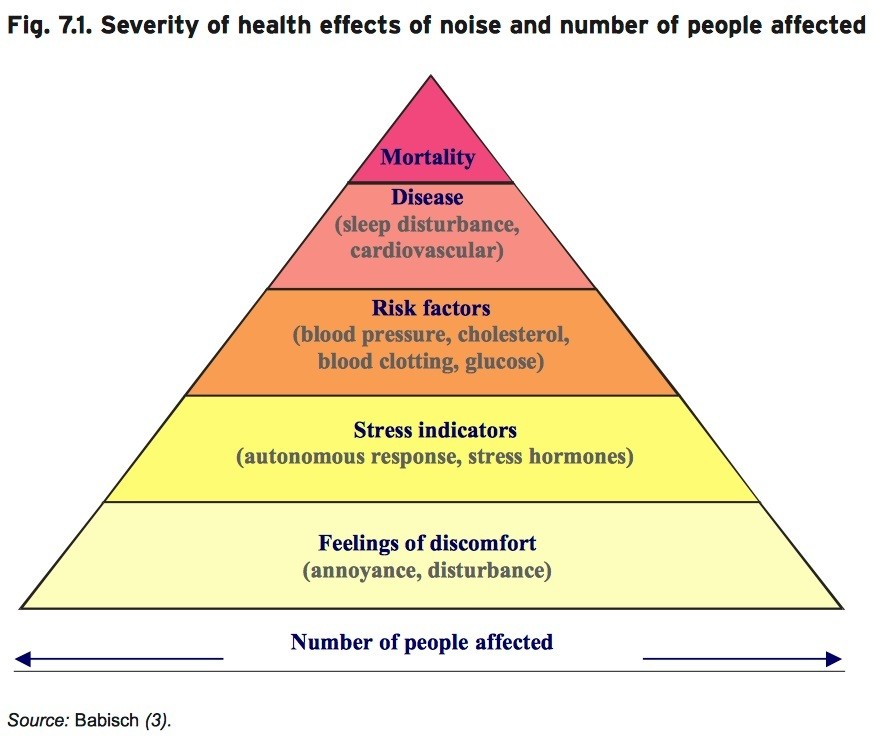
Control Measures of Noise Pollution
- Since there are three components of noise pollution e.g. (1) source of noise, (ii) medium of noise, and (iii) objects affected by noise, noise pollution should be tackled at any of the three components.
- As noise pollution involves individual and communities, it should also be tackled at individual, community and governmental levels.
- Noise pollution abatement programmes include two aspects viz. (i) noise reduction, which may be achieved through several techniques and (ii) noise control.
Noise Reduction:
- Intensity of noise may be reduced by several devices e.g., enclosure of machinery with sound absorbing materials which can reduce the intensity of noise produced from industrial operations.
- Noise may be controlled at source by providing silencers to the machines, by reducing the amplitude of existing forces, by proper greasing of vital parts of machines to reduce friction etc.
- Noise generated by record players and loudspeakers may be effectively reduced by convincing the people and by effective prohibitory laws.
- Noise pollution may also be reduced by increasing the distance between the source and receiver of noise, by proper layout of buildings, by deflecting the path of sound waves etc.
- The intensity of noise at receiver's end may be effectively reduced by providing acoustic absorbing materials in the community halls, dance halls, cinema halls, temples, Churches, mosques and other buildings affected by high intensity noise.
- Roadside plantation has proved to be effective measure of control of noise pollution as green trees reduce the intensity of noise by 10 to 15 db.
- Railroads and highways should be routed away from the cities via by-passes and the cities should be linked to the main roads by link and connecting.
- It is recommended noise levels be kept below 65 dB during the day and indicates that restful sleep is impossible with nighttime ambient noise levels in excess of 30 dB.
Acceptable noise levels in different areas
| Location | Noise Levels (dB) | Location | Noise Levels (dB) |
|---|---|---|---|
| Rural areas | 25-35 | Radio and TV Studios | 25-35 |
| Suburban areas | 30-40 | Music room | 30-35 |
| Residential (urban) | 35-40 | Hospitals, classrooms, hotels, conference rooms, etc. | 35-40 |
| Residential and business (urban) | 40-45 | Court rooms, private offices, libraries | 40-45 |
| City areas | 45-55 | Large public offices, banks, storages, restaurants, etc. | 50-55 |
| Industrial areas | 50-60 |
Noise Pollution in India
- Most of the million cities of India are suffering from noise pollution because of phenomental growth in automobiles and other noise pollutants consequent upon unchecked growth of urban population.
- Most of the big cities of India have high level of noise pollution, generally above 70 dB e.g., Delhi (89 dB), Kolkata (87dB), Mumbai (85 dB), Chennai (89 dB), Cochin (80 dB), Madurai (75 dB), Nagpur (75 dB), Trivandrum (70 dB) etc.
Statutory provisions related to noise pollution in India
- Constitution of India: Article 21 of the Indian Constitution grants the right to life to the citizens of India. any person who faces problems due to noise pollution and it disrupts the person’s peace and comfort then it means the noise pollution is violating the person’s right to life.
- The Code of Criminal Procedure: Section 133 of The Code of Criminal Procedure empowers an executive magistrate, district magistrate or sub-divisional magistrate to conditionally remove something that is causing a nuisance. This provision can be used or utilised in case of nuisance caused by noise.
- Indian Penal Code: Section 268, Section 287, Section 288, Section 290, Section 291 and Section 294 deals with noise pollution.
- Law of Torts: Any person who is facing an issue due to noise pollution can file a civil suit to claim damages. As long as there is interference in the use of land by the person due to the noise pollution and the person can prove such damages then in that case the person can file a suit related to such noise pollution.
- Motor Vehicle Act: It lays down guidelines and related to the use of horns in vehicles.
- Noise Pollution Control Rule, 2000 under The Environment Protection Act, 1996:
- The noise standard for day time in industrial areas is 75 dB, commercial areas are 65 dB, residential areas is 55 dB and for silence zone is 50 dB.
- The noise standard for night time in industrial areas is 70 dB, commercial areas are 55 dB, residential areas is 45 dB and for silence zone is 40 dB.
- Area of 100 meters of any hospital, schools, universities and court premises must be declared as silence zone and minimal noise shall be made in the 100 meters range.
- Any loudspeaker can only be used after it has been permitted by the authority and such loudspeaker cannot be used from 10 p.m. to 6 a.m.
Global Scenario
- In 2011 the World Health Organisation (WHO) published a report titled ‘Burden of Disease from Environmental Noise’.
- It revealed that the adverse impact of environmental noise (broadly defined as any noise outside of an industrial workplace) is far greater than imagined.
- According to WHO, 360 million people worldwide have disabling hearing loss, and 32 million of these are children.
- WHO says that exposure to excessive noise is one of the causes.
- According to the European Environment Agency (EEA), noise is responsible for 16,600 premature deaths and more than 72,000 hospitalisations every year in Europe alone.
- A recent study found that Guangzhou in China had the worst noise pollution, while Zurich in Switzerland had the least.
- Delhi was the second worst city for noise pollution, followed by Cairo, Mumbai, Istanbul and Beijing.
- WHO says that 1.1 billion teenagers and young adults are at risk of developing hearing loss due to the unsafe use of personal audio devices and exposure to damaging levels of sound in noisy entertainment venues.
Marine Pollution
Introduction
- Marine pollution occurs when substances used or spread by humans, such as industrial, agricultural and residential waste, particles, noise, excess carbon dioxide or invasive organisms enter the ocean and cause harmful effects there.
- Marine water is subjected to contaminants coming from various sources that are commonly found in the surroundings.
- These contaminants change the characteristics of ocean and coastal zones, thereby affecting the biodiversity of the marine ecosystem, the quality of ocean water and productivity from marine ecology.
Definition
- Marine pollution is defined as the introduction of substances from humans into the marine environment resulting in such harmful effects as harm to living resources, hazards to human health, hindrance to marine activities including fishing, impairment of quality for use of seawater and the reduction of facilities.
- Bjorn Jennssen (2003) notes in his article, "Anthropogenic pollution may reduce biodiversity and productivity of marine ecosystems, resulting in reduction and depletion of human marine food resources".
Source of Pollutants
There are three main types of inputs of pollution into the ocean: direct discharge of waste into the oceans, runoff into the waters due to rain, and pollutants released from the atmosphere.
Direct discharge:
- From urban sewerage and industrial waste discharges, sometimes in the form of hazardous and toxic wastes, or in the form of plastics.
- Minerals discharged in the course of the mining for copper, gold etc.
Land runoff:
- Surface runoff from farming, as well as urban runoff and runoff from the construction of roads, buildings, ports, channels, and harbours.
Ship pollution:
- Oil spills from tankers discharging ballast water from oil tanks used on return ships, leaking pipelines or engine oil disposed of down sewers.
- Discharge of cargo residues from bulk carriers can pollute ports, waterways, and oceans
- Ships also create noise pollution that disturbs natural wildlife, and water from ballast tanks can spread harmful algae and other invasive species.
Atmospheric pollution:
- Wind-blown dust and debris, including plastic bags.
- Climate change.
- Raising levels of carbon dioxide in the atmosphere.
Deep sea mining:
- Release of potential toxic metals such as copper, zinc, cadmium, lead, rare earth metal etc.
- Increase of noise, light and sediment laden plumes.
Types of Pollution
Marine debris pollution
- Marine debris, also known as marine litter, is human-created waste that has deliberately or accidentally been released in a sea or ocean.
- Floating oceanic debris tends to accumulate at the center of gyres and on coastlines, frequently washing aground, when it is known as beach litter or tidewrack.
- Deliberate disposal of wastes at sea is called ocean dumping.
- Dumping, container spillages, litter washed into storm drains and waterways and wind-blown landfill waste all contribute to this problem. Naturally occurring debris, such as driftwood and drift seeds, are also present.
- A wide variety of man-made objects can become marine debris;
- Ghost nets: Ghost nets are fishing nets that have been abandoned, lost or otherwise discarded in the ocean.
- Macroplastic, Microplastics: Microplastics are beads of plastic less than 5 millimeters wide, and they are commonly found in hand soaps, face cleansers, and other exfoliators.
- Deep-sea debris: Litter, made from diverse materials that are denser than surface water (such as glasses, metals and some plastics), have been found to spread over the floor of seas and open oceans, where it can become entangled in corals and interfere with other sea-floor life, or even become buried under sediment
- Garbage patches (gyres): A garbage patch is a gyre of marine debris particles caused by the effects of ocean currents and increasing plastic pollution by human populations.
Plastic pollution
- Marine plastic pollution (or plastic pollution in the ocean) is a type of marine pollution by plastics, ranging in size from large original material such as bottles and bags, down to microplastics formed from the fragmentation of plastic material.
- Eighty percent of marine debris is plastic.
- Oceans are polluted by plastic particles ranging in size from large original material such as bottles and bags, down to microplastics formed from the fragmentation of plastic material.
- Microplastics and nanoplastics result from the breakdown or photodegradation of plastic waste in surface waters, rivers or oceans.
- Microplastics are commonly found in hand soaps, face cleansers, and other exfoliators.
- Plastic pellet pollution is a type of marine debris originating from plastic particles utilized in manufacturing large-scale plastics.
Ocean acidification
- Ocean acidification is the reduction in the pH value of the Earth’s ocean.
- The root cause of ocean acidification is carbon dioxide emissions from human activities which have led to atmospheric carbon dioxide (CO2) levels of more than 410 ppm (in 2020).
- The oceans absorb CO2 from the atmosphere.
- This leads to the formation of carbonic acid which dissociates into a bicarbonate ion and a hydrogen ion .
- The free hydrogen ions decrease the pH of the ocean, therefore increasing acidity.
- A decrease in pH corresponds to a decrease in the concentration of carbonate ions, which are the main building block for calcium carbonate shells and skeletons.
- Colder and higher latitude waters have the capacity to absorb more CO2. This can increase acidity, lowering the pH and carbonate saturation states in these regions.
- Factors that affect the atmosphere-ocean CO2 exchange, and therefore impact local ocean acidification, include: ocean currents and upwelling zones, proximity to large continental rivers, sea ice coverage, and atmospheric exchange with nitrogen and sulfur from fossil fuel burning and agriculture.
Nutrient pollution
- Nutrient pollution, a form of water pollution, refers to contamination by excessive inputs of nutrients.
- It is a primary cause of eutrophication of surface waters in which excess nutrients, usually nitrogen or phosphorus, stimulate algal growth.
- The biggest culprit are rivers that empty into the ocean, and with it the many chemicals used as fertilizers in agriculture as well as waste from livestock and humans.
Toxicants
- Apart from plastics, there are particular problems with other toxic pollutants that either do not break down or breakdowns only very slowly in the marine environment.
- Examples of persistent toxicants are PCBs, DDT, TBT, pesticides, furans, dioxins, phenols, and radioactive waste.
- Heavy metals are metallic chemical elements that have a relatively high density and are toxic or poisonous at low concentrations.
- Examples are mercury, lead, copper and cadmium.
Underwater Noise Pollution
- It is a major source of disruption of marine ecosystems and does significant harm to sea life, including marine mammals, fish and invertebrates.
- The principal anthropogenic noise sources come from merchant ships, naval sonar operations, underwater explosions (nuclear), and seismic exploration by oil and gas industries. Cargo ships generate high levels of noise due to propellers and diesel engines.
- This noise pollution significantly raises the low-frequency ambient noise levels above those caused by wind.
- The ability to detect vibration through mechanosensory structures is most important in invertebrates and fish.
- Mammals, also, depend on pressure detector ears to perceive the noise around them.
- Sound is also used in multiple behavioral contexts by many groups of invertebrates.
- This includes regularly sound produced or perceived in the context of aggression or predator avoidance.
- Invertebrates utilize sound to attract or locate mates, and often employ sound in the courtship process.
- Therefore, not only does anthropogenic noise often mask invertebrate communication, but it also negatively impacts other biological system functions through noise-induced stress.
Examples of negative effect on aquatic life:
- Higher ambient noise levels cause animals to vocalize more loudly, which is called the Lombard effect.
- Noise pollution may have caused the death of certain species of whales that beached themselves after being exposed to the loud sound of military sonar.
- The elevated levels of noise pollution altered the temporal hearing threshold of the finless porpoises in Yangzte river and posed a significant threat to their survival.
- Boat-noise has been shown to affect the embryonic development and fitness of the sea hare Stylocheilus striatus.
- The anthropogenic noise caused the clams to close their valves and relocate to an area above the interface of the sediment-water. This response inhibits the clam from mixing the top layer of the sediment profile and hinders suspension feeding.
- mollusks exposed to boat noise playbacks had a 21% reduction in embryonic development.
- The squid reacted by jetting, inking, pattern change and other startle responses due to being exposured to noise.
Impact
- Ghost nets can entangle fish, dolphins, sea turtles, sharks, dugongs, crocodiles, seabirds, crabs, and other creatures, including the occasional human diver. Acting as designed, the nets restrict movement, causing starvation, laceration and infection, and suffocation in those that need to return to the surface to breathe.
- Larger plastic waste can be ingested by marine species, filling their stomachs and leading them to believe they are full when in fact they have taken in nothing of nutritional value. This can bring seabirds, whales, fish, and turtles to die of starvation with plastic-filled stomachs.
- Bottle caps have been found in the stomachs of turtles and seabirds, which have died because of the obstruction of their respiratory and digestive tracts.
- Marine species can also be suffocated or entangled in plastic garbage.
- Microplastics are frequently consumed by marine organisms at the base of the food chain, like plankton and fish larvae, which leads to a concentration of ingested plastic up the food chain.
- Plastics are produced with toxic chemicals, so these toxic substances enter the marine food chain, including the fish that some humans eat.
- Reduction in calcium carbonate due to acidification affects Marine calcifying organisms, like mollusks, oysters and corals.
- An excess of oxygen-depleting chemicals in the water can lead to hypoxia and the creation of a dead zone.
- Some toxicants can accumulate in the tissues of many species of aquatic life in a process called bioaccumulation.
- They are also known to accumulate in benthic environments, such as estuaries and bay muds.
- Surface runoff of pesticides can alter the gender of fish species genetically, transforming male into female fish.
- Invasive species can take over once occupied areas, facilitate the spread of new diseases, introduce new genetic material, alter underwater seascapes, and jeopardize the ability of native species to obtain food.
- The Fukushima Daiichi nuclear disaster in 2011 caused radioactive toxins from the damaged power plant to leak into the air and ocean. There are still many isotopes in the ocean, which directly affects the benthic food web and also affects the whole food chain.
- Silt-bearing surface runoff can inhibit the penetration of sunlight through the water column, hampering photosynthesis in aquatic plants.
Mitigation
- There are two ways the overall level of this pollution can be mitigated: either the human population is reduced, or a way is found to reduce the ecological footprint left behind by the average human.
- Balanced information on the sources and harmful effects of marine pollution need to become part of general public awareness, and ongoing research is required to fully establish, and keep current, the scope of the issues.
Global laws and policies
- The 10 largest emitters of oceanic plastic pollution worldwide are, from the most to the least, China, Indonesia, Philippines, Vietnam, Sri Lanka, Thailand, Egypt, Malaysia, Nigeria, and Bangladesh.
- Largely through the rivers Yangtze, Indus, Yellow, Hai, Nile, Ganges, Pearl, Amur, Niger, and the Mekong, and they account for "90 percent of all the plastic that reaches the world's oceans."
- Marine pollution was a concern during several United Nations Conventions on the Law of the Sea beginning in the 1950s.
- In 1973 and 1978, MARPOL 73/78 was a treaty written to control vessel pollution, especially regarding oil. In 1983, the International Convention for the Prevention of Pollution from Ships enforced the MARPOL 73/78 treaty internationally.
- The 1982 United Nations Convention on the Law of the Sea (UNCLOS) was established to protect the marine environment by governing states to control their pollution to the ocean. It put restrictions on the amount of toxins and pollutants that come from all ships internationally.
- In 2006, the Marine Debris Research, Prevention and Reduction Ac was established by the National Oceanic and Atmospheric Administration (NOAA) to help identify, determine the source of, reduce and prevent marine debris
- In 2017, the United Nations adopted a resolution establishing Sustainable Development Goals, including reduced marine pollution as a measured goal under Goal 14.
- The international community has agreed that reducing pollution in the oceans is a priority, which is tracked as part of Sustainable Development Goal 14 which actively seeks to undo these human impacts on the oceans.
Radioactive Pollution
Introduction
- Radiation is essentially energy that travels and spreads out as it goes. This is referred to as electromagnetic radiation.
- Examples include visible light, radio waves, microwaves, infrared and ultraviolet lights, X-rays, and gamma-rays.
- Radioactive Pollution is defined as the increase in the natural radiation levels caused by human activities.
Definition
- Radioactive contamination, also called radiological pollution, is the deposition of, or presence of radioactive substances on surfaces or within solids, liquids, or gases (including the human body), where their presence is unintended or undesirable (from the International Atomic Energy Agency (IAEA) definition).
Types of radiation
Ionizing radiation
- It is the short wavelength radiation or particulate radiation emitted by certain unstable isotopes during radioactive decay.
- They can knock electrons out of their orbits around atoms, upsetting the electron/proton balance and giving the atom a positive charge.
There are many types of ionizing radiation
- Alpha radiation: consists of two protons and two neutrons. It can be blocked by a piece of paper and human skin.
- Beta radiation: consists of fast-moving electrons ejected from the nucleus of an atom. It can penetrate through skin, while can be blocked by some pieces of glass and metal.
- Gamma rays: It has no mass or charge. It can penetrate easily to human skin and damage cells on its way through, reaching far, and can only be blocked by a very thick, strong, massive piece of concrete.
- X-rays: They are a form of radiation similar to gamma radiation, but they are produced mainly by artificial means rather than from radioactive substances.
- Neutron radiation: It occurs when neutrons are ejected from the nucleus by nuclear fission and other processes. It is absorbed by materials with lots of hydrogen atoms, like paraffin wax and plastics.
Non-ionizing radiation
- These are defined as extremely low frequency (ELF) waves.
- They are relatively long-wavelength electromagnetic radiation, such as radiowaves, microwaves, visible radiation, ultraviolet radiation, and very low-energy electromagnetic fields.
- Nonionizing radiation is generally considered less dangerous than ionizing radiation.
- However, some forms of nonionizing radiation, such as ultraviolet, can damage biological molecules and cause health problems.
Sources of radiation
The sources of radioactive pollution can be natural or man-made.
Natural Sources
The United Nations Scientific Committee on the Effects of Atomic Radiation (UNSCEAR) identifies four major sources of public exposure to natural radiation:
Cosmic radiation:
- It consists of fast moving particles that exist in space and originate from a variety of sources, including the sun and other celestial events in the universe.
- It mostly consists of protons. They can also be particles or wave energy.
- Doses of radiation vary depending on location and habits. Regions at higher altitudes receive more cosmic radiation.
Terrestrial radiation:
- The composition of the earth's crust is a major source of natural radiation.
- It include natural deposits of uranium, potassium and thorium.
- In the process of natural decay they release small amounts of ionizing radiation.
- Uranium and thorium are "ubiquitous," which means they can be found almost wherever.
- Traces of these minerals are also found in building materials, so exposure to natural radiation can occur indoors as well as outdoors.
Inhalation:
- This is the exposure due to inhalation of radioactive gases that are produced by radioactive minerals found in soil and bedrock.
- Radon produced by the decay of uranium-238, Thoron produced by thorium are radioactive gases that are found in atmosphere.
- Once released into the air, these gases normally dilute to harmless levels in the atmosphere, but sometimes they become trapped and accumulate inside buildings where they are inhaled by occupants.
Ingestion:
- Trace amounts of radioactive minerals are naturally found in the contents of food and drinking water.
- Once ingested, these minerals result in internal exposure to natural radiation.
- Potassium-40, Carbon-14 and their isotopes are the radioactive and non-radioactive elements that are used in building and maintaining our bodies.
Artificial or man made sources
Nuclear Power Plants:
- Nuclear power plants emit radiation to a very smaller extent except accidental leaks.
- It also generate radioactive waste due to fission process.
- These radioactive wastes such as uranium mill tailings, spent (used) reactor fuel and other radioactive wastes are a serious environmental hazard associated with nuclear power plants.
- Due to their long decay period they can be harmful for thousands of years.
Nuclear Waste Handling and Disposal:
- Nuclear waste handling and disposal can produce low to medium levels of radioactivity over time.
- The primary problem with radioactive waste is that it cannot be decomposed chemically or handled biologically.
- Storage in remote regions with little or no life could also keep the waste contained (such as remote caves or abandoned salt mines).
- However this cover may get damaged over time.
- Furthermore, previous waste disposal techniques may not have taken the necessary precautions to isolate the radiation.
- As a result, such sites become the cause of radiation to land, air and water bodies nearby.
- Some countries producing large quantity of nuclear wastes dump them in ocean near other countries.
Nuclear Explosion:
- During nuclear explosion, a large number of radio-nuclides are generated in the atmosphere.
- The radio nuclides settle down with rain contaminating the soil and water bodies.
- Finally, these enter into food chain causing serious problem to the living organisms.
- The causes of explosion can be an accident in nuclear plant, nuclear weapons etc.
Radio-isotopes:
- Radio-isotopes are also prepared artificially either by nuclear fusion or by nuclear fission.
- If these radio-isotopes are not properly handled, these emit radiations causing pollution.
Electronic devices:
- Electronic devices such as cell phones, microwave, Television sets etc produce radiations which can also cause cancer.
Medical and Industrial uses:
- If a radionuclide used in nuclear medicine is spilled (accidentally or through ignorance), the material could be spread by people as they walk around.
- Contamination may also be an inevitable result of certain processes, such as the release of radioactive xenon in nuclear fuel reprocessing, Uranium mining etc.
Types of Radioactive Pollution
- Continuous Pollution: Continuous radioactive pollution is the type of pollution constantly coming from uranium mines, nuclear reactors, and test laboratories, where the radioactive contaminants are always present.
- Occasional Pollution: Occasional radioactive pollution is the type of pollution that occurs during nuclear tests or during experimental tests on radioactive substances.
- Accidental Pollution: Accidental radioactive pollution is the type of pollution that occurs when certain experiments involving dangerous substances fail, and the substances used for experimentation get out of control.
Effects
Health effects
- Radioactivity is toxic because it forms ions when it reacts with biological molecules.
- These ions can form free radicals, which damage proteins, membranes, and nucleic acids.
- Ionizing radiation can irradiate the human body from an external or internal origin.
- It may cause skin burns which may lead to skin cancer.
- Radioactivity can damage DNA (deoxyribonucleic acid) by destroying individual bases (particularly thymine), by breaking single strands, by breaking double strands, by cross-linking different DNA strands, and by cross-linking DNA and proteins.
- Damage to DNA can lead to cancers, birth defects, and even death.
- Acute radiation syndrome is a rare condition that is one of the most deadly side effects of radioactive pollution.
- Anemia, decreased life expectancy, leukemia, bleeding, accelerated aging, fatalities, cardiovascular issues and Cancer are some of the health issues that can arise due to continuous exposure to radiation.
- Low level radiation causes many psychological effects.
- Nuclear accident may lead to social isolation, anxiety, depression, psychosomatic medical problems, reckless behavior, even suicide.
- Radiation causes the cells in the body to become distorted, resulting in irreversible damage to the organs and organ systems.
- It causes cell mutation and cell death.
Effect on soil
- Radioactive element in the soil react with various nutrients, causing the nutrients to be destroyed and the soil to become infertile and very poisonous.
- Such soil results in the harvest of crops that are contaminated with radiation and consequently unsafe for human and animal consumption.
- Plants that grow in this type of soil are also genetically modified.
- Through the consumption of these plants by bottom level organism of food chain, radiation can enter the food chain.
- Principle of Biomagnification causes the high radiation content in the upper levels of food chain.
Wildlife
- Insects and flies are less affected of radioactivity than higher level species.
- Radionuclides interact with organism DNA and enter their metabolic cycles.
- Low level of radionuclides result into mutated animal with higher health risks.
Plants
- Increased ultraviolet waves causes the maximum damage to plants.
- As the number of radiation increases, the stomata stop evaporating.
- When chromosomes are damaged by radiation, reproduction is impeded.
- Low level of radiation affect plant’s form, size, health whereas high level radiation can cause plant death.
- Through the consumption of affected plants, radioactive nuclides enters the food chain.
Birds
- As bird’s surface area is larger than its weight, they absorb more radiation.
- Electromagnetic radiation from cell towers affect navigation skill of birds.
- This causes changes in the migratory routes, death by collision to telecommunication poles etc.
Marine life
- Radionuclides gets accumulated in fishes’ soft tissues as well s their bones, seaweeds and other aquatic food resources.
Control
Radiation Exposure Protection:
- The three principles of radiation protection are distance, time to exposure and shielding.
- Exposure decreases with increase in distance from source.
- Exposure time should be kept minimum.
- Proper shield should be used between source of radiation and the surrounding.
Radiation Contamination Protection:
- Inhalation can be minimised by using laboratory hoods, air filters and exhaust systems, eliminating dry sweeping, wearing protective clothing, prohibition of smoking and eating activity in radiation zone etc preventive measures.
Controlled Area:
- Areas which cause or permit exposure to radiation are required to have controlled accessibility.
- Level of radiation pollutant should be regularly checked in the high risk areas.
- Radiation resistant cases or walls should be constructed for screening workers from radioactive materials.
Collection, Storage and Disposal:
- Radioactive material can not be buried or incinerated.
- As seepage is possible waste should be collected and stored properly.
- Since storage may not be practicable, another alternative is to dilute the radiation.
Proper Labeling
- Material with radioactive elements must be labelled with the required precautions stated on the label's content.
- As even light contact with radioactive material can allow radiation to enter the body.
- Container labelling should encourage the use of protective equipment when handling them.
Prohibition of Nuclear Tests
- The tests conducted to perfect the energy of nuclear weapon play a significant role in the overall presence of radioactive materials.
- Although being conducted in the deserts, these materials are leaked into other ecosystems, impacting the livelihoods of many people.
Alternative Energy Sources
- When radioactivity is used to generate energy in nuclear power plants, radioactive waste is emitted from the various processes and combustion results in more radiation being discharged into the atmosphere.
- Thus more ecologically friendly energy sources, such as renewable energy sources like solar, hydroelectric, and wind power should be explored.