
SOIL EROSION | Biogeography Optional for UPSC
SOIL EROSION | Biogeography Optional for UPSC

Introduction
- Soil erosion is defined as the accelerated removal of topsoil from the land surface through water, wind and tillage.
- It is one of the ten major soil threats, identified in the Status of the World's Soil Resources Report.
- It depends on soil properties, ground slope, vegetation, and rainfall amount and intensity.
- Soil erosion may be a slow process that continues relatively unnoticed, or it may occur at an alarming rate causing a serious loss of topsoil.
- Soil erosion is a natural process in mountainous areas, but is often made much worse by poor management practices.
Definition
- Soil erosion is an extreme form of soil degradation in which natural geomorphological processes are accelerated so that soil is removed at much faster than rates at which new soil forms (R.P.C Morgan, 1985).
Geographical Thinkers on Soil Erosion:
- J.W. Powell: He recognized the significant role of water in shaping landscapes and causing soil erosion.
- H.H. Bennett: Known as the "father of soil conservation" in the United States. Highlighted the detrimental effects of soil erosion and advocated for the implementation of soil conservation practices, such as contour plowing and terracing.
- Sir Albert Howard: Emphasized the importance of organic farming methods to prevent soil erosion. He developed the concept of "indore method" which involved recycling organic waste to improve soil fertility and prevent erosion.
- Charles Darwin: Emphasized the role of bioturbation (earthworm activity) in soil formation and erosion processes.
- David Montgomery: Advocated for regenerative agriculture practices to restore degraded soils and prevent erosion, highlighting the importance of soil health for sustainable food production.
- Wangari Maathai: Founded the Green Belt Movement, which focused on reforestation efforts to combat erosion and improve soil quality.
Case Studies of Soil Erosion
1. The Dust Bowl (Great Plains, United States)
- Causes: Overgrazing, improper land management, severe drought, and strong winds
- Impact: Widespread soil erosion, formation of massive dust storms, agricultural devastation, and economic hardships
2. Loess Plateau (China)
- Causes: Deforestation, unsustainable agricultural practices, and water erosion
- Measures taken: Implementing terracing, afforestation, and water conservation techniques
- Impact: Massive soil erosion and degradation leading to reduced productivity and environmental degradation
3. Amazon Rainforest (Brazil)
- Causes: Deforestation for agriculture, logging, and urbanization
- Impact: Increased runoff, loss of topsoil, decreased soil fertility, and loss of biodiversity
4. Lake Tahoe (United States)
- Causes: Urbanization, construction activities, and inadequate erosion control measures
- Impact: Sedimentation in the lake, loss of clarity, and degradation of aquatic ecosystems
5. Yellow River (China)
- Causes: Overgrazing, deforestation, and dam construction
- Impact: High sediment load in the river, increased flood risks, and decreased water quality
6. The Sahel (Sub-Saharan Africa)
- Causes: Overgrazing, deforestation, and drought
- Impact: Soil degradation, desertification, and food insecurity
7. Mekong Delta (Vietnam)
- Causes: Dam construction, coastal erosion, and sea level rise
- Impact: Saltwater intrusion, soil salinization, and reduced agricultural productivity
8. The Aral Sea (Kazakhstan and Uzbekistan)
- Causes: Diversion of rivers for irrigation, unsustainable agricultural practices, and climate change
- Impact: Shrinking of the sea, increased salinity, and desertification
9. Three Gorges Dam (Yangtze River, China)
- Causes: Construction of the dam and reservoir, deforestation, and increased sedimentation
- Impact: Erosion along the riverbanks, downstream sedimentation, and altered river ecology
Indian Case Studies of Soil Erosion
Case Study 1: Chambal Ravines
- Location: Chambal region in Madhya Pradesh and Rajasthan.
- Causes: Overgrazing, deforestation, improper land use practices, and lack of soil conservation measures.
- Impact: Extensive gully erosion, loss of fertile topsoil, and land degradation.
- Solutions: Afforestation, contour plowing, check dams, and watershed management programs.
Case Study 2: Western Ghats
- Location: Western coastal region of India.
- Causes: Deforestation, construction activities, unsustainable agriculture practices, and heavy rainfall.
- Impact: Soil erosion on slopes, landslides, siltation of rivers, and loss of biodiversity.
- Solutions: Reforestation, terrace farming, conservation farming practices, and strict regulations on land use.
Case Study 3: Arid and Semi-Arid Regions of Rajasthan
- Location: Thar Desert and other arid and semi-arid areas in Rajasthan.
- Causes: Wind erosion, water erosion during occasional heavy rainfall, and improper agricultural practices.
- Impact: Desertification, loss of topsoil, reduced agricultural productivity, and land degradation.
- Solutions: Contour bunding, sand dune stabilization, agroforestry, and water conservation techniques.
Case Study 4: Eastern Himalayas
- Location: Himalayan region in northeastern India.
- Causes: Deforestation, shifting cultivation, road construction, and hilly terrain.
- Impact: Soil erosion, landslides, sedimentation of rivers, and habitat loss.
- Solutions: Forest conservation, afforestation, adoption of terrace farming, and soil conservation measures.
Case Study 5: Coastal Areas of Kerala
- Location: Coastal regions of Kerala.
- Causes: Coastal erosion due to natural processes and human activities like sand mining, construction, and improper coastal management.
- Impact: Loss of fertile coastal land, saltwater intrusion, and coastal flooding.
- Solutions: Mangrove restoration, construction of coastal protection structures, beach nourishment, and sustainable coastal development practices.
Process of Soil Erosion
Soil erosion involves mainly two processes:
- Loosening and Detachment of Soil Particles
- Soil particles are loosened and detached from the soil mass due to natural forces like wind, water, and gravity.
- Example: Raindrops hitting the soil surface can dislodge soil particles, especially in areas with little vegetation cover.
- Removal and Transport of Detached Soil Particles Downslope
- Once detached, soil particles are transported downslope by agents like water, wind, or ice.
- Example: During heavy rainfall, water runoff carries soil particles along, leading to gully erosion in steep terrains.
Factors Influencing Soil Detachability
- Grain Size and Cohesiveness: L. D. Meyer and W. H. Wischmeier noted that the detachability of soil particles depends on their grain size and cohesiveness.
- Particles with a grain size above 0.2 mm require more force for detachment, often provided by the velocity of moving water.
- Critical velocity for detachment increases with larger grain sizes, making coarse soils more resistant to erosion compared to fine soils.
Types of Soil Erosion
Water Erosion
Splash erosion:
- This type of erosion occurs when a raindrop hits the soil. the impact of a falling raindrop creates a small crater in the soil, ejecting soil particles.
- Once freed, these particles are more vulnerable to being swept away by other forces.
- This type of erosion is hard to detect.
Sheet erosion:
- It is the transport of loosened soil particles by overland flow.
- If the soil is saturated, or if the rainfall rate is greater than the rate at which water can infiltrate into the soil, surface runoff occurs.
- If the runoff has sufficient flow energy, it will transport loosened soil particles (sediment) down the slope.
Rill erosion:
- This form of erosion leaves the ground marked with parallel lines of small, clear-cut channels.
- It refers to the development of small, ephemeral concentrated flow paths which function as both sediment source and sediment delivery systems for erosion on hillslopes.
Gully erosion:
- It occurs when runoff water accumulates and rapidly flows in narrow channels during or immediately after heavy rains or melting snow, removing soil to a considerable depth.
- Grazing, which often results in ground compaction, is another reason behind gully erosion.
- Soil loses the ability to absorb excess water because of being exposed and erosion can develop in susceptible areas.
Bank erosion:
- It is the wearing away of the banks of a stream or river.
- This is distinguished from changes on the bed of the watercourse, which is referred to as scour.
- Erosion and changes in the form of riverbanks may be measured by inserting metal rods into the bank and marking the position of the bank surface along the rods at different times.
Ephemeral erosion:
- This is form of erosion that occurs in natural depressions.
Coastal erosion:
- Coastal erosion of soil occurs along seashores.
- It is caused by the wave action of the sea and the inward movement of the sea into the land.
Wind erosion
- It is a natural process that moves soil from one location to another by wind power.
- The loose soil particles are blown and transported from wind by following three ways:
- Siltation: blown by the wind in a series of short bounces.
- Suspension: transported over long distances in the form of suspended particles.
- Soil creep: transported at ground level by high-velocity winds.
Causes of Soil Erosion
Morisawa (1968) has identified two major independent factors which control the rate and type of soil erosion occurring on hill slopes i.e. climate and geology.
Climate:
- The amount and intensity of precipitation (heavy rainfall).
- Strong winds.
- Average temperature and temperature range.
- The size and velocity of raindrops.
- Air humidity and solar radiation.
Soil structure and composition:
- The composition, moisture, and compaction of soil.
- Sediments containing more clay tend to be more resistant to erosion.
- Soil containing high levels of organic materials are often more resistant to erosion (the organic materials coagulate soil colloids).
- The amount of water present in the soil before the precipitation (it sets limits on the amount of water that can be absorbed by the soil).
- Soil compaction also affects the permeability of the soil to water.
- More compacted soils will have a larger amount of surface runoff than less compacted soils.
Vegetative cover:
- It increases the permeability of the soil to rainwater, thus decreasing runoff.
- It shelters the soil from winds, which results in decreased wind erosion, as well as advantageous changes in microclimate.
- The roots of the plants bind the soil together, and interweave with other roots, forming a more solid mass that is less susceptible to both water and wind erosion.
Topography:
- The topography of the land determines the velocity at which surface runoff will flow thus decide erosivity.
- Longer, steeper slopes (especially those without adequate vegetative cover) are more susceptible to very high rates of erosion during heavy rains.
- Steeper terrain is also more prone to mudslides, landslides, and other forms of gravitational erosion processes.
Land Use:
- Changing land use pattern.
Natural activities of erosion
- Rainfall and surface runoff.
- Rivers and streams.
- Floods (kolks, or vortices are formed by large volumes of rapidly rushing water that cause extreme local erosion).
- Wind movement.
- Mass movement- landslides, slumping, depressions etc.
Human activities/ anthropogenic factors
- Agricultural practices such as tilling, continuous croppind, monoculture cropping etc.
- Overgrazing of livestock
- Deforestation
- Construction activities like compacting the soil
- Road construction increase rate of surface runoff and surface wind
- Altering drainage patterns and disruption to surrounding watersheds
- Urban sprawls
- Economic activities like extraction of minerals
- Acid rain
- Climate change
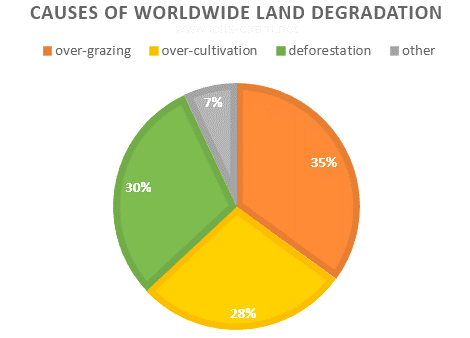
Effects of Soil Erosion
Environmental:
- Land degradation.
- Lower surface water quality.
- Sedimentation of aquatic ecosystems.
- Declines in fish and other species.
- Airborne dust pollution.
- Worsening the floods.
Economic:
- Loss of soil fertility.
- Reduced crop production potential.
- increased water usage.
- Global economic losses.
Social:
- Gradual destruction of land resources.
- Threat to food security.
- Gully erosion interrupts traffic, and breaks the ground surface shape.
- Exacerbates poverty.
Prevention of Soil Erosion
- Retain vegetation cover.
- Controlled Cattle grazing.
- Crop rotation.
- Increase soil organic matter.
- Runoff water should be stored in the catchment for as possible by maintaining vegetation cover and as by constructing dams for storing water
- Protective vegetation along the beaches
- Access of wind to the soil should be controlled by leaving the stubble or mulch on the soil.
- Shelter belt to reduce wind speed
- Agro-forestry and soil synthetic conditioners.