
PT 360 IR (International Relations) August 2024: UPSC Prelims 2025
Tip: For reading free UPSC Prelims 2025 Current Affairs for International Relations online, use the Next/Previous buttons or refer to the Sidebar. If you are using a mobile device, click the menu icon (three horizontal lines) to access the sidebar.
Click here for Printable PDF and Lectures.

GLOBAL DEVELOPMENT COMPACT
News Context
India has introduced the Global Development Compact (GDC) aimed at alleviating the mounting debt challenges faced by the Global South and other developing nations.
What is the Global Development Compact (GDC)?
At the third Voice of Global South Summit, India proposed a holistic and people-focused "Global Development Compact" designed specifically for the Global South.
Key Features of the GDC
- Four Core Elements: The GDC is based on trade-driven development, capacity building for sustainable growth, technology transfer, and concessional finance and grants tailored to specific projects.
- No Debt Burden: The GDC emphasizes infrastructure and development financing without adding debt burdens to developing countries, addressing concerns about the 'debt trap' associated with certain international lending practices, including those from China.
- Alternative Development Pathways: The compact encourages exploring new avenues for economic progress, social equity, and environmental sustainability.

Impacts of High Debt Burden
- Debt Sustainability Concerns: Currently, nearly 60% of low-income nations face a high risk of debt distress or are already in distress.
- Increased Resource Allocation for Interest Payments: In 54 developing countries, over 10% of government revenues are directed toward net interest payments.
- This limits the government's capacity to enhance spending on public welfare. For instance, in Africa, average per capita spending on interest ($70) surpasses that on education ($60) and health ($39).
- Climate Change Efforts are Impeded: Developing countries are channeling a larger portion of their GDP toward interest payments (2.4%) compared to climate action (2.1%).
- Challenges of Reliance on Private Creditors: Dependence on private creditors brings issues in debt restructuring and higher volatility during crises. These loans are also costlier than concessional financing from multilateral or bilateral sources.
- Sovereign Debt Crisis and Global Financial Instability: Elevated debt levels in developing nations can foster global financial instability, creating a cycle of borrowing and repayment that risks defaults and economic crises.
- For example, in just the past three years, there have been 18 sovereign defaults across 10 developing countries, exceeding the total defaults over the previous two decades.
UNCTAD’s Recommendations for Sustainable and Inclusive Debt Solutions
- Global Financial Reform: Enact a comprehensive overhaul of the global financial system and establish a global debt authority to oversee and coordinate sovereign debt restructuring efforts.
- Concessional Loans: Boost the lending capacity of multilateral and regional banks by increasing their base capital.
- Transparency in Financing: Improve transparency in financing by reducing resource and information gaps.
- Deterrence of Predatory Lending: Enforce legislative measures aimed at reducing predatory lending practices.
- Crisis Resilience: Adopt standstill provisions to temporarily halt debt repayments during external economic crises.
- Automatic Restructuring Mechanisms: Establish automatic debt restructuring rules and reinforce the global financial safety network.
INDIA AND GLOBAL SOUTH
News Context
- India hosted the third Voice of Global South Summit virtually.
- India organized the first Voice of Global South Summit in January 2023, followed by the second in November 2023, both held virtually.
- The Voice of Global South Summit embodies India’s philosophy of Vasudhaiva Kutumbakam, translating to “One Earth, One Family, One Future,” on a global platform.
Key Highlights of the 3rd VOGSS
- Participation: Included 123 countries (excluding China and Pakistan).
- Theme: “An Empowered Global South for a Sustainable Future.”
- India proposed a comprehensive, people-focused “Global Development Compact” to address the escalating debt crisis facing developing nations in the Global South.
- Note: Details on the Global Development Compact are covered in the following article.
- India aims to support the Global South by providing affordable generic medicines and sharing insights on natural farming practices.
- India plans to launch:
- A special fund of $2.5 million to enhance trade promotion.
- An additional $1 million fund dedicated to capacity-building in trade policy and negotiation.

What is the Global South?
- The term refers to socially and technologically less advanced countries, mostly located in the Southern Hemisphere, particularly in Africa, Asia, and Latin America.
- The Brandt Report introduced the North-South divide, classifying countries based on factors such as technological development and GDP.
How India is Positioning Itself as a Voice for the Global South:
- Boosting Connectivity and Economic Links: India is advancing projects across various sectors—such as large-scale infrastructure, health, housing, environment, and education—enhancing both physical and economic connectivity with partner nations.
- Providing financial, budgetary, and humanitarian support to partner countries to help them address economic hardships and manage crises.
- Building Capacity and Acting as the Global South's First Responder: Examples include the India-UN Capacity Building Initiative and the Vaccine Maitri initiative during the Covid-19 pandemic.
- Leading Global Climate Initiatives: India champions programs like the International Solar Alliance (ISA) and the Coalition for Disaster Resilient Infrastructure (CDRI) and supports the principle of Common but Differentiated Responsibilities (CBDR).
- Advocating for Global South Priorities: For instance, India supported the inclusion of the African Union in the G20.
- Reforming Multilateral Institutions: India is advocating for expanding permanent membership in the United Nations Security Council (UNSC).
- Promoting Alternative Approaches to Democracy and Human Rights: Guided by principles from the Panchsheel, Gujral Doctrine, and the Non-Aligned Movement, India promotes unique frameworks for addressing democracy and human rights issues.
India’s Actions Advocating for the Global South
- Social Impact Fund: India pledges $25 million to enhance Digital Public Infrastructure (DPI) across the Global South.
- Global South Young Diplomat Forum: Initiated to foster educational growth and build capacity in diplomatic skills.
- African Union’s Inclusion in G20: Brought in as a permanent member under India’s G20 leadership.
- Aarogya Maitri Vision: Promoting the "One World-One Health" mission for global health security, highlighted by India’s recent launch of its first overseas Jan Aushadi Kendra in Mauritius.
INDIAN AMERICAN DIASPORA
A report by BCG and Indiaspora underscores the significant impact of Indian Americans on U.S. society, even though they make up only around 1.5% of the population.
Contributions of the Indian Diaspora in the U.S.:
- Economic Impact: Indian-origin CEOs lead 16 Fortune 500 companies, with figures such as Satya Nadella and Shantanu Narayen (Adobe) among the prominent leaders.
- Cultural Influence: Diwali and Holi are widely celebrated, and Indian Americans like chef Vikas Khanna and wellness figure Deepak Chopra contribute to popularizing Indian cuisine and holistic practices.
- Innovation, Research, and Development: Indian Americans contributed to 13% of U.S. scientific publications, with notable scientists including Har Gobind Khorana, Abhijit Banerjee, and Manjul Bhargava.
- Public Service: High-profile leaders include Kamala Harris (first woman Vice President of Indian descent) and Bobby Jindal (first Indian American governor).
Benefits for India:
- Economic: The U.S. ranks as India’s top source of remittances ($26 billion out of $113 billion in 2022-2023), and U.S. companies have invested $63 billion in FDI since 2000.
- Brain Gain: Around 20% of Indian unicorn companies have founders who utilized U.S. education, such as Rahul Chari (PhonePe) and Harsh Jain and Bhavin Seth (Dream11).
- Political Influence: Indian Americans contribute to diplomacy and advocacy, as seen in the Indo-U.S. civil nuclear deal, and serve in global institutions like Gita Gopinath, Raghuram Rajan, and Soumya Swaminathan.
- Cultural Diplomacy and Soft Power: Approximately 1 in 10 Americans practice yoga (as of 2023), and Indian cuisine and Ayurveda are gaining popularity.
- Scientific Collaboration: Joint initiatives like NISAR and iCET showcase Indo-U.S. partnerships in science and technology.
India's diaspora engagement initiatives include:
- Know India Programme (KIP): An initiative by the Ministry of External Affairs.
- Pravasi Bharatiya Divas: Celebrated biennially on January 9th to honor the contributions of overseas Indians.
- Indian Community Welfare Fund (ICWF): Established to provide support for Indians abroad in need.
INDIA-CENTRAL AND EASTERN EUROPE RELATIONS
News Context
India’s Prime Minister recently visited Poland, signaling a strategic move to enhance the significance of Central and Eastern Europe in India’s foreign policy.
- Malaysia has joined the list of international markets now accepting UPI payments.
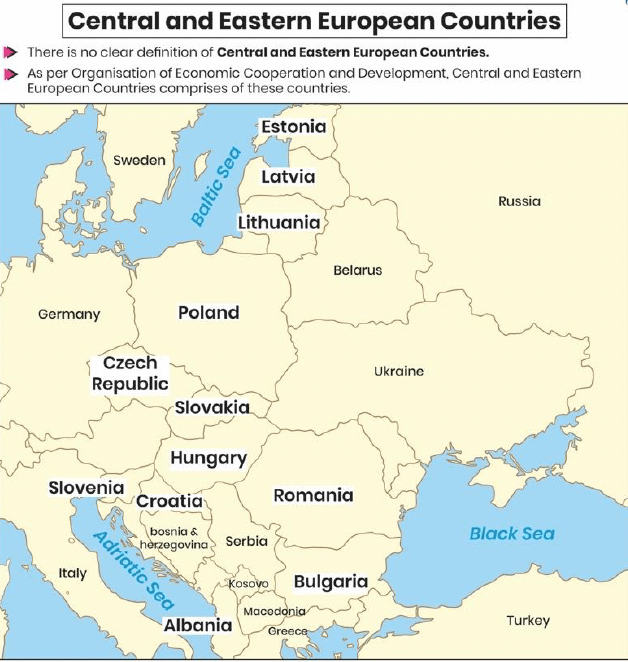
India's Outreach to Central and Eastern Europe
- Strategic Engagement: India has expanded its diplomatic and economic presence in Central and Eastern European (CEE) nations.
- Economic & Commercial Relations: Poland stands as India’s top trade and investment partner in CEE, with bilateral trade reaching $6 billion in 2023.
- India-Middle East-Europe Economic Corridor (IMEC): Announced during the G20 summit, this initiative seeks to enhance connectivity across Asia, Europe, and the Middle East.
- Cultural and Educational Relations: India is utilizing its rich cultural heritage to foster stronger ties with CEE countries.
- Examples include Poland’s strong interest in Indology, yoga, and historical connections such as Maharaja Jam Saheb Digvijaysinhji’s support during World War II.
- Strengthening the India-EU Strategic Partnership: India is intensifying its diplomatic efforts with regional EU members like Poland, reinforcing its partnership with the EU.
- Strategic Autonomy in Action: For instance, India’s Prime Minister’s visit to Ukraine highlights India’s independent stance on Ukraine, separate from Russia's influence.
Concerns in India’s Shift toward Eastern Europe
- India-Russia Relations: India’s historical Soviet-era ties with Eastern Europe, particularly with Russia, tend to overshadow potential modern geopolitical partnerships.
- Evolving Eurasian Geopolitics: For instance, conflicts like the Russia-Ukraine War highlight shifting dynamics.
- Expanding Chinese Influence: China’s increasing economic and political involvement in Eastern Europe, largely driven by initiatives such as the Belt and Road Initiative.
- Project Implementation Delays: Examples include setbacks in the India-EU Connectivity Partnership and the India-Middle East-Europe Economic Corridor (IMEC).
- Balancing Autonomy with Varied Interests: Navigating India’s independent position within alliances like QUAD, SCO, and G7.
INDIA ELECTED AS VICE-CHAIR OF IPEF’S SUPPLY CHAIN COUNCIL
Under the Indo-Pacific Economic Framework’s (IPEF) Supply Chain Agreement, India and 13 other IPEF partners have formed three key supply chain bodies:
- Supply Chain Council: Focuses on actionable steps to reinforce supply chains, especially for sectors and goods essential for national security, public health, and similar priorities.
- Crisis Response Network: Serves as a platform for coordinated emergency responses to urgent or impending supply chain disruptions.
- Labor Rights Advisory Board: Brings together workers, employers, and governments to advance labor rights and workforce development within regional supply chains.
Supply Chain Resilience (SCR)
- SCR: Refers to a supply chain’s capability to endure disruptions and reduce their impact on revenues, costs, and customer satisfaction.
- The supply chain is the entire journey of raw materials or products from their initial production through to final sale.
- SCR Threats: Include geopolitical issues (e.g., energy supply disruptions due to the Russia-Ukraine conflict), economic challenges (e.g., demand and supply shocks from COVID-19), among others.
- India’s SCR Measures:
- Global: Initiatives like the Supply Chain Resilience Initiative (Australia, India, Japan), and the Quad Supply Chain Initiative.
- National: Includes efforts like the PM Gati Shakti National Master Plan, National Logistics Policy, and the Production-Linked Incentive (PLI) Scheme across various sectors.
Indo-Pacific Economic Framework (IPEF)
- Launch: Initiated in 2022 in Tokyo, Japan.
- Member Nations (14): Australia, Brunei, Fiji, India, Indonesia, Japan, South Korea, Malaysia, New Zealand, Philippines, Singapore, Thailand, Vietnam, and the United States.
- Purpose: Aims to strengthen economic cooperation among member nations to foster growth, peace, and prosperity in the Indo-Pacific region.
- Focus Areas: Comprises four core pillars—Trade, Supply Chain Resilience, Clean Economy, and Fair Economy.
- India's Involvement: Actively participates in Pillars II to IV, with observer status in Pillar I.
INDIA MALAYSIA RELATIONS
News Context
The Malaysian Prime Minister recently undertook a State visit to India.
Key Outcomes of the Visit:
- Comprehensive Strategic Partnership: The strategic partnership established between India and Malaysia in 2015 has now been elevated to a Comprehensive Strategic Partnership.
- Malaysia Joins IBCA: Malaysia has chosen to become a founding member of the International Big Cat Alliance (IBCA).
- IBCA, launched in 2023 to celebrate the 50th anniversary of Project Tiger, aims to collaborate with 97 range countries covering the natural habitats of seven big cat species (Tiger, Lion, Leopard, Snow Leopard, Cheetah, Jaguar, and Puma).
- Digital Technology Cooperation: An MoU was signed for collaboration in digital technologies, along with an agreement to hold an early session of the Malaysia-India Digital Council.
- The Council aims to foster cooperation in areas like Digital Public Infrastructure, B2B digital partnerships, digital skill development, cybersecurity, and emerging technologies, including 5G and quantum computing.
- India-Malaysia Startup Alliance: Both countries have committed to bolstering their startup ecosystems through a dedicated alliance.
- Support for AITIGA Review: India and Malaysia have agreed to back the review process of the ASEAN-India Trade in Goods Agreement (AITIGA), aiming to make it more beneficial and conducive to trade for businesses in both countries.
India-Malaysia Relations Overview
- Background: India initiated diplomatic relations with the Federation of Malaya (now Malaysia) in 1957.
- Economic Ties: In FY 2023-24, bilateral trade between India and Malaysia reached $20.01 billion, positioning Malaysia as India's 16th largest trading partner and its 3rd largest in ASEAN. Key initiatives include the Malaysia-India Comprehensive Economic Cooperation Agreement (MICECA) Joint Committee Meeting, efforts to enhance trade in local currencies, and collaboration between central banks.
- Oil Palm Diplomacy: Malaysia supplies three million metric tonnes of palm oil to India annually, out of India’s total import of 9.7 million tonnes. Malaysia has also shown interest in supporting India’s National Mission on Edible Oils through services in research, seed supply, and partnership management.
- Defence Cooperation: The scope of bilateral defense cooperation includes joint ventures, joint development, procurement, logistics and maintenance support, and training. The Malaysia-India Defence Cooperation Committee (MIDCOM) meets annually to assess progress in these areas. Additionally, HAL opened its first regional office in Kuala Lumpur in 2023.
- People-to-People Connections: Over two million people of Indian origin reside in Malaysia, forming the third-largest Indian diaspora after the United States and the UAE.
India's Efforts to Enhance Relations with Malaysia:
- A dedicated allocation of 100 seats for Malaysian nationals under India’s Technical and Economic Cooperation (ITEC) Programme.
- Malaysia-India Comprehensive Economic Cooperation Agreement (MICECA) Joint Committee Meeting to expand economic collaboration.
- The Netaji Subhash Chandra Bose Indian Cultural Centre in Kuala Lumpur fosters Indian cultural heritage through language, dance, and yoga.
- Malaysia is among the international markets that accept UPI payments.
INDIA-POLAND RELATIONSHIP
News Context
Recently, the Indian Prime Minister visited Poland, marking the 70th anniversary of diplomatic relations between the two nations.
Key Highlights of the Official Visit
- Social Security Agreement: Both countries agreed on a social security agreement aimed at safeguarding the rights of cross-border workers.
- Jam Saheb of Nawanagar Youth Exchange Program: India will launch a youth exchange program with Poland in memory of Maharaja Jam Saheb Digvijaysinhji, who sheltered displaced Polish children during WWII in Jamnagar.
- Strategic Partnership: Both nations agreed to elevate their bilateral relationship to a Strategic Partnership and implement a five-year Action Plan (2024-2028) to support this.

Five-Year Action Plan for Strategic Partnership
- Political Dialogue and Security Cooperation: An annual political dialogue at the deputy foreign minister level will be established. Additionally, both sides will promote regular consultations on security and defense to strengthen defense industry contacts, modernize equipment, and resolve outstanding issues.
- Trade and Investment: The Joint Commission for Economic Cooperation will convene at least twice in five years to boost economic security by increasing supply chain resilience and reducing trade dependency risks.
- India-EU Cooperation: Both nations will work towards an early conclusion of India-EU trade and investment talks, including the operationalization of the India-EU Trade and Technology Council.
- Counter-Terrorism: Cooperation will focus on designating individuals linked to UNSC 1267-sanctioned terrorist groups.
- Additional Areas of Collaboration: Further cooperation in cyber security, circular economy, wastewater management, and related fields.
INDIA-UKRAINE RELATIONSHIP
News Context
India's Prime Minister made his first visit to Ukraine since establishing diplomatic relations in 1992.
Key Highlights of the Visit
- Prospective Partnership: Both nations agreed to potentially elevate their comprehensive partnership to a strategic level in the future.
- BHISHM Cubes Initiative: India extended Bharat Health Initiative for Sahyog Hita & Maitri (BHISHM) cubes to Ukraine under the ‘Aarogya Maitri’ project. These BHISHM cubes are portable hospitals designed to deliver swift medical aid in emergency situations.
- Agreements: Several agreements were signed, covering agriculture, food industry, medical product regulations, Indian Humanitarian Grant Assistance, and a cultural cooperation program for 2024-2028.

Significance of the PM’s Visit to Ukraine
- Repairing Ties with Ukraine: This visit aims to restore India's ties with Ukraine in the post-Soviet era.
- Positioning India as a Global Mediator: By promoting peace, India is establishing itself as an influential mediator on the global stage, aiming to extend its reach beyond its South Asian neighbors. This mediator role is not solely about the Ukraine crisis but also boosts India’s global credibility compared to other emerging powers like China.
- Shift in India’s Neutral Stance in Foreign Policy: The visit reflects a shift from India’s traditional non-alignment policy to a more engaged stance, where India maintains it has always stood on the side of peace in the Russia-Ukraine conflict.
- Balancing Relations with the West and Russia: India’s multi-alignment strategy highlights its nuanced balance between Western countries and Russia amid the ongoing war.
- Expanding Focus on Europe: Previously, India's relations in Europe centered on major countries like Russia, Germany, France, and Britain. Now, India’s broader pursuit of peace in Europe indicates a larger diplomatic push in the region.
Role India Can Play in Mediating the Russia-Ukraine Conflict
- Foster collaboration to uphold the UN Charter, adhere to principles of international law, and respect each nation's territorial integrity and sovereignty.
- Contribute to global food security by emphasizing the need for a continuous and unrestricted supply of agricultural goods.
- Facilitate the development of innovative, widely acceptable solutions through inclusive multi-stakeholder consultations.
INDIA VIETNAM RELATIONS
News Context
The Prime Minister of Vietnam recently visited India on an official State visit.
Key Outcomes of the Visit:
- Plan of Action (2024-2028): A roadmap was unveiled to advance the Comprehensive Strategic Partnership between the two nations.
- Line of Credit: India committed a US$ 300 million credit line to support Vietnam's maritime security efforts.
- Cultural Cooperation: A Letter of Intent was signed to assist with the conservation and restoration of the "My Son" World Heritage Site temples.
- MoUs Signed: Agreements were finalized to enhance cooperation in radio and television sectors, along with the development of the National Maritime Heritage Complex in Lothal, Gujarat.
- Additional Announcements:
- A virtual inauguration of an Army Software Park took place in Nha Trang, Vietnam.
- Vietnam announced its intention to join the Coalition for Disaster Resilient Infrastructure (CDRI).

India-Vietnam Relations
- Background: India backed Vietnam's fight for independence from France, opposed U.S. involvement in Vietnam during the 1960s, and was among the first nations to recognize a unified Vietnam in 1975 following the Vietnam War.
- Strategic Partnership: The two nations established a "Strategic Partnership" in 2007, upgraded to a "Comprehensive Strategic Partnership" in 2016. This collaboration currently follows the “Joint Vision for Peace, Prosperity, and People 2020” framework.
- Economic Cooperation: Bilateral trade reached $14.82 billion in 2023-2024, with Vietnam ranking as India's 23rd-largest trade partner globally and 5th within ASEAN nations.
- Defence Cooperation: The defense relationship is diverse, encompassing dialogues, training, joint exercises (such as PASSEX, VINBAX, and MILAN), capacity-building collaborations, and naval and coast guard ship exchanges. In 2022, both countries signed a "Joint Vision Statement on Defence Partnership Towards 2030" and an MoU on Mutual Logistics Support.
- Integration into Supply Chains: Partnership with Vietnam supports India’s integration into resilient and efficient regional and global supply chains. Vietnam's free trade agreement with the European Union further enhances its role in global trade networks.
- Cultural Ties: India and Vietnam share over 2,000 years of cultural and civilizational connections, underpinned by a strong bond through their shared Buddhist heritage.
India’s Efforts to Enhance Relations with Vietnam
- Mekong-Ganga Cooperation (MGC): A collaborative framework between India and five ASEAN countries—Cambodia, Lao PDR, Myanmar, Thailand, and Vietnam—aimed at fostering ties in tourism, culture, education, and transport and communication sectors.
- Quick Impact Projects: India undertakes these initiatives in various Vietnamese provinces within the MGC framework to provide swift and visible benefits.
- Training and Capacity Building: India offers training programs, capacity-building initiatives, and educational courses in India specifically for Vietnamese nationals.
- Defense Collaboration: In 2023, India transferred the indigenously built missile corvette, INS KIRPAN, to Vietnam, strengthening defense ties between the two nations.
KURSK REGION
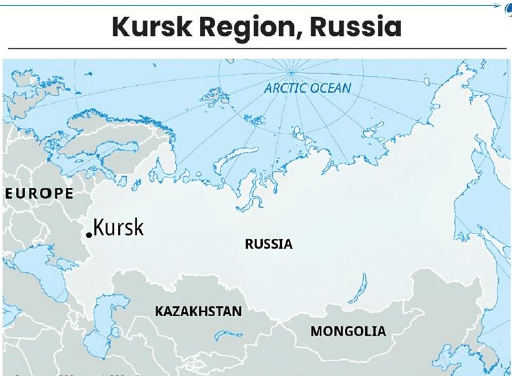
Russia declared a state of emergency in the Kursk region.
About the Kursk Region:
- Located centrally on the Eastern European Plain, it shares a border with Ukraine.
- The Dnieper and Don river basins, including the Seim and Psel rivers, run through the area.
- The predominant soil type is chernozem (black soil).
- The region contains explored deposits of iron ore, phosphorites, peat, and various building materials.
PARA-DIPLOMACY
News Context
Recently, the Ministry of External Affairs (MEA) expressed disapproval of Kerala's decision to appoint an 'External Cooperation' official.
Details on the Issue
- The MEA stated that state governments should avoid intervening in matters outside their constitutional authority, as foreign affairs fall under the Union's exclusive jurisdiction.
- According to India’s Constitution, Seventh Schedule, Union List, Item 10, foreign affairs and all related interactions with foreign nations are solely managed by the Union Government.
- This development has sparked a discussion on an emerging area in India’s foreign policy known as "para-diplomacy," or the role of subnational governments in international engagement.
About Para-Diplomacy
- Para-diplomacy allows subnational governments to engage in foreign affairs.
- Also known as ‘state diplomacy’, ‘regional diplomacy’, or ‘subnational diplomacy’, this approach permits states or regions to pursue their own international interests.
- Unlike traditional diplomatic relations handled by central governments, para-diplomacy provides a framework for federal or subnational units to pursue global outreach.
- In 2014, the MEA established the "States Division" to collaborate with States and Union Territories, aiming to enhance their efforts in promoting exports, tourism, and attracting foreign investment and expertise.
Constitutional Provisions
- Seventh Schedule: Item 10 of the Union List specifies that foreign affairs and all matters connecting the Union with foreign nations fall under the Union's purview.
- Article 253: Grants Parliament the authority to enact laws necessary for implementing treaties with other countries or any decisions taken at international conferences.
- Article 293: Restricts states from borrowing externally, limiting their borrowing capabilities strictly within India's borders.
Need for Para-Diplomacy
Given the Indian subcontinent's diverse cultural and geographical interconnections, Indian states have historically influenced foreign policy decisions significantly.
- Regional Strengths: Para-diplomacy enables states to leverage their unique strengths to boost trade and enhance cultural exchanges with foreign nations.
- Example: Kerala has utilized its diaspora to advance trade, attract investment, and foster cultural connections with Gulf countries.
- Attracting Investment: States can adapt investment strategies to draw in foreign direct investment by highlighting local advantages, like skilled labor and natural resources, and providing an attractive investment environment.
- Example: Investment summits such as Vibrant Gujarat, Progressive Punjab, and Vibrant Goa exemplify this approach.
- Cultural Diplomacy: Para-diplomacy supports states in deepening historical and cultural ties, promoting tourism, cultural interactions, and educational partnerships.
- Example: Tamil Nadu’s ethnic connections with Sri Lanka and West Bengal’s cultural ties with Bangladesh are prime examples.
- Support for National Foreign Policy: Although foreign policy is a central government function, states can strengthen India's diplomacy by building relationships that align with national objectives.
- Example: The West Bengal Chief Minister’s 1996 visit to Bangladesh facilitated the Farrakka Water sharing agreement.
- Strengthening Federalism: Para-diplomacy can reinforce India’s federal structure by enabling states to participate more actively in international affairs, promoting a more decentralized and adaptable foreign policy.
Criticism of Para-Diplomacy
- Constitutional Constraints: Foreign affairs are under the Union List in the Constitution, and state involvement in international relations could be viewed as encroaching on Union powers.
- Resource Constraints: Building and sustaining international partnerships, hosting delegations, and other diplomatic activities can strain states' financial resources.
- Political Divergence: State governments may prioritize different issues or hold differing ideologies than the central government, creating potential conflicts or limited central support.
- Example: Maharashtra’s Dabhol Project only progressed with central government backing.
- Diverging Interests: State governments may have priorities that conflict with national foreign policy, potentially causing inconsistencies.
- Example: The Teesta Water Sharing Agreement was delayed due to opposition from the West Bengal government.
- Impact on Bilateral Relations: State-level influence in foreign affairs can impact India’s international relations and its stance on global policies.
- Example: India’s UNHRC vote against Sri Lanka, a neighboring ally, illustrates this impact.
- Security Concerns: Para-diplomatic activities in sensitive regions, such as states bordering Pakistan or China, could inadvertently pose security risks.
SAINT MARTIN’S ISLAND
Reports suggest that the US aimed to set up a military base on St. Martin’s Island in Bangladesh.
About St. Martin’s Island:
- A small coral island in the northeastern Bay of Bengal.
- Also known as 'Narikel Jinjira' or Coconut Island, and 'Daruchini Dwip' or Cinnamon Island, among other names.
- Originally an extension of the Teknaf peninsula, it became an isolated island after part of the peninsula submerged.
- In 1974, Bangladesh and Myanmar agreed that the island would belong to Bangladesh.
- Geopolitical Importance: Positioned close to both Bangladesh and Myanmar.
SOUTH CHINA SEA TENSIONS & INTERNATIONAL TRADE
News Context
Incidents involving aggressive and hazardous behavior by Chinese vessels in the highly disputed South China Sea have significantly increased over the last 17 months.
Details on the News
- China recently instructed Malaysia to cease all operations in an oil-rich region off the coast of Sarawak.
- Notably, this area lies just 100 km from Malaysia but nearly 2,000 km from mainland China.

Overview of the South China Sea (SCS)
Geographical Location of the SCS
- The SCS forms part of the western Pacific Ocean, situated around Southeast Asia.
- It lies south of China, to the east and south of Vietnam, west of the Philippines, and north of Borneo.
- The area contains over 200 small, largely uninhabitable islands, rocks, and reefs.
The Dispute
- 1992: China asserts its claim over the entire SCS based on historical rights dating back to the Western Han dynasty.
- 2016: The Permanent Court of Arbitration rules in favor of the Philippines, declaring that China’s “nine-dash line” has no legal foundation.
Significance for Global Trade
- Approximately one-third of global maritime trade, covering 3.5 million square kilometers, moves through this seaway each year.
- Roughly 40% of the world’s traded petroleum products are transported through the South China Sea annually.
Key Players in the South China Sea (SCS)
- China: Claims the largest portion of the SCS, asserting rights over nearly 90% of the area, including full occupation of the Paracel Islands and nine reefs within the Spratly Islands.
- Taiwan: Shares historical ties with China and mirrors China’s broad claims over the region.
- Vietnam: Has maintained active control over both the Paracels and Spratlys since the 17th century.
- The Philippines: China's claimed territories overlap with the Philippines’ exclusive economic zone, an area referred to by Manila as the West Philippine Sea.
- Malaysia and Brunei: Contend that their claims fall within their Exclusive Economic Zones (EEZs), as defined by the United Nations Convention on the Law of the Sea (UNCLOS).
- The United States: Although it holds no territorial claims, the U.S. plays a pivotal role by conducting freedom of navigation operations in the region.
How the South China Sea (SCS) Dispute Threatens Global Trade:
- Chinese Aggression: China's military has recently intensified its actions in the seaway, including confrontations with Filipino vessels, heightening concerns about the potential for large-scale conflict.
- U.S. Defense Commitments: The U.S. has consistently warned that it has an obligation to defend the Philippines if attacked, including in the SCS region.
- Taiwan Tensions: Beijing's possible use of military force to assert control over the democratic island of Taiwan could further escalate tensions in the SCS.
- Malacca Strait Blockade Risk: In the event of a China-Taiwan conflict, a blockade of the Malacca Strait could seriously disrupt global trade, worsening congestion and security challenges.
- Rising Shipping Costs: Growing instability in the SCS may open a new crisis point in global shipping (in addition to the Red Sea and the Strait of Hormuz), potentially leading to rerouting, delays, higher costs, shortages, and significant revenue losses for major Asian ports.
India and the South China Sea
- India's Engagement: Through its Look East Policy, India has steadily strengthened its presence in the South China Sea, emphasizing economic and strategic partnerships with Southeast Asian countries, despite China's opposition.
- Strategic Significance for India:
- Vital Waterway: The South China Sea links the Indian Ocean to the East China Sea through the Malacca Strait, an essential route for global commerce.
- Trade Dependency: A large portion of India’s international trade, especially over half of it, transits through the Malacca Strait, making this region crucial for India's economy and security.
- Energy Interests: The South China Sea holds significant energy reserves, which India is keen to access to meet its rising domestic energy demands, including joint exploration of Oil Block 128 off Vietnam's coast.
- India's Goals in the South China Sea: India advocates for open and inclusive access to shared global spaces, especially maritime areas.
- Strategic Approach:
- Strengthen economic and strategic connections with ASEAN members.
- Participate in joint naval exercises, offer military training, and facilitate arms sales (e.g., BrahMos missiles to the Philippines).
- Involve itself in offshore energy initiatives in the South China Sea.
- Policy Frameworks: India's Act East, Neighborhood First, and SAGAR (Security and Growth for All in the Region) initiatives, along with strategic collaboration through QUAD, guide its approach in the region.
10 YEARS OF INDIA’S ACT EAST POLICY
News Context
- Experts note that the recent visit of the Indian Prime Minister to Singapore aims to reinvigorate India’s ties with Southeast Asia and, more broadly, the wider Pacific region.
- This visit holds special importance as 2024 marks the tenth anniversary of India's Act East Policy, initially introduced by the Prime Minister at the 9th East Asia Summit in 2014.
India and East Asia: Evolution from Look East to Act East Policy
- Origins of the Look East Policy (LEP): After the Cold War, India’s loss of the USSR as a strategic ally prompted the launch of LEP in the early 1990s. The initiative aimed to build stronger connections with the U.S. and Southeast Asian allies to counterbalance China’s growing influence.
- Look East Policy and ASEAN: As part of the LEP’s implementation, India joined ASEAN in 1992 as a sectoral dialogue partner.
- India advanced its partnership, becoming a Dialogue Partner in 1996, a Summit-level Partner in 2002, and establishing a strategic partnership by 2012.
- India’s Act East Policy (AEP): In 2014, India introduced the 'Act East' policy, initially focused on economic engagement. Over time, it has expanded to encompass political, strategic, and cultural dimensions, broadening India’s engagement with East Asia.
Act East Policy (AEP) in Action
- Expansion of AEP from East Asia to the Indo-Pacific: While the Look East Policy focused exclusively on ASEAN, the Act East Policy broadens the strategic horizon to include the Indo-Pacific, with ASEAN at its center in this expanded neighborhood.
- Example: The Indo-Pacific Oceans Initiative launched in 2019.
- Strengthening Multilateral and Regional Engagements: India has intensified partnerships with ASEAN, BIMSTEC, Asia Cooperation Dialogue (ACD), Indian Ocean Rim Association (IORA), among others.
- Example: The recent adoption of the BIMSTEC Charter.
- Increasing Institutional Collaborations: India is deepening ties with the United States and allies like Japan, Australia, and South Korea.
- Example: India's participation in the US-led Indo-Pacific Economic Framework for Prosperity (IPEF) and the Supply Chain Resilience Initiative (SCRI).
- Additionally, Japan has extended loans for connectivity projects in Northeast India.
- Proactive Role in Defence Diplomacy and Exports:
- Example: In 2022, the Philippines became the first export destination for India’s BrahMos shore-based anti-ship missiles.
- India and Vietnam have a military logistics pact allowing mutual base access and boosting joint production capabilities.
- Enhanced Connectivity Initiatives: Key projects include the Kaladan Multi-Modal Transit Transport Project connecting Mizoram with Myanmar’s Sittwe Port, the India-Myanmar-Thailand Trilateral Highway, and the Mekong-India Economic Corridor.
- India’s Active Socio-Cultural and Developmental Engagement: India is fostering closer people-to-people ties, with a 2-million-strong diaspora, and making high-level visits such as the Prime Minister's recent trip to Brunei and Singapore.
- Developmental Outreach to Pacific Island Nations: India established the Forum for India-Pacific Islands Cooperation (FIPIC) and extended the Vaccine Maitri initiative, providing vaccines to countries like Papua New Guinea.
Alignment of strategic interests and partnerships.
- India has developed strategic partnerships with Indonesia, Vietnam, Malaysia, Japan, South Korea, and Australia.
- Significant progress has been made in deepening unofficial ties between India and Taiwan.
- India’s Act East policy aligns well with Japan’s Free and Open Indo-Pacific initiative, South Korea’s New Southern Policy, and the ASEAN Outlook on Indo-Pacific (AOIP).
- India expresses solidarity with the Philippines regarding issues in the South China Sea.
- India remains firmly committed to ASEAN unity and centrality in the Indo-Pacific.
- Establishing strategic and security frameworks to counter China’s regional dominance, such as India’s support for an open, stable, and prosperous Indo-Pacific.
Trade and Investments Cooperation
- ASEAN stands as India's fourth-largest trading partner, contributing to 10% of India's overall trade.
- Approximately half of India's trade activities are focused within the Indo-Pacific Region, while the
- Indian Ocean serves as a channel for 90% of India's trade and energy flow.
- Japan ranks as the fifth-largest investor in India’s economy.