
PT 360 Economy May 2024: UPSC 2025
Tip: For reading free UPSC Prelims 2025 Current Affairs for Economy online, use the Next/Previous buttons or refer to the Sidebar. If you are using a mobile device, click the menu icon (three horizontal lines) to access the sidebar.

AUTHORISED ECONOMIC OPERATOR (AEO) STATUS
Authorized Economic Operator (AEO) Status Extended to Gem and Jewellery Sector
- Operates under World Customs Organization (WCO) SAFE Framework
- Goal is to improve international supply chain security and ease movement of legal goods
- Aligns with commitments from World Trade Organization trade facilitation agreement
- Allows Indian Customs to boost cargo security and work closely with key players in international supply chain
COST INFLATION INDEX (CII)
COST INFLATION INDEX (CII) FOR FY 2024-25
- CBDT has announced the Cost Inflation Index (CII) for the financial year 2024-25.
- This index is used to calculate long-term capital gains (LTCG).
LONG-TERM CAPITAL GAINS (LTCG)
- LTCG refers to the profit made from selling a capital asset held for 12 to 36 months.
- Capital assets can include stocks, bonds, jewelry, buildings, etc.
IMPORTANCE OF CII
- CII is notified annually under the Income-tax Act (1961).
- Taxpayers use the CII to determine gains from the sale of capital assets after adjusting for inflation.
COMMODITY DEPENDENCE
- Recent Attention to Commodity Dependence: The President of the United Nations General Assembly has brought attention to the issue of commodity dependence.
Understanding Commodity Dependence
- A country is considered commodity-dependent when its exports are heavily focused on primary commodities like oil, coal, and iron ore.
- Factors contributing to commodity dependence include resource endowment, institutional framework, and historical context.
Challenges Associated with Commodity Dependence
- Vulnerability to economic shocks: Dependence on commodities can make an economy susceptible to fluctuations in global markets, as seen during events like the COVID-19 pandemic.
- Impact on human well-being: Countries with high commodity dependence often have lower Human Development Index (HDI) scores.
- Climate change vulnerability: Many small island developing states, which are heavily impacted by climate change, are also commodity dependent.
- Social implications: Countries reliant on industries like mining may see unequal distribution of benefits, with capital owners benefiting more than workers.
Moving Forward
- Developing a diversification strategy to reduce reliance on commodities.
- Promoting education and skill development to create more resilient economies.
- Providing support for commodity-dependent countries.
- Encouraging strong national political will to address the challenges of commodity dependence.
DRIP PRICING
Warning against Drip Pricing: The Department of Consumer Affairs has issued a warning against drip pricing.
What is Drip Pricing?
- Drip pricing is a pricing technique where firms only advertise part of a product's price and reveal additional charges later in the buying process.
- It is used to attract customers into starting the purchasing process.
- Drip pricing has been identified as a dark pattern under the Guidelines for Prevention and Regulation of Dark Patterns, 2023.
Dark Patterns: Dark patterns are practices used by online platforms to mislead people into paying for items or services they did not originally intend to purchase.
ELIGIBILITY FOR UNIVERSAL BANKING BY SFBS
- Eligibility Criteria for Small Finance Banks (SFB) to Transition into Universal Banking
- Offer a wide range of financial services beyond commercial and investment banking, such as insurance
- SFBs were previously limited to basic banking activities
On-Tap Licensing
- Introduced in 2016 to allow banks to apply for licenses throughout the year
- Prior to this, licenses were granted by invitation from the RBI
Eligibility Requirements for SFBs to Transition into Universal Banks
- Net Worth: Minimum of Rs 1,000 crore
- Status: Scheduled banks with a satisfactory performance track record of at least 5 years
Financial Health:
- Profitability: Net profits in the last two financial years
- Asset Quality: GNPA and N-NPA must be less than or equal to 3% and 1% respectively over the last two FYs
- Stock Listing: Shares must be listed on a recognized stock exchange
Promoter Requirements:
- No new promoters or changes to existing promoters allowed during transition
- No changes to previously approved promoter shareholding dilution plan
- Preference: SFBs with a diversified loan portfolio will be preferred for transition.
About Small Finance Banks (SFB)
- Small Finance Banks (SFB) were introduced in the Union budget of 2014-15
- SFBs are registered as public limited companies under the Companies Act, 2013
- They are licensed and governed under the Banking Regulation Act, 1949 with no restrictions on where they can operate
- The capital requirement for SFBs is 200 crore, except for some exceptions
- SFBs are mandated to extend 75% of their Adjusted Net Bank Credit (ANBC) to the priority sector for financial inclusion.
‘FIVE-YEAR REVIEW OF INDIA’S MERCHANDISE TRADE’ REPORT
- Five-Year Review of India's Merchandise Trade Report
- Impact of FTAs on India's Global Trade Dynamics
- The report, released by the Global Trade Research Initiative (GTRI), evaluates the effects of international disruptions and domestic obstacles on India's trade performance.
- It also examines the influence of Free Trade Agreements (FTAs) on India's global trade dynamics.
- FTAs are agreements between two or more countries aimed at reducing barriers to trade and investment, fostering stronger trade relationships.
- Key findings of the report on India's FTAs include a significant increase in merchandise imports from FTA partners compared to exports.
- India's FTA with Asean, signed in 2010, resulted in faster growth in imports than exports.
- India ranks 17th globally in merchandise exports and 8th in merchandise imports.
- Challenges with India's FTAs include low utilization rates, high compliance costs, non-tariff barriers, and limited awareness among exporters about the benefits of FTAs.
Key Recommendations on Free Trade Agreements (FTAs) by Surjit Bhalla Committee (2019)
- Integrated Approach towards Trade: Adopt a comprehensive approach towards trade in goods, services, and investment to maximize benefits from FTAs.
- Technical Regulations Programme: Implement a thorough programme on technical regulations based on international standards to address non-tariff barriers (NTBs) effectively.
- Support for MSMEs: Provide institutional support to Micro, Small, and Medium Enterprises (MSMEs) to help them leverage FTAs in line with international obligations.
- Database on FTA Utilization: Develop an objective database to track and analyze the utilization of FTAs by businesses and industries.
- Inter-ministerial Coordination: Improve coordination among different ministries to ensure a cohesive approach towards FTAs.
- State-wise Outreach: Conduct outreach programs at the state level to educate and engage stakeholders on the benefits of FTAs.
- Stakeholders' Consultation: Involve stakeholders in the decision-making process related to FTAs to ensure their concerns and interests are addressed.
- Use of Trade Remedies: Utilize trade remedies such as anti-dumping and countervailing duties available under FTAs to protect domestic industries from unfair trade practices.
INDIA AND GLOBAL VALUE CHAINS (GVCS)
News Context
- Importance of Global Value Chains (GVCs) for India's economy
- NITI Aayog CEO emphasizes the need for India to participate in GVCs
- GVCs can help boost exports and secure supply chains for India
What are Global Value Chains (GVCs)?
- GVCs are a production sequence for a final consumer good that involves multiple stages taking place in different countries.
- Each stage of the production process adds value, such as production, processing, marketing, transportation, and distribution.
Significance of GVCs
- According to the OECD, approximately 70% of global trade occurs through GVCs.
- Countries can participate in GVCs through backward or forward linkages based on their economic specialization.
Backward Linkages in GVCs
- Backward linkages occur when one country uses inputs from another country for domestic production.
- For example, India imports cotton fabric from Italy to make and export shirts.
Forward Linkages in GVCs
- Forward linkages happen when one country supplies inputs or intermediate goods that are used for production in another country.
- For example, India supplies auto components to a German automaker for use in car production.

India’s participation in GVC
- Low Participation in GVC
- India's GVC-related trade is only at 40.3% in 2022, which is significantly lower compared to other large economies like the US, China, and Japan, as well as smaller countries like South Korea and Malaysia.
- Post-COVID-19 supply chain redistribution presents an opportunity for India to increase its participation.
- Low Export of Network Products: Only 10% of India's total merchandise exports are network products like electronics, computers, telecommunication equipment, and vehicles that are key in GVC production.
- Key Products Driving India's GVC Participation: India's GVC participation is mainly driven by products like coal and petroleum, business services, chemicals, and transport equipment.
- Predominance on Forward Linkages: India heavily relies on exporting raw materials and intermediate products, indicating a focus on forward linkages in GVCs.
Measures Taken to Integrate India in GVC
- Foreign Trade Policy 2023: Aims to streamline processes and use automation to make it easier for exporters to do business.
- Production linked incentive (PLI) scheme for large scale Electronics manufacturing: Introduced in 2020 to encourage participation in GVC, leading to Apple Inc's contract manufacturers setting up bases in India.
- One District One Product- Districts as Export Hubs (ODOP-DEH) initiative: Focuses on districts as manufacturing and export hubs by identifying products with export potential.
- Make-in-India Initiative: Launched in 2014 to make India a hub for manufacturing, design, and innovation, leading to a 57% increase in FDI equity inflow in the manufacturing sector between 2014 and 2022.
INDIA’S AGRICULTURE EXPORT POLICY
News Context
- Missed Target: Agricultural exports in India fell short of the ambitious target of $60 billion by 2022 set by India's Agricultural Export Policy in 2018.
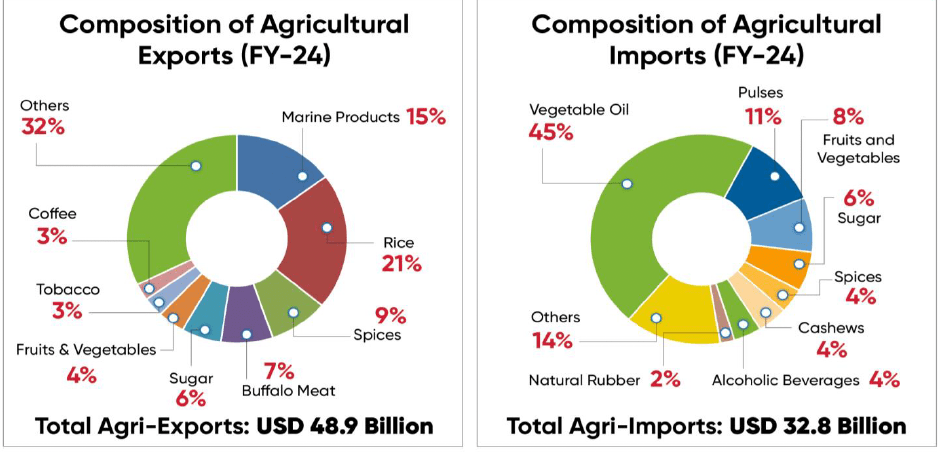
- Decrease in Exports: Agricultural exports in India registered an 8% decline in the year 2023-24, dropping from $53.2 billion in 2022-23 to $48.9 billion.
- Decrease in Imports: India's agricultural imports also saw a notable decline of 8% in the year 2023-24, decreasing from $35.7 billion in 2022-23 to $32.8 billion.
- Global Ranking: According to the WTO's Trade Statistical Review in 2023, India's share of agricultural exports and imports in world agriculture trade in 2022 were 2.4% and 1.9% respectively. India was ranked 9th in the global ranking of agricultural exporters.

Agriculture Export Policy (AEP) 2018
- Overview: The AEP is designed to prioritize agriculture export-oriented production, promote exports, improve farmer earnings, and align with the policies of the Government of India.
- Goal: Increase farmer income by adding value to agricultural products and reducing losses throughout the value chain.
Elements of Agriculture Export Policy Framework:
- Strategic Recommendations:
- Stable trade policy measures
- Infrastructure and logistics support
- Holistic approach to boosting exports
- Greater involvement of state governments in agriculture exports
Operational Recommendations:
- Building clusters
- Promoting value-added exports
- Marketing and promoting "Brand India"
- Attracting private investments in production and processing
- Establishing a strong quality regimen
- Increasing research and development efforts
Targets/Aim of Agricultural Export Policy
- Increase agricultural exports to over US$ 60 billion by 2022
- Diversify export basket and destinations
- Promote novel, indigenous, organic, ethnic, traditional, and non-traditional agricultural products
- Double India's share in world agricultural exports by integrating with global value chain
- Enable farmers to benefit from export opportunities in overseas markets
- Establish institutional mechanism for market access, tackling barriers, and addressing sanitary and phytosanitary issues
Steps taken for promoting Agricultural - export:
- Trade Infrastructure for Export Scheme (TIES): Ministry of Commerce initiative to support infrastructure development for export growth.
- Market Access Initiatives (MAI) Scheme: Ministry of Commerce program to boost India's exports consistently.
- Agricultural & Processed Food Products Export Development Authority (APEDA): Department of Commerce organization promoting agricultural exports, including millets.
- State specific Action Plans: States creating plans and committees to support agricultural exports.
- Farmer Connect Portals by APEDA: Platform for farmers, FPOs, and cooperatives to engage with exporters.
- Transport and Marketing Assistance Scheme: Central scheme to aid in international freight and marketing of agricultural produce.
INDIA INTERNATIONAL BULLION EXCHANGE (IIBX)
India International Bullion Exchange (IIBX)
- State Bank of India is the first trading-cum-clearing member at IIBX
- Bullion refers to high purity physical gold and silver in the form of bars, ingots, or coins
About IIBX
- Established at GIFT International Financial Services Centre (IFSC) in Gandhinagar, Gujarat in 2022
- Regulated by IFSC Authority (IFSCA)
- Promoted by leading market infrastructure institutions like National Stock Exchange, Multi Commodity Exchange of India
Benefits
- Gateway to import bullion into India
- Provides a world-class bullion exchange ecosystem to promote bullion trading, investment in bullion financial products, and vaulting facilities in IFSCs.
INDIA VOLATILITY INDEX (VIX)
India Volatility Index (VIX) Surge: Recently, India VIX has increased above 21, indicating increased volatility in the Indian stock market.
Understanding India VIX
- India VIX measures the expected fluctuation of an underlying index in the near term (30 calendar days).
- Higher India VIX values indicate higher expected volatility, and vice versa.
- It is based on index option prices of NIFTY.
- The computation methodology is based on the Chicago Board of Options Exchange (CBOE).
- CBOE introduced the first volatility index for US markets in 1993.
ISHAN INITIATIVE
- The Airports Authority of India (AAI) has launched the ISHAN (Indian Single Sky Harmonized Air Traffic Management) Initiative.
About Ishan
- Combining India's four Flight Information Regions (FIRs) into a single system overseen from Nagpur.
- Currently, Indian airspace is divided into 4 FIRs (Mumbai, Kolkata, Delhi, Chennai) and a sub-FIR in Guwahati, each managed separately.
- Unifying these FIRs under a single authority in Nagpur is expected to enhance efficiency, safety, and seamlessness in air traffic operations.
LOGISTICS SECTOR OF INDIA
News Context
India's Logistics Cost Analysis
- India's logistics cost estimated to be 7.8-8.9% of GDP in 2021-22
- National Council of Applied Economic Research (NCAER) conducted the analysis
- Task assigned by Department for Promotion of Industry and Internal Trade (DPIIT)
- World Bank reviewed methodology and found it appropriate for future fine-tuning
Previous Estimates Comparison
- NCAER's 8.9% of GDP for 2017-18
- CII's 10.9% of GDP in 2015
- Armstrong and Associates' (A&A) 13.0% of GDP in 2016
- A&A estimate widely circulated and influenced National Logistics Policy goal to reduce cost to global benchmarks by 2030
Logistic performance index report (2023)
- Published by the World Bank
- India's ranking is 38 out of 139 countries in 2023
- This is an improvement of 6 places from its ranking of 44 in 2018
Six LPI Parameters:
- Customs
- Infrastructure
- Ease of arranging shipments
- Quality of logistics services
- Tracking and Tracing
- Timeliness
Logistics Landscape in India
Major Components of Logistics:
- Procurement of materials from outside suppliers, including negotiation, order placement, inbound transportation
- Material handling for efficient order processing in warehouses
- Warehousing, packaging, and inventory control of finished goods
- Transportation for physical delivery of goods to distributors and end customers
Importance of Efficient Logistics Infrastructure:
- Supply chain efficiency: crucial for meeting consumer demand and optimizing production processes
- Connectivity and accessibility enable businesses to reach a wider customer base and contribute to economic integration
- Cost reduction and competitiveness leads to lower transportation, storage, and distribution costs
- Job creation: opportunities in transportation, warehousing, distribution, and related services.
Modal split – freight movement in India in 2022
- Road transportation accounts for 66% of freight movement in India
- Rail transportation accounts for 31% of freight movement
- Shipping accounts for 3% of freight movement
- Air transportation accounts for 1% of freight movement
- In terms of ton-km, road transportation moves 3.05 trillion metric tons
- Rail transportation moves 0.82 trillion metric tons
- Shipping moves 1,108 million metric tons
- Air transportation moves 2,068 million metric tons
Steps Taken for Improvement of Logistic Sector in India
National Logistics Policy (NLP) 2022
- Focuses on soft infrastructure and logistics sector development
- Includes process reforms, improvement in logistics services, digitization, human resource development, and skilling
- Complements PM Gati Shakti National Master Plan (NMP)
- Targets to reduce logistics cost, improve Logistics Performance Index ranking, and create data-driven decision support mechanism
- Comprehensive Logistics Action Plan (CLAP) launched as part of NLP covering eight action areas
Unified Logistics Interface Platform (ULIP)
- Integrates 34 logistics-related digital systems/portals across Ministries/Departments
- GST data integration
- Private players can access data on ULIP for use cases
EXIM Logistics
- Addresses infrastructure and procedural gaps in India's EXIM connectivity
- Logistics Data Bank (LDB) provides visibility for 100% of India’s EXIM containers
Logistics given infrastructure status: Enables access to infra-lending at easier terms
Logistics Ease Across Different States (LEADS)
- Indigenous logistics performance index for monitoring across states
- States ranked according to performance annually
Multimodal Logistics Parks (MMLPs)
- Act as freight aggregation and distribution hubs
- Government planned 35 MMLPs with $6.2 Billion investment outlay
Bharatmala Pariyojana: Construction of 65,000 km of National Highways in two phases
Dedicated Freight Corridors (DFC): Assist in increasing rail freight traffic share from 27% to 45% by 2030
Sagarmala and Inland waterways: Flagship programme to promote port-led development through India’s coastline and waterways
LEADS 2023: Performance snapshot

LAND SQUEEZE
News Context
Recent Report by IPES-Food
- IPES-Food released a report titled 'Land Squeeze' highlighting pressures on land leading to inequality in India and globally.
- IPES-Food is a global think-tank providing expert guidance for sustainable food systems worldwide.
- The report showcases how land is facing unprecedented pressures, resulting in land squeezing and inequality.
Key Highlights of the report
Global Land Inequality
- 1% of the world's largest farms control 70% of farmland
- Land prices have nearly doubled globally and tripled in Central-Eastern Europe between 2008 and 2022
Land Inequality in India
- Top 10% of landowners own 45% of farmland in India
- More than 70% of India's arable land is undergoing one or more forms of land degradation
Drivers of Land Squeeze
Land Grabbing:
- Privatization of common land through lease, concessions, quotas
- Deregulation of land markets by governments
- Financialization transferring land ownership to financial actors
- Focus on rapid resource extraction through 'water grabs' and 'resource grabs'
Green Grab:
- Appropriation of land for conservation schemes like Carbon offset and biodiversity initiatives
- Accounts for about 20% of large-scale land deals
Expansion and Encroachment of farmlands:
- Land used for mining, urbanization, and mega-city development
- Mining projects account for 14% of large-scale land deals
Food System Reconfiguration: Industrialization and consolidation of agri-food sector with concepts like contract farming and value chain integration
Other reasons:
- Colonial reasons like extractive revenue collections
- Social inequalities and discrimination like caste system and patriarchy
These drivers are worsened by factors like lack of 'just transition' pathways, insecurity of tenure, economic limitations, limited political representation of small-scale farmers and marginalized groups, and biases in development strategies and trade liberalization.
Impacts of Land Squeeze
On Local and Farming Communities
- Land loss, concentration, and fragmentation due to increased input costs, land price volatility, and undermined security of tenure, especially for smallholder agriculture
- 34% of land grabbed since 2000 was from smallholder farmers
- Exacerbation of persistent rural poverty and livelihood pressures on small-scale food producers
- Wealth inequality as methods like contract farming reduce farmers' autonomy and access to credit or insurance products
Impact on Indigenous People: Land conversion and dispossession leading to oppression, discrimination, mass displacement, and land conflicts
On Environment
- Loss and damage to biodiversity, with 87% of land grabs occurring in regions of high biodiversity
- Land degradation from techno-centric, capital-intensive, and chemical input-intensive agriculture
- Water stress from land diversion to water-intensive projects like 'green hydrogen', with over half of land grabs intended for water-intensive crop production
On Food Security: Conversion of farmland to solar parks, land degradation, concentration, and fragmentation leading to shrinking land available for sustainable food production.
Steps taken to address land inequality in India
Post-Independence Era
- Abolition of the Zamindari system eliminated intermediaries between cultivators and the state.
- Tenancy abolition aimed to outlaw or regulate rents to provide security to tenants, successful in West Bengal and Kerala.
- Land Ceiling Acts imposed limits on land ownership by families.
- Bhoodan Movement by Acharya Vinova Bhave aimed to provide land to the landless.
Post 2000
- Forest Rights Act, 2006 ensures land tenure and security for forest-dwelling Scheduled Tribes.
- Svamitva Scheme by Ministry of Panchayati Raj provides legal ownership cards through drone technology mapping.
- RFCTLARR Act, 2013 ensures transparent land acquisition for industrialization.
- Model Tenancy Act aims to create a transparent ecosystem for renting premises.
PARADOX OF THRIFT (POT) THEORY
Theory
- Popularized by British economist John Maynard Keynes
- PoT states that a rise in individuals' savings can actually lead to a decrease in overall savings and investments
- It argues that higher savings can be detrimental to the economy, as growth is dependent on consumer spending
Criticism of PoT
- Ignores the role of banks in lending out saved income
- Fails to consider the impact of inflation and deflation on the economy
RBI SURPLUS TRANSFER
News Context
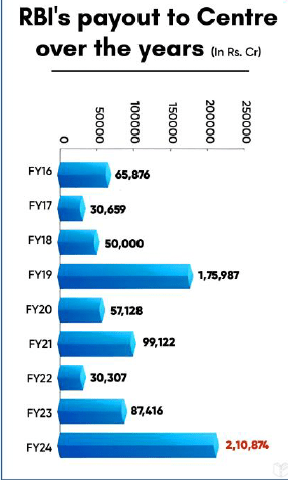
- RBI approved a surplus transfer of Rs 2.11 lakh crore to the government for FY24
- This amount is more than double the previous year's transfer of ₹86,416 crore
- Higher income from forex holding of the central bank
- Other factors also played a role in the significant jump in surplus amount
- The transfer is for the fiscal year 2023-2024
- The surplus will reflect in the government's account in the fiscal year 2024-25
About RBI Surplus
- Surplus refers to the amount of income that exceeds expenses.
- The RBI's total expenditure is significantly lower than its total net interest income, resulting in a surplus.
- This surplus is generated due to the RBI's ability to earn more income than it spends on operating expenses.
| RBI’s Income | RBI’s Expenditure |
|---|---|
| Interest on Rupee Securities (RS): Interest earned on holding RS adjusted with Profit/Loss on sale and redemption, Depreciation and Amortization of RS. | Risk Provisions: The RBI incurs a major chunk of its expenditure in making Risk Provisions, including Contingency Fund (CF) and Asset Development Fund (ADF). |
| Interest earned on LAF and MSF operations: Net interest earned on Liquidity Adjustment Facility (LAF) and Marginal Standing Facility (MSF). | CF: Kept for unforeseen contingencies like depreciation of securities values, risks from monetary rate policy, etc. |
| Interest earned on Loans & Advances: Interest income on loans and advances extended to Central and State Governments, banks and financial institutions and employees. | ADF: Represents provisions made towards investments in subsidiaries and associated institutions and to meet internal capital expenditure. |
| Interest earned from Foreign Sources: Consists of Interest Income from Foreign Currency Assets (FCA). | Printing of notes |
| Agency charges: Includes commission to banks, primary dealers etc. | |
| Employee cost |
Provisions regarding RBI transfer surplus to the government
- RBI Act, 1934: The RBI is exempt from paying income tax or super tax on its income, profits, or gains, but it transfers its surplus to the government after setting aside funds for contingency and ADF.
- Committees' recommendations: Various committees have recommended the amount of surplus the RBI should transfer to the government, leading to an increase in transfers after the Malegam Committee's recommendations in 2013.
- Economic Capital Framework (ECF): The ECF determines the level of risk provisions and profit distribution under Section 47 of the RBI Act, 1934.
- Realized equity: The CF should be maintained at 5.5% of the RBI's balance sheet, with excess amounts transferred to the government.
- Economic capital: CGRA should be kept at 20.8-25.4% of the balance sheet, with the remainder transferred to the government. CGRA includes capital, reserves, risk provisions, and revaluation balances.
TRAVEL & TOURISM DEVELOPMENT INDEX, 2024
- TTDI measures factors and policies for sustainable Travel and Tourism development
- Evolved from the Travel & Tourism Competitiveness Index (TTCI) series
- TTCI has been produced by WEF since 2007
India's Rank Improvement in TTDI, 2024
- India's rank improved to 39 in 2024 from 54 in 2021
- Reflects positive growth and development in the Travel and Tourism sector in India
UN PANEL FOR CRITICAL ENERGY TRANSITION MINERALS
Establishment of UN Panel for Critical Energy Transition Minerals
- Panel aims to develop global common and voluntary principles for energy transition
- Addresses issues of equity, transparency, investment, sustainability, and human rights
Composition of the panel: Includes Government and intergovernmental actors from various countries
Importance of Critical Energy Transition Minerals
- Essential components in clean energy technologies
- Examples include copper, lithium, nickel, cobalt, etc.
Challenges and issues related to Critical Energy Transition Minerals
- Geographical concentration leading to geopolitical tensions and supply chain disruption
- Example: Lithium triangle in South America
- Unsustainable mining and processing causing environmental and human rights issues
- Growing demand with a mismatch in supply
- International Energy Agency predicts demand to grow significantly by 2030
Other Key Initiatives
1. Global Initiatives
- Mineral Security Partnership (MSP) launched to strengthen critical minerals supply chains, with India as a participant
- Critical Minerals Mapping Initiative
- UN Framework on Just Transition for Critical Energy Transition Minerals expected to be launched by the end of 2024
2. India Initiatives
- Identification of 30 critical minerals essential for self-reliance
- Partnership with Australia for lithium and cobalt, and with Argentina for lithium
- Formation of Khanij Bidesh India Limited (KABIL) to identify, acquire, process, and commercially utilize strategic minerals in overseas locations for supply in India.